Division of Gastroenterology, Department of Medicine, University of Miami Miller School of Medicine, Miami, Florida, USA.
BMC Gastroenterol. 2010 Jul 16;10:82. doi: 10.1186/1471-230X-10-82.
We have previously found that TLR4-deficient (TLR4-/-) mice demonstrate decreased expression of mucosal PGE 2 and are protected against colitis-associated neoplasia. However, it is still unclear whether PGE 2 is the central factor downstream of TLR4 signaling that promotes intestinal tumorigenesis. To further elucidate critical downstream pathways involving TLR4-mediated intestinal tumorigenesis, we examined the effects of exogenously administered PGE 2 in TLR4-/- mice to see if PGE 2 bypasses the protection from colitis-associated tumorigenesis.
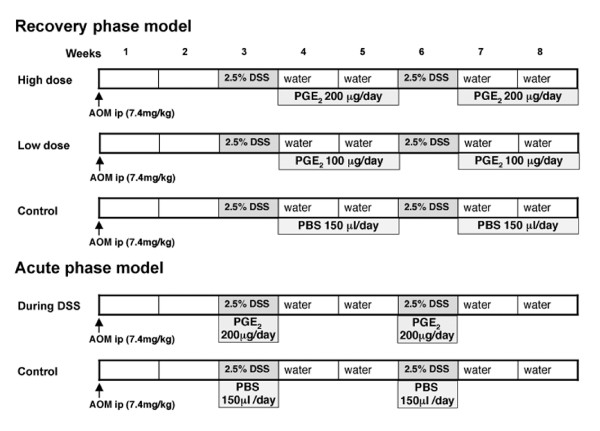
Mouse colitis-associated neoplasia was induced by azoxymethane (AOM) injection followed by two cycles of dextran sodium sulfate (DSS) treatment. Two different doses of PGE 2 (high dose group, 200 microg, n = 8; and low dose group, 100 microg, n = 6) were administered daily during recovery period of colitis by gavage feeding. Another group was given PGE 2 during DSS treatment (200 microg, n = 5). Inflammation and dysplasia were assessed histologically. Mucosal Cox-2 and amphiregulin (AR) expression, prostanoid synthesis, and EGFR activation were analyzed.
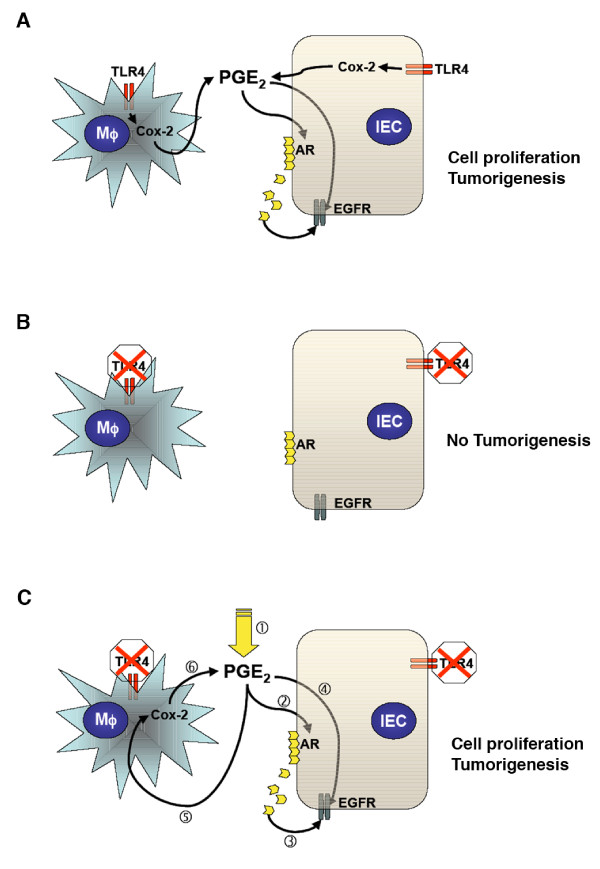
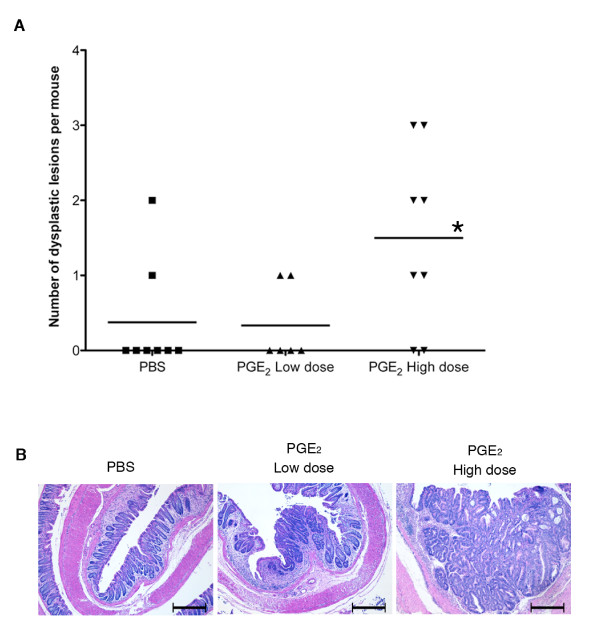
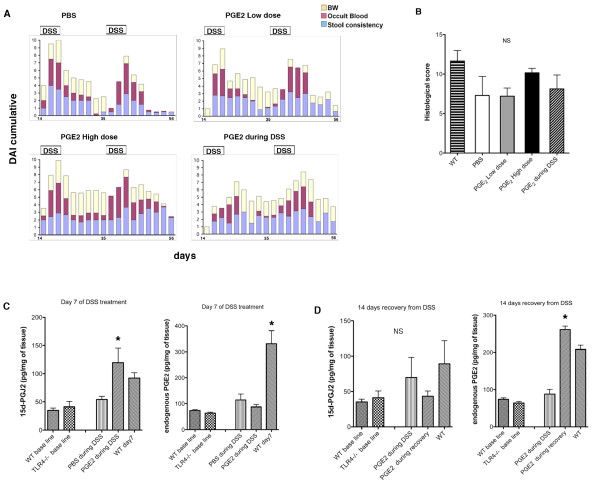
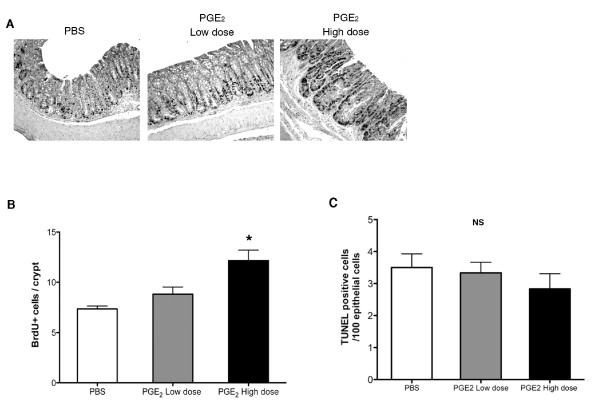
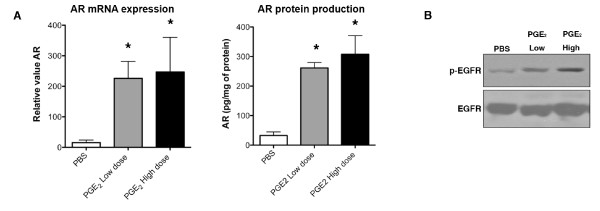
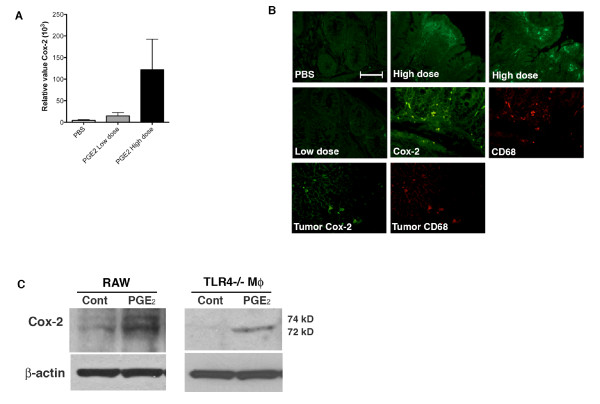
In control mice treated with PBS, the average number of tumors was greater in WT mice (n = 13) than in TLR4-/- mice (n = 7). High dose but not low dose PGE 2 treatment caused an increase in epithelial proliferation. 28.6% of PBS-treated TLR4-/- mice developed dysplasia (tumors/animal: 0.4 +/- 0.2). By contrast, 75.0% (tumors/animal: 1.5 +/- 1.2, P < 0.05) of the high dose group and 33.3% (tumors/animal: 0.3 +/- 0.5) of the low dose group developed dysplasia in TLR4-/- mice. Tumor size was also increased by high dose PGE 2 treatment. Endogenous prostanoid synthesis was differentially affected by PGE 2 treatment during acute and recovery phases of colitis. Exogenous administration of PGE 2 increased colitis-associated tumorigenesis but this only occurred during the recovery phase. Lastly, PGE 2 treatment increased mucosal expression of AR and Cox-2, thus inducing EGFR activation and forming a positive feedback mechanism to amplify mucosal Cox-2.
These results highlight the importance of PGE 2 as a central downstream molecule involving TLR4-mediated intestinal tumorigenesis.
我们之前发现 TLR4 缺陷(TLR4-/-)小鼠表现出黏膜 PGE2 表达降低,并对结肠炎相关肿瘤形成具有保护作用。然而,目前尚不清楚 PGE2 是否是促进肠道肿瘤发生的 TLR4 信号下游的中心因素。为了进一步阐明涉及 TLR4 介导的肠道肿瘤发生的关键下游途径,我们研究了外源性给予 PGE2 在 TLR4-/-小鼠中的作用,以观察 PGE2 是否可以绕过结肠炎相关肿瘤形成的保护作用。
通过氧化偶氮甲烷(AOM)注射和两次葡聚糖硫酸钠(DSS)处理诱导小鼠结肠炎相关肿瘤形成。通过灌胃喂养在结肠炎恢复期每天给予两种不同剂量的 PGE2(高剂量组,200μg,n=8;低剂量组,100μg,n=6)。另一组在 DSS 处理期间给予 PGE2(200μg,n=5)。通过组织学评估炎症和发育不良。分析黏膜 Cox-2 和 Amphiregulin(AR)表达、前列腺素合成和 EGFR 激活。
在接受 PBS 治疗的对照小鼠中,WT 小鼠(n=13)的肿瘤数量多于 TLR4-/-小鼠(n=7)。高剂量但不是低剂量 PGE2 治疗导致上皮增殖增加。28.6%的 PBS 处理的 TLR4-/-小鼠发生发育不良(肿瘤/动物:0.4 +/- 0.2)。相比之下,高剂量组的 75.0%(肿瘤/动物:1.5 +/- 1.2,P < 0.05)和低剂量组的 33.3%(肿瘤/动物:0.3 +/- 0.5)发生发育不良。高剂量 PGE2 治疗也增加了肿瘤大小。内源性前列腺素合成在结肠炎的急性和恢复期受到 PGE2 治疗的不同影响。外源性给予 PGE2 增加了结肠炎相关的肿瘤发生,但仅在恢复期发生。最后,PGE2 治疗增加了黏膜 AR 和 Cox-2 的表达,从而诱导 EGFR 激活并形成正反馈机制来放大黏膜 Cox-2。
这些结果强调了 PGE2 作为涉及 TLR4 介导的肠道肿瘤发生的中心下游分子的重要性。