Gupta Ruchi, Singh Saru
Prof & Head, Deptt. of Anaesthesia, Sri Guru Ram Das Institute of Medical Sciences & Research, Amritsar - 143001, Punjab.
Indian J Anaesth. 2009 Oct;53(5):560-6.
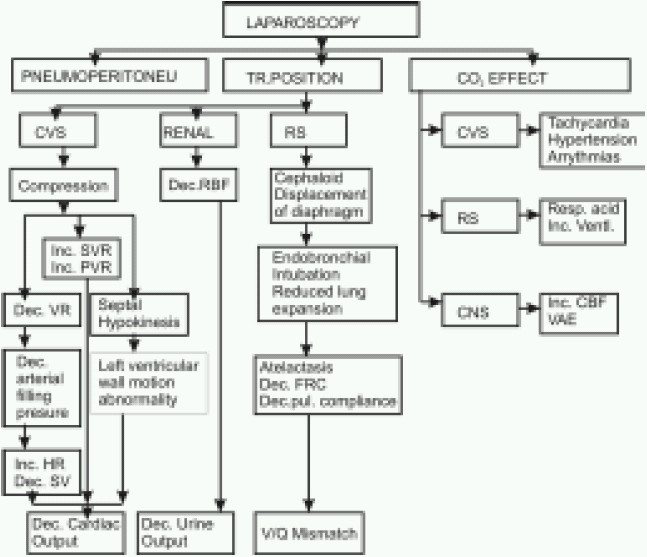
Today in the era of minimally invasive surgery, paediatric laparoscopy has become widely popular.The anaesthetic management in these cases poses special problems due to pneumoperitoneum created and extremes of position adopted in addition to the fact that paediatric anaesthesia itself is a challenge. Mostly the physiological as well as anaesthetic consideration are same except that child is not a small adult. The pressure of pnemoperitoneum needs to be kept between 6-12cm H(2)O, flow of gas about 0.9l, ventilation to be controlled, temperature monitoring being essential, use of atropine as premedicant, intravenous fluid management to be meticulous, induction with sevoflurane preferred as children may not allow i.v.puncture, intraoperative surgical complications being more, one needs to be very vigilant to diagnose and treat it. Using periumbilical area in paediatric age group should be avoided because the umbilical vessels have not involuted and can get punctured.Thus careful management in paediatric laparoscopic surgery will assume an important place in paediatric surgery.
在当今微创手术时代,小儿腹腔镜手术已广泛普及。由于气腹的形成以及所采用的极端体位,再加上小儿麻醉本身就是一项挑战,这些病例的麻醉管理存在特殊问题。除了儿童并非缩小版的成人这一事实外,大多数生理及麻醉方面的考量是相同的。气腹压力需维持在6 - 12厘米水柱之间,气体流量约为0.9升,通气需加以控制,体温监测至关重要,使用阿托品作为术前用药,静脉输液管理要精细,诱导时首选七氟醚,因为儿童可能不配合静脉穿刺,术中手术并发症较多,需要高度警惕以进行诊断和治疗。小儿年龄组应避免使用脐周区域,因为脐血管尚未退化,可能会被刺破。因此,小儿腹腔镜手术中的精细管理在小儿外科中将占据重要地位。