Division of Biomedical Sciences, University of California-Riverside, 900 University Avenue, Riverside, CA 92521-0121, U.S.A.
ASN Neuro. 2010 Jul 12;2(3):e00037. doi: 10.1042/AN20100010.
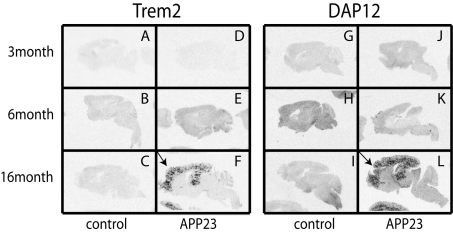
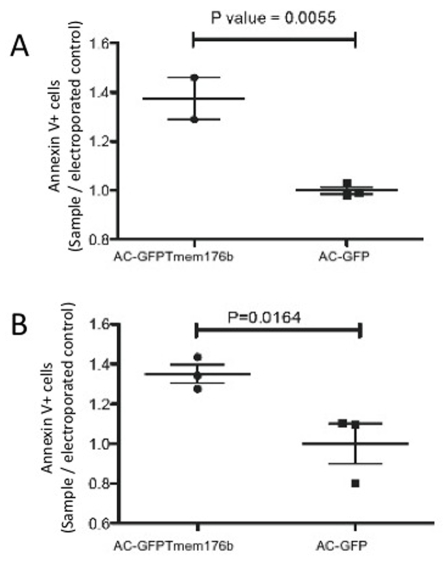
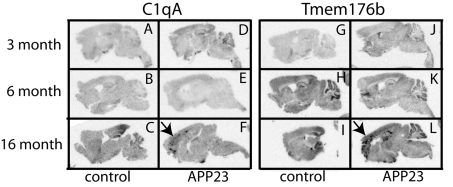
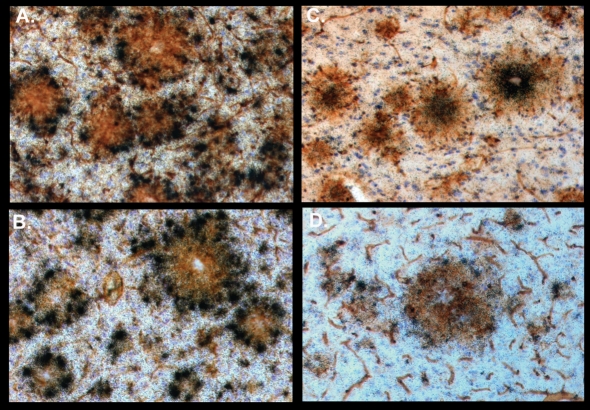
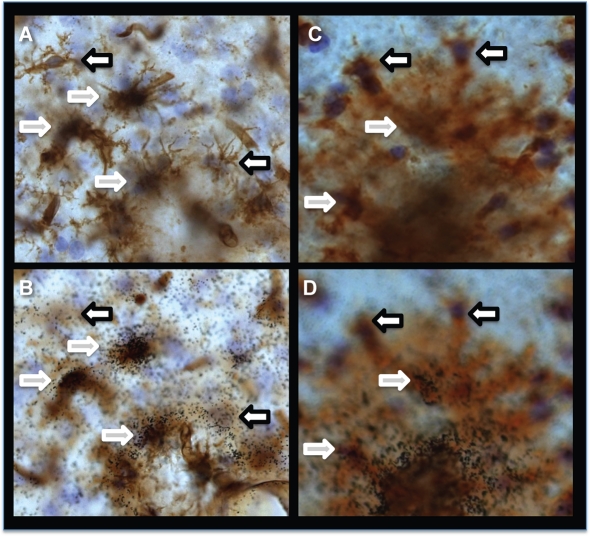
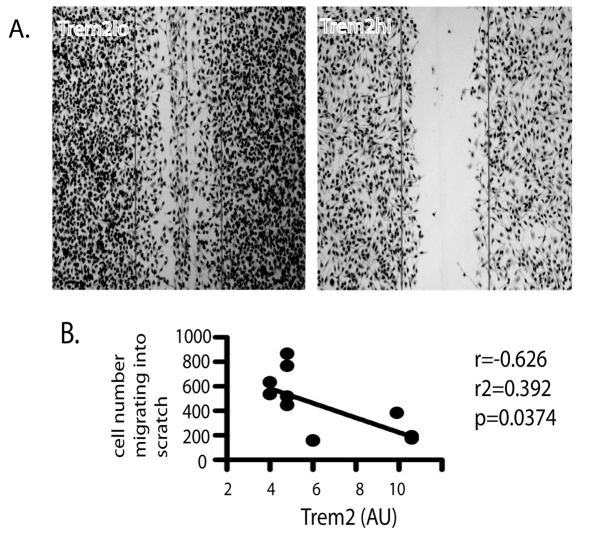
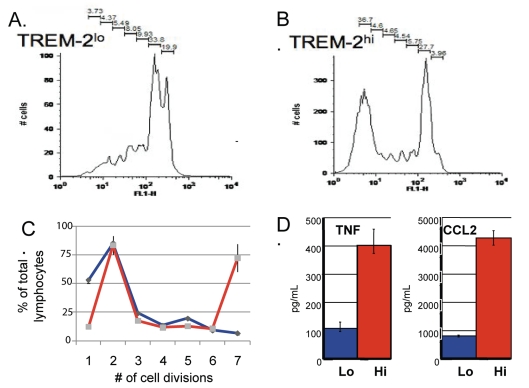
Vaccine-based autoimmune (anti-amyloid) treatments are currently being examined for their therapeutic potential in Alzheimer's disease. In the present study we examined, in a transgenic model of amyloid pathology, the expression of two molecules previously implicated in decreasing the severity of autoimmune responses: TREM2 (triggering receptor expressed on myeloid cells 2) and the intracellular tolerance-associated transcript, Tmem176b (transmembrane domain protein 176b). In situ hybridization analysis revealed that both molecules were highly expressed in plaque-associated microglia, but their expression defined two different zones of plaque-associated activation. Tmem176b expression was highest in the inner zone of amyloid plaques, whereas TREM2 expression was highest in the outer zone. Induced expression of TREM2 occurred co-incident with detection of thioflavine-S-positive amyloid deposits. Transfection studies revealed that expression of TREM2 correlated negatively with motility, but correlated positively with the ability of microglia to stimulate CD4(+) T-cell proliferation, TNF (tumour necrosis factor) and CCL2 (chemokine ligand 2) production, but not IFNgamma (interferon gamma) production. TREM2 expression also showed a positive correlation with amyloid phagocytosis in unactivated cells. However, activating cells with LPS (lipopolysaccharide), but not IFNgamma, reduced the correlation between TREM2 expression and phagocytosis. Transfection of Tmem176b into both microglial and macrophage cell lines increased apoptosis. Taken together, these data suggest that, in vivo, Tmem176b(+) cells in closest apposition to amyloid may be the least able to clear amyloid. Conversely, the phagocytic TREM2(+) microglia on the plaque outer zones are positioned to capture and present self-antigens to CNS (central nervous system)-infiltrating lymphocytes without promoting pro-inflammatory lymphocyte responses. Instead, plaque-associated TREM2(+) microglia have the potential to evoke neuroprotective immune responses that may serve to support CNS function during pro-inflammatory anti-amyloid immune therapies.
基于疫苗的自身免疫(抗淀粉样蛋白)疗法目前正在阿尔茨海默病中进行治疗潜力的研究。在本研究中,我们在淀粉样蛋白病理学的转基因模型中研究了两个先前被认为能降低自身免疫反应严重程度的分子的表达:TREM2(髓细胞触发受体 2)和细胞内耐受相关转录物 Tmem176b(跨膜域蛋白 176b)。原位杂交分析显示,这两种分子在斑块相关小胶质细胞中高度表达,但它们的表达定义了斑块相关激活的两个不同区域。Tmem176b 的表达在淀粉样斑块的内区最高,而 TREM2 的表达在外区最高。TREM2 的诱导表达与硫黄素 S 阳性淀粉样沉积物的检测同时发生。转染研究表明,TREM2 的表达与运动性呈负相关,但与小胶质细胞刺激 CD4(+)T 细胞增殖、TNF(肿瘤坏死因子)和 CCL2(趋化因子配体 2)产生的能力呈正相关,但与 IFNgamma(干扰素 γ)产生无关。TREM2 的表达也与未激活细胞中的淀粉样蛋白吞噬作用呈正相关。然而,用 LPS(脂多糖)激活细胞,但不是 IFNgamma,降低了 TREM2 表达与吞噬作用之间的相关性。Tmem176b 转染到小胶质细胞和巨噬细胞系中均可增加细胞凋亡。综上所述,这些数据表明,在体内,与淀粉样蛋白最接近的 Tmem176b(+)细胞可能最不能清除淀粉样蛋白。相反,斑块外区的吞噬 TREM2(+)小胶质细胞位于捕捉并向中枢神经系统(CNS)浸润淋巴细胞呈递自身抗原的位置,而不会促进促炎淋巴细胞反应。相反,斑块相关的 TREM2(+)小胶质细胞具有引发神经保护免疫反应的潜力,这可能有助于在促炎抗淀粉样免疫治疗期间支持中枢神经系统功能。