Department of Geriatrics, The First Affiliated Hospital of Nanjing Medical University, Nanjing 210029, Jiangsu, China.
J Exp Clin Cancer Res. 2010 Jul 19;29(1):99. doi: 10.1186/1756-9966-29-99.
Klotho, as a new anti-aging gene, can shed into circulation and act as a multi-functional humoral factor that influences multiple biological processes. Recently, published studies suggest that klotho can also serve as a potential tumor suppressor. The aim of this study is to investigate the effects and possible mechanisms of action of klotho in human lung cancer cell line A549.
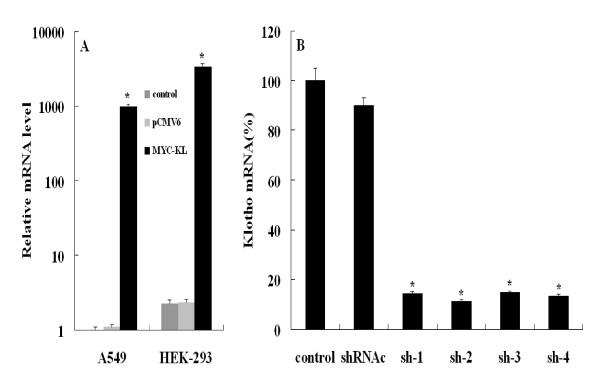
In this study, plasmids encoding klotho or klotho specific shRNAs were constructed to overexpress or knockdown klotho in vitro. A549 cells were respectively treated with pCMV6-MYC-KL or klotho specific shRNAs. The MTT assay was used to evaluate the cytotoxic effects of klotho and flow cytometry was utilized to observe and detect the apoptosis of A549 cells induced by klotho. The activation of IGF-1/insulin signal pathways in A549 cells treated by pCMV6-MYC-KL or shRNAs were evaluated by western blotting. The expression levels of bcl-2 and bax transcripts were evaluated by quantitative reverse transcription-polymerase chain reaction (qRT-PCR).
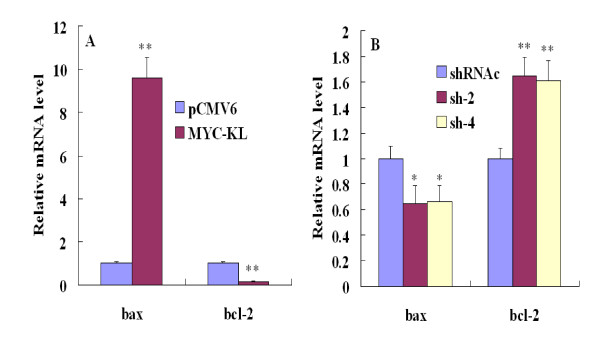
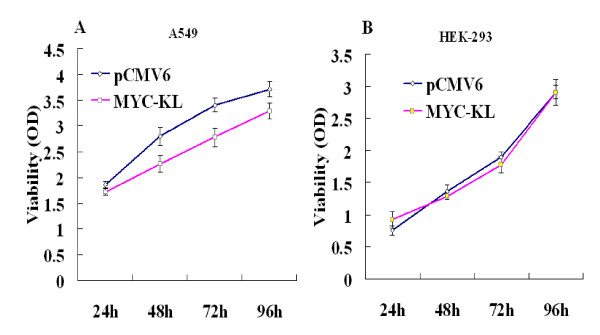
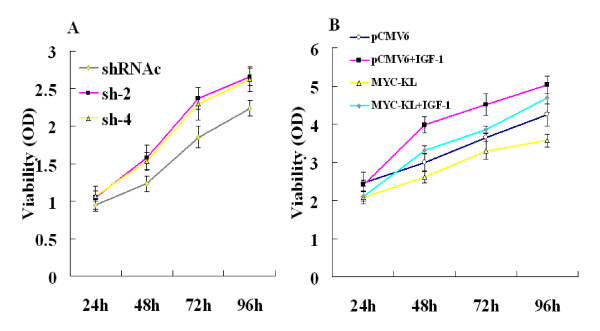
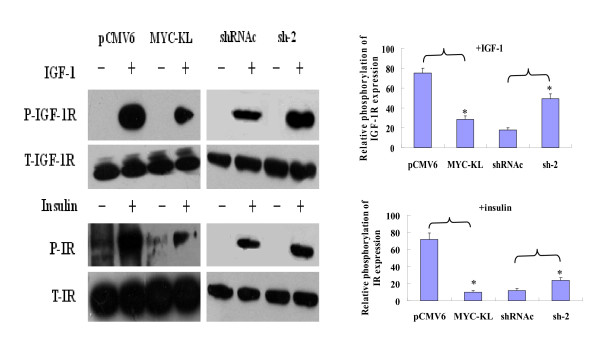
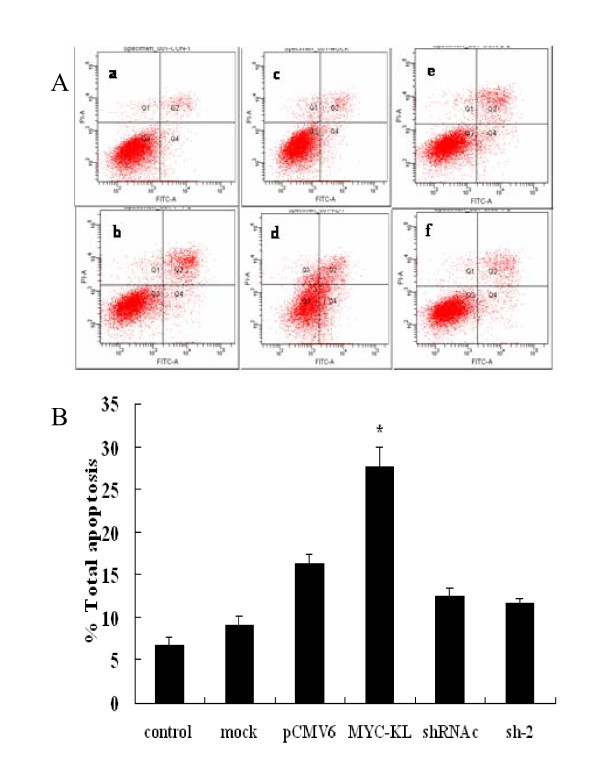
Overexpression of klotho reduced the proliferation of lung cancer A549 cells, whereas klotho silencing in A549 cells enhanced proliferation. Klotho did not show any effects on HEK-293 cells. Klotho overexpression in A549 cells was associated with reduced IGF-1/insulin-induced phosphorylation of IGF-1R (IGF-1 receptor)/IR (insulin receptor) (P < 0.01). Overexpression of klotho can promote the apoptosis of A549 cells (P < 0.01). Overexpression of klotho, a bcl family gene bax, was found up-regulated and bcl-2, an anti-apoptosis gene, was found down-regulated (P < 0.01). In contrast, bax and bcl-2 were found down-regulated (P < 0.05) and up-regulated (P < 0.01), respectively when silencing klotho using shRNAs.
Klotho can inhibit proliferation and increase apoptosis of A549 cells, this may be partly due to the inhibition of IGF-1/insulin pathways and involving regulating the expression of the apoptosis-related genes bax/bcl-2. Thus, klotho can serve as a potential tumor suppressor in A549 cells.
Klotho 作为一种新的抗衰老基因,可以分泌到循环中,并作为一种影响多种生物过程的多功能体液因子发挥作用。最近发表的研究表明,Klotho 也可以作为一种潜在的肿瘤抑制因子。本研究旨在探讨 Klotho 在人肺癌细胞系 A549 中的作用及其可能的作用机制。
本研究构建了编码 Klotho 的质粒或 Klotho 特异性 shRNAs,以在体外过表达或敲低 Klotho。分别用 pCMV6-MYC-KL 或 Klotho 特异性 shRNAs 处理 A549 细胞。用 MTT 法评估 Klotho 对 A549 细胞的细胞毒性作用,用流式细胞术观察和检测 Klotho 诱导的 A549 细胞凋亡。用 Western blot 法评价 pCMV6-MYC-KL 或 shRNAs 处理的 A549 细胞中 IGF-1/胰岛素信号通路的激活。用定量逆转录-聚合酶链反应(qRT-PCR)法评价 bcl-2 和 bax 转录本的表达水平。
Klotho 的过表达降低了肺癌 A549 细胞的增殖,而 A549 细胞中 Klotho 的沉默增强了增殖。Klotho 对 HEK-293 细胞没有任何影响。A549 细胞中 Klotho 的过表达与 IGF-1/胰岛素诱导的 IGF-1 受体(IGF-1R)/胰岛素受体(IR)磷酸化减少有关(P < 0.01)。Klotho 的过表达可促进 A549 细胞的凋亡(P < 0.01)。Klotho 的过表达导致凋亡相关基因 bax 上调,抗凋亡基因 bcl-2 下调(P < 0.01)。相反,当使用 shRNAs 沉默 Klotho 时,发现 bax 和 bcl-2 分别下调(P < 0.05)和上调(P < 0.01)。
Klotho 可抑制 A549 细胞的增殖并增加其凋亡,这可能部分归因于 IGF-1/胰岛素途径的抑制,并涉及调节凋亡相关基因 bax/bcl-2 的表达。因此,Klotho 可作为 A549 细胞中的一种潜在肿瘤抑制因子。