Behavioural Ecology of Sexual Signals Group, Vogelwarte Radolfzell, Max Planck Institute for Ornithology, Radolfzell, Germany.
PLoS One. 2010 Jul 14;5(7):e11582. doi: 10.1371/journal.pone.0011582.
Plumage coloration is important for bird communication, most notably in sexual signalling. Colour is often considered a good quality indicator, and the expression of exaggerated colours may depend on individual condition during moult. After moult, plumage coloration has been deemed fixed due to the fact that feathers are dead structures. Still, many plumage colours change after moult, although whether this affects signalling has not been sufficiently assessed.
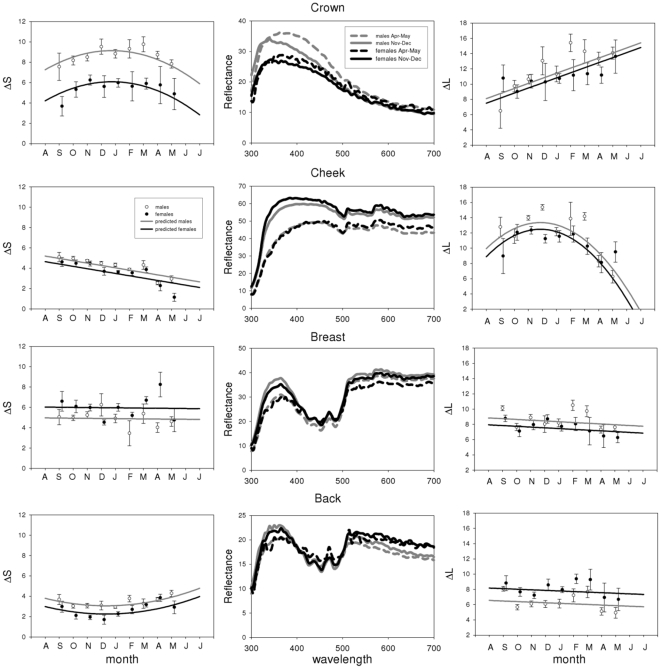
METHODOLOGY/PRINCIPAL FINDINGS: We studied changes in coloration after moult in four passerine birds (robin, Erithacus rubecula; blackbird, Turdus merula; blue tit, Cyanistes caeruleus; and great tit, Parus major) displaying various coloration types (melanin-, carotenoid-based and structural). Birds were caught regularly during three years to measure plumage reflectance. We used models of avian colour vision to derive two variables, one describing chromatic and the other achromatic variation over the year that can be compared in magnitude among different colour types. All studied plumage patches but one (yellow breast of the blue tit) showed significant chromatic changes over the year, although these were smaller than for a typical dynamic trait (bill colour). Overall, structural colours showed a reduction in relative reflectance at shorter wavelengths, carotenoid-based colours the opposite pattern, while no general pattern was found for melanin-based colours. Achromatic changes were also common, but there were no consistent patterns of change for the different types of colours.
CONCLUSIONS/SIGNIFICANCE: Changes of plumage coloration independent of moult are probably widespread; they should be perceivable by birds and have the potential to affect colour signalling.
羽毛颜色对鸟类的交流很重要,尤其是在性信号传递中。颜色通常被认为是一个很好的质量指标,而夸张颜色的表达可能取决于换羽期间个体的状况。换羽后,由于羽毛是死的结构,羽毛的颜色被认为是固定的。尽管如此,许多羽毛颜色在换羽后会发生变化,尽管这是否会影响信号传递还没有得到充分评估。
方法/主要发现:我们研究了四种雀形目鸟类(知更鸟、红腹灰雀、蓝山雀和大山雀)换羽后颜色的变化,它们表现出不同的颜色类型(黑色素、类胡萝卜素和结构)。在三年内,我们定期捕获鸟类以测量羽毛的反射率。我们使用鸟类颜色视觉模型得出了两个变量,一个描述了一年中色彩的变化,另一个描述了非色彩的变化,可以在不同颜色类型之间进行比较。除了蓝山雀的黄色胸部外,所有研究的羽毛斑块都表现出了显著的颜色变化,但这些变化比典型的动态特征(喙色)要小。总的来说,结构色在较短的波长上显示出相对反射率的降低,类胡萝卜素基颜色则相反,而黑色素基颜色则没有发现一般模式。非色彩变化也很常见,但不同颜色类型的变化没有一致的模式。
结论/意义:独立于换羽的羽毛颜色变化可能很普遍;它们应该能被鸟类感知到,并有可能影响颜色信号传递。