Centre of Expertise for Health and Work Ability, Finnish Institute of Occupational Health, Finland.
BMC Musculoskelet Disord. 2010 Jul 20;11:165. doi: 10.1186/1471-2474-11-165.
Shoulder pain is a common health problem. The purpose of this study was to assess the associations of lifestyle factors, metabolic factors and carotid intima-media thickness with shoulder pain and chronic (> 3 months) rotator cuff tendinitis.
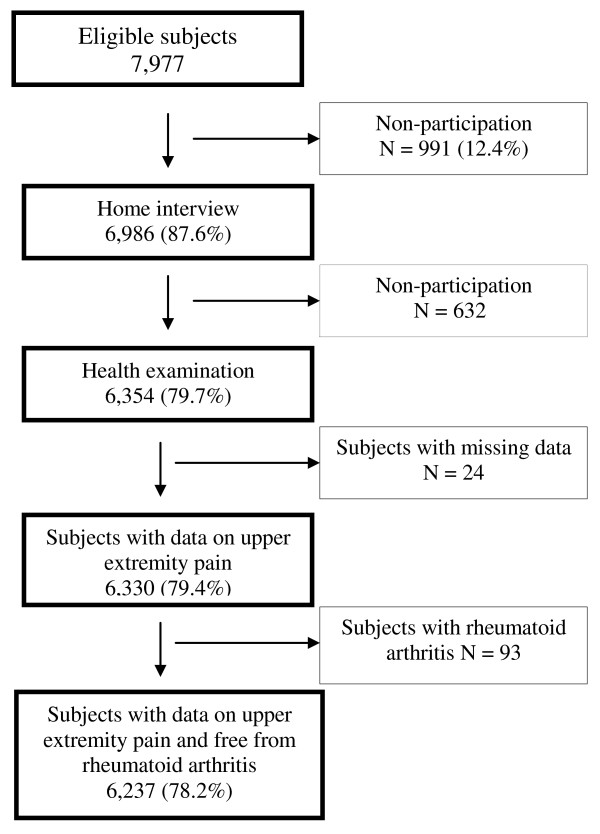
In this cross-sectional study, the target population consisted of subjects aged 30 years or older participating in a national Finnish Health Survey during 2000-2001. Of the 7,977 eligible subjects, 6,237 (78.2%) participated in a structured interview and clinical examination. Chronic rotator cuff tendinitis was diagnosed clinically. Weight-related factors, C-reactive protein and carotid intima-media thickness were measured.
The prevalence of shoulder joint pain during the preceding 30 days was 16% and that of chronic rotator cuff tendinitis 2.8%. Smoking, waist circumference and waist-to-hip ratio were related to an increased prevalence of shoulder pain in both genders. Metabolic syndrome, type 2 diabetes mellitus and carotid intima-media thickness were associated with shoulder pain in men, whereas high level of C-reactive protein was associated with shoulder pain in women. Increased waist circumference and type 1 diabetes mellitus were associated with chronic rotator cuff tendinitis in men.
Our findings showed associations of abdominal obesity, some other metabolic factors and carotid intima-media thickness with shoulder pain. Disturbed glucose metabolism and atherosclerosis may be underlying mechanisms, although not fully supported by the findings of this study. Prospective studies are needed to further investigate the role of lifestyle and metabolic factors in shoulder disorders.
肩部疼痛是一种常见的健康问题。本研究旨在评估生活方式因素、代谢因素和颈动脉内膜中层厚度与肩部疼痛和慢性(>3 个月)肩袖肌腱炎的关系。
在这项横断面研究中,研究对象为年龄在 30 岁及以上的参加 2000-2001 年全国芬兰健康调查的人群。在 7977 名合格的研究对象中,有 6237 名(78.2%)参加了结构化访谈和临床检查。慢性肩袖肌腱炎通过临床诊断。测量体重相关因素、C 反应蛋白和颈动脉内膜中层厚度。
在过去 30 天中,肩部关节疼痛的患病率为 16%,慢性肩袖肌腱炎的患病率为 2.8%。吸烟、腰围和腰臀比与两性肩部疼痛的患病率增加有关。代谢综合征、2 型糖尿病和颈动脉内膜中层厚度与男性肩部疼痛有关,而高 C 反应蛋白水平与女性肩部疼痛有关。腰围增加和 1 型糖尿病与男性慢性肩袖肌腱炎有关。
我们的研究结果表明,腹部肥胖、一些其他代谢因素和颈动脉内膜中层厚度与肩部疼痛有关。葡萄糖代谢紊乱和动脉粥样硬化可能是潜在的机制,但本研究的结果并未完全支持这一点。需要前瞻性研究进一步探讨生活方式和代谢因素在肩部疾病中的作用。