Children's National Medical Center, Department of Neuroscience, Washington, DC 20010, USA.
Brain Lang. 2010 Aug;114(2):115-25. doi: 10.1016/j.bandl.2010.06.002.
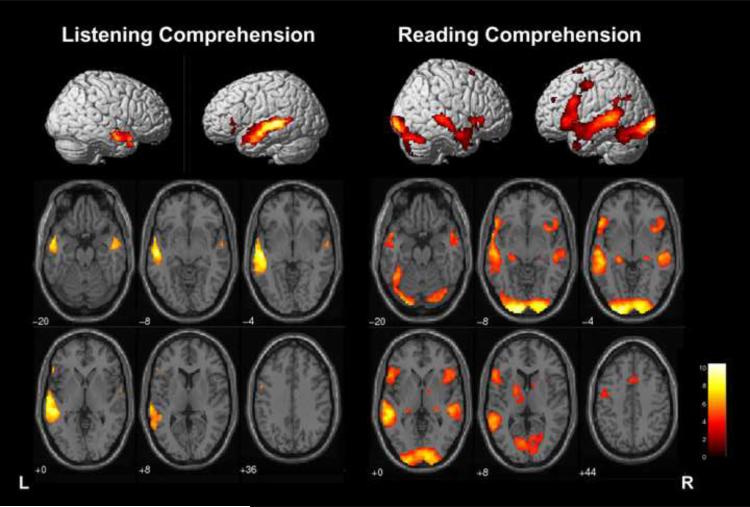
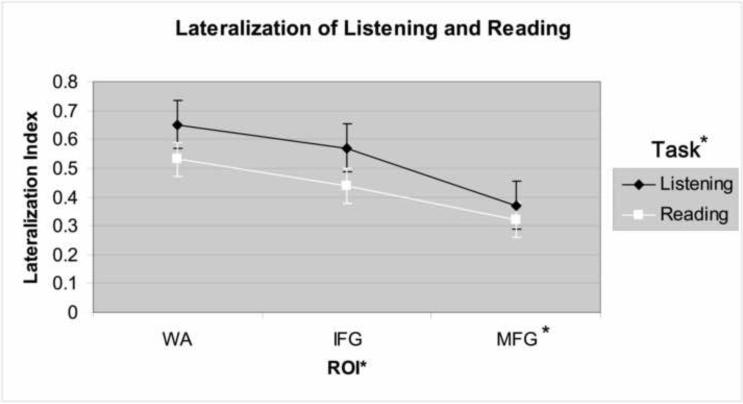
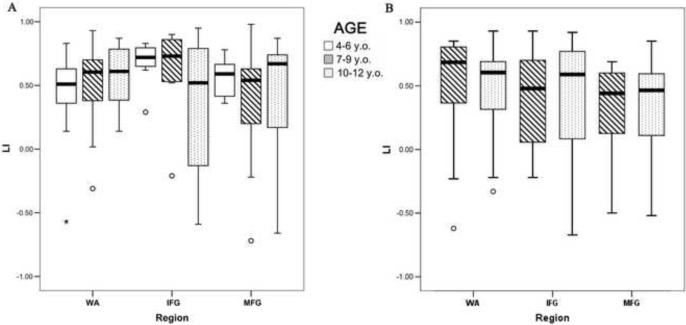
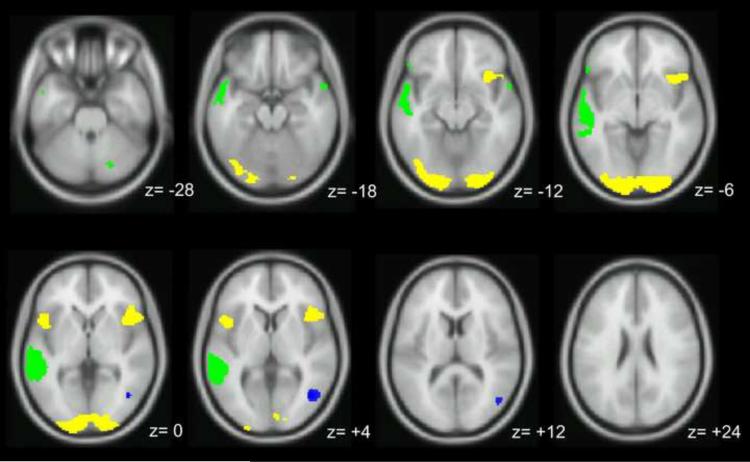
Listening and reading comprehension of paragraph-length material are considered higher-order language skills fundamental to social and academic functioning. Using ecologically relevant language stimuli that were matched for difficulty according to developmental level, we analyze the effects of task, age, neuropsychological skills, and post-task performance on fMRI activation and hemispheric laterality. Areas of supramodal language processing are identified, with the most robust region being left-lateralized activation along the superior temporal sulcus. Functionally, this conjunction has a role in semantic and syntactic processing, leading us to refer to this conjunction as "comprehension cortex." Different from adults, supramodal areas for children include less extensive inferior frontal gyrus but more extensive right cerebellum and right temporal pole. Broader neuroanatomical pathways are recruited for reading, reflecting the more active processing and larger set of cognitive demands needed for reading compared to listening to stories. ROI analyses reveal that reading is a less lateralized language task than listening in inferior frontal and superior temporal areas, which likely reflects the difficulty of the task as children in this study are still developing their reading skills. For listening to stories, temporal activation is stable by age four with no correlations with age, neuropsychological skills or post-task performance. In contrast, frontal activation during listening to stories occurs more often in older children, and frontal activation is positively correlated with better performance on comprehension questions, suggesting that the activation of frontal networks may reflect greater integration and depth of story processing.
段落长度的听力和阅读理解被认为是社交和学术功能的高阶语言技能。我们使用与发展水平相匹配的具有生态相关性的语言刺激物,根据任务、年龄、神经心理学技能和任务后表现来分析 fMRI 激活和半球侧化的影响。确定了超模态语言处理的区域,最强大的区域是沿着颞上回的左侧激活。从功能上讲,这个联合在语义和句法处理中起作用,因此我们将这个联合称为“理解皮层”。与成年人不同,儿童的超模态区域包括不太广泛的额下回,但包括更广泛的右侧小脑和右侧颞极。阅读需要更广泛的神经解剖学途径,这反映了阅读比听故事需要更积极的处理和更大的认知需求。ROI 分析表明,阅读是一种比听故事语言任务更不偏向于一侧的任务,这可能反映了任务的难度,因为本研究中的儿童仍在发展他们的阅读技能。对于听故事,颞叶激活在四岁时是稳定的,与年龄、神经心理学技能或任务后表现无关。相比之下,在听故事时,额叶的激活在年龄较大的儿童中更为常见,并且额叶的激活与更好的理解问题表现呈正相关,这表明额叶网络的激活可能反映了故事处理的更大整合和深度。