Department of Civil and Environmental Engineering, Massachusetts Institute of Technology, Cambridge, Massachusetts, United States of America.
PLoS One. 2012;7(8):e43432. doi: 10.1371/journal.pone.0043432. Epub 2012 Aug 29.
Growth of the ocean's most abundant primary producer, the cyanobacterium Prochlorococcus, is tightly synchronized to the natural 24-hour light-dark cycle. We sought to quantify the relationship between transcriptome and proteome dynamics that underlie this obligate photoautotroph's highly choreographed response to the daily oscillation in energy supply.
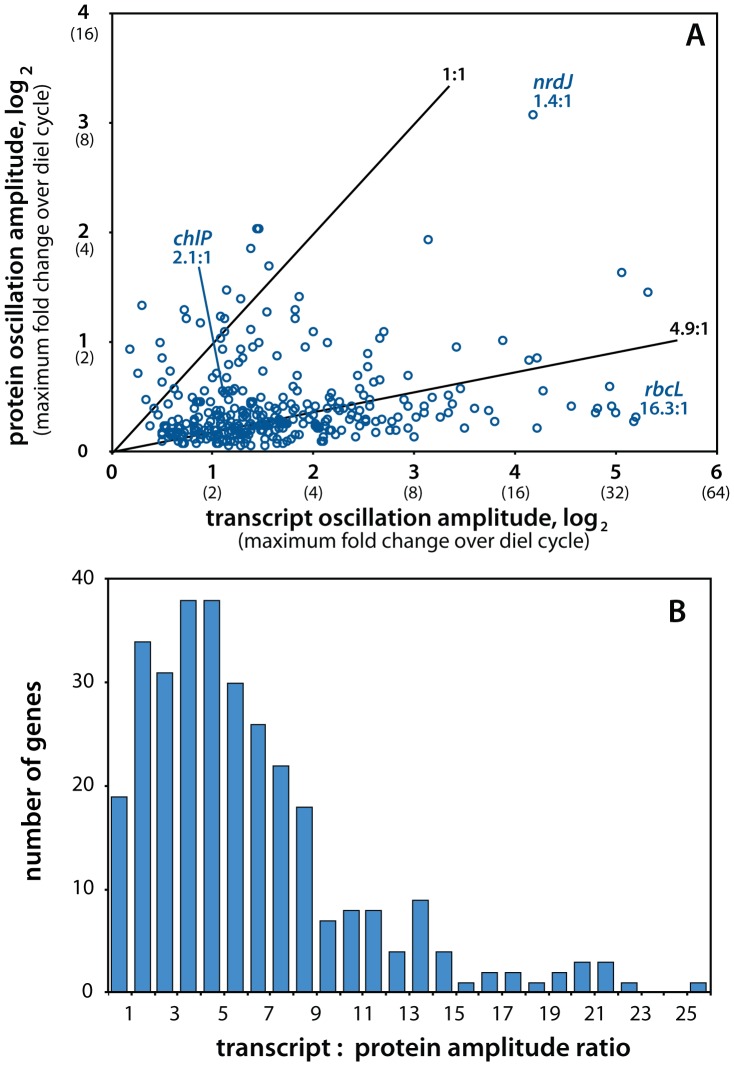
METHODOLOGY/PRINCIPAL FINDINGS: Using RNA-sequencing transcriptomics and mass spectrometry-based quantitative proteomics, we measured timecourses of paired mRNA-protein abundances for 312 genes every 2 hours over a light-dark cycle. These temporal expression patterns reveal strong oscillations in transcript abundance that are broadly damped at the protein level, with mRNA levels varying on average 2.3 times more than the corresponding protein. The single strongest observed protein-level oscillation is in a ribonucleotide reductase, which may reflect a defense strategy against phage infection. The peak in abundance of most proteins also lags that of their transcript by 2-8 hours, and the two are completely antiphase for some genes. While abundant antisense RNA was detected, it apparently does not account for the observed divergences between expression levels. The redirection of flux through central carbon metabolism from daytime carbon fixation to nighttime respiration is associated with quite small changes in relative enzyme abundances.
CONCLUSIONS/SIGNIFICANCE: Our results indicate that expression responses to periodic stimuli that are common in natural ecosystems (such as the diel cycle) can diverge significantly between the mRNA and protein levels. Protein expression patterns that are distinct from those of cognate mRNA have implications for the interpretation of transcriptome and metatranscriptome data in terms of cellular metabolism and its biogeochemical impact.
海洋中最丰富的初级生产者——蓝细菌聚球藻的生长与自然 24 小时光暗循环紧密同步。我们试图量化转录组和蛋白质组动态之间的关系,这些动态是这种必需的光自养生物对每日能量供应波动高度协调反应的基础。
方法/主要发现:使用 RNA 测序转录组学和基于质谱的定量蛋白质组学,我们在光暗循环过程中每 2 小时测量了 312 个基因的配对 mRNA-蛋白质丰度的时间过程。这些时间表达模式揭示了转录丰度的强烈振荡,在蛋白质水平上广泛减弱,mRNA 水平的变化平均比相应的蛋白质高出 2.3 倍。观察到的最强的蛋白质水平振荡是在核核苷酸还原酶中,这可能反映了一种针对噬菌体感染的防御策略。大多数蛋白质的丰度峰值也比其转录物滞后 2-8 小时,并且对于一些基因,两者完全相反。虽然检测到了大量的反义 RNA,但它显然不能解释观察到的表达水平差异。通过中央碳代谢将通量从白天的碳固定重定向到夜间的呼吸作用,与相对酶丰度的相当小变化相关。
结论/意义:我们的结果表明,对常见于自然生态系统(如昼夜周期)的周期性刺激的表达反应在 mRNA 和蛋白质水平之间可能存在显著差异。与同源 mRNA 不同的蛋白质表达模式对解释转录组和宏转录组数据在细胞代谢及其生物地球化学影响方面具有重要意义。