Department of Gastroenterology, West China Hospital, Sichuan University, 37# Guoxue Road, Chengdu, 610041, China.
BMC Gastroenterol. 2010 Jul 31;10:85. doi: 10.1186/1471-230X-10-85.
Glyceryl trinitrate (GTN) has been shown to be able to relax the sphincter of Oddi (SO) both in animals and humans. Theoretically, the use of these compounds during and after endoscopic retrograde cholangiopancreatgraphy (ERCP) could relax the biliary and pancreatic sphincters, facilitating cannulation of common bile duct (CBD) during the procedure, or minimizing potential pancreatic outflow obstruction after the procedure. However, clinical trials evaluating the protective effect of GTN on the post-endoscopic retrograde cholangiopancreatgraphy pancreatitis (PEP) have yielded inconclusive results. This meta-analysis is to systematically assess the effect of prophylactic administration of glyceryl trinitrate (GTN) on the prevention of PEP and the effect on the cannulation of bile ducts.
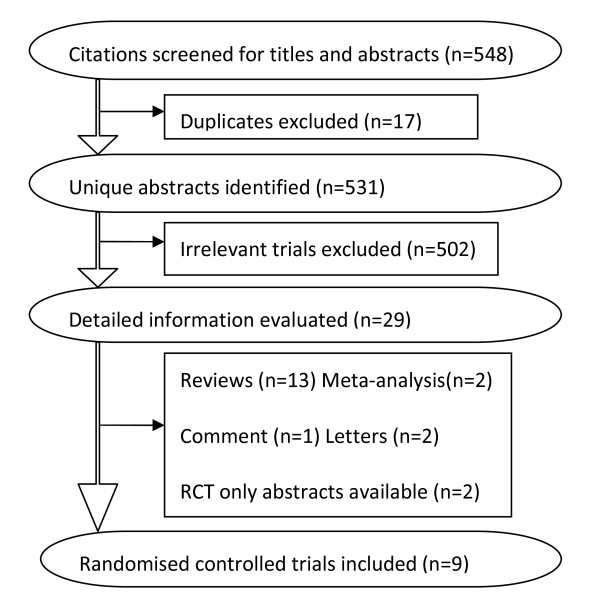
By searching PubMed (1966 to September 2009), CENTRAL (Cochrane Controlled trials Register; issue 3, 2009) and EMBASE.com (1984 to September 2009), two independent reviewers systematically identified prospective randomized controlled trials (RCTs) detecting the effect of prophylactic GTN on the incidence of PEP and on the cannulation of bile ducts. A meta-analysis of these clinical trials was then performed.
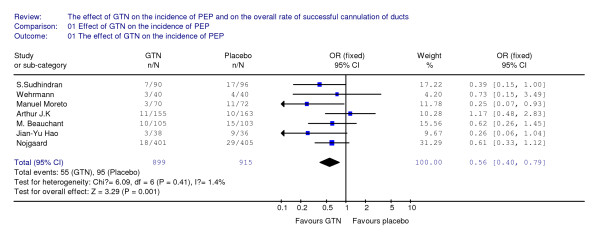
There are 55/899(6.1%) patients suffering PEP in the treatment group versus 95/915(10.4%) patients in the placebo group. The overall pooled risk of PEP was significantly lower in the GTN group than in the placebo group (OR 0.56, 95% CI: 0.40 to 0.79, p = 0.001). Subgroup analyses suggested that GTN administered by the sublingual form (OR 0.34,95% CI:0.16 to 0.75, p = 0.007) is more effective than transdermal route(OR 0.64,95% CI:0.40 to 1.01, p = 0.05), and the protective effect of GTN was far more obvious in the centers with high incidence of PEP (OR 0.40, 95% CI:0.24 to 0.67, p = 0.0006) than those centers with a low incidence of PEP (OR 0.75, 95% CI: 0.47 to 1.20, p = 0.22). Additionally, the meta-analysis suggests that GTN was not helpful for the cannulation of bile ducts.
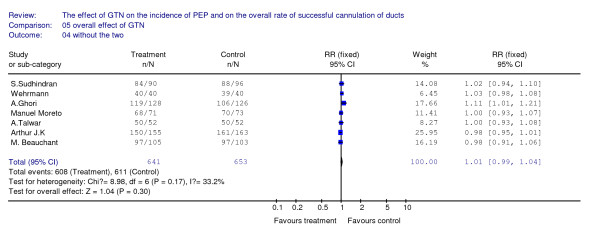
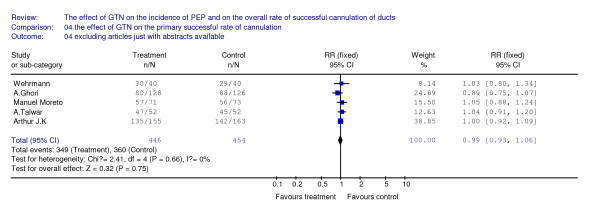
We concluded that prophylactic administration of GTN may significantly reduce the incidence of PEP and not be helpful for the cannulation of bile ducts.
硝酸甘油(GTN)已被证明能够在动物和人类中松弛 Oddi 括约肌(SO)。理论上,在进行内镜逆行胰胆管造影术(ERCP)期间和之后使用这些化合物可以松弛胆管和胰管的括约肌,从而在手术期间更容易插管胆总管(CBD),或者在手术后最小化潜在的胰液流出阻塞。然而,评估 GTN 对内镜逆行胰胆管造影术后胰腺炎(PEP)的保护作用的临床试验得出的结果不一致。本荟萃分析旨在系统评估预防性给予硝酸甘油(GTN)对预防 PEP 的效果,以及对胆管插管的效果。
通过搜索 PubMed(1966 年至 2009 年 9 月)、CENTRAL(Cochrane 对照试验登记处;第 3 期,2009 年)和 EMBASE.com(1984 年至 2009 年 9 月),两名独立的审查员系统地确定了前瞻性随机对照试验(RCT),以检测预防性 GTN 对 PEP 发生率和胆管插管的影响。然后对这些临床试验进行荟萃分析。
治疗组有 55/899(6.1%)名患者发生 PEP,而安慰剂组有 95/915(10.4%)名患者发生 PEP。GTN 组的 PEP 总体累积风险明显低于安慰剂组(OR 0.56,95%CI:0.40 至 0.79,p = 0.001)。亚组分析表明,舌下含服 GTN(OR 0.34,95%CI:0.16 至 0.75,p = 0.007)比经皮途径更有效(OR 0.64,95%CI:0.40 至 1.01,p = 0.05),并且在 PEP 发生率较高的中心,GTN 的保护作用更为明显(OR 0.40,95%CI:0.24 至 0.67,p = 0.0006),而在 PEP 发生率较低的中心,GTN 的保护作用则不明显(OR 0.75,95%CI:0.47 至 1.20,p = 0.22)。此外,荟萃分析表明 GTN 对胆管插管没有帮助。
我们的结论是,预防性给予 GTN 可能显著降低 PEP 的发生率,但对胆管插管没有帮助。