Australian Patient Safety Foundation, Playford Building, University of South Australia, Adelaide, South Australia, Australia.
Implement Sci. 2010 Aug 2;5:60. doi: 10.1186/1748-5908-5-60.
This study set out to achieve three objectives: to test the application of a context assessment tool in an acute hospital in South Australia; to use the tool to compare context in wards that had undergone an evidence implementation process with control wards; and finally to test for relationships between demographic variables (in particular experience) of nurses being studied (n = 422) with the dimensions of context.
The Alberta Context Tool (ACT) was administered to all nursing staff on six control and six intervention wards. A total of 217 (62%) were returned (67% from the intervention wards and 56% from control wards). Data were analysed using Stata (v9). The effect of the intervention was analysed using nested (hierarchical) analysis of variance; relationships between nurses' experience and context was examined using canonical correlation analysis.
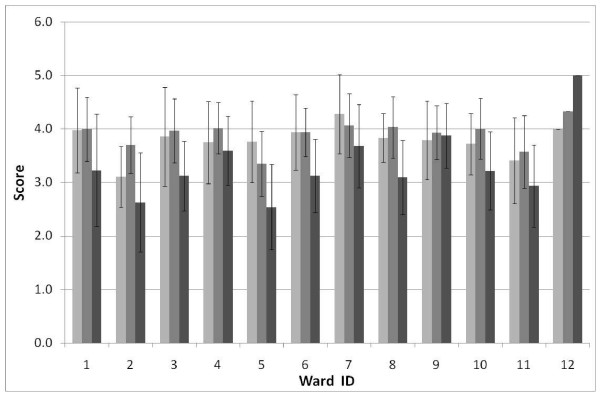
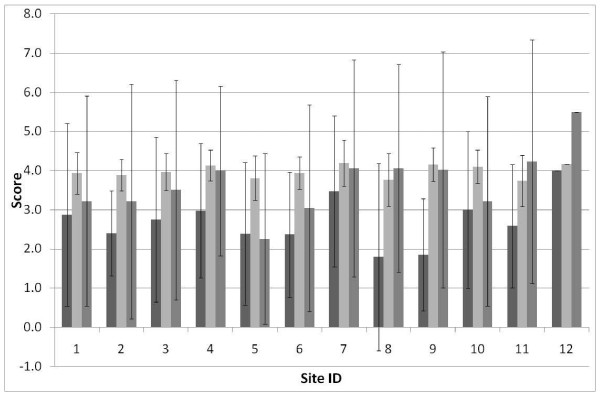
Results confirmed the adaptation and fit of the ACT to one acute care setting in South Australia. There was no difference in context scores between control and intervention wards. However, the tool identified significant variation between wards in many of the dimensions of context. Though significant, the relationship between nurses' experience and context was weak, suggesting that at the level of the individual nurse, few factors are related to context.
Variables operating at the level of the individual showed little relationship with context. However, the study indicated that some dimensions of context (e.g., leadership, culture) vary at the ward level, whereas others (e.g., structural and electronic resources) do not. The ACT also raised a number of interesting speculative hypotheses around the relationship between a measure of context and the capability and capacity of staff to influence it.We propose that context be considered to be dependent on ward- and hospital-level factors. Additionally, questions need to be considered about the unit of measurement of context in studies of knowledge implementation--is individual (micro), ward (meso) or hospital-level (macro) data most appropriate? The preliminary results also raise questions about how best to utilise this instrument in knowledge translation research.
本研究旨在实现三个目标:在南澳大利亚的一家急性医院测试情境评估工具的应用;使用该工具比较经历循证实施过程的病房与对照病房的情境;最后,测试正在研究的护士(n=422)的人口统计学变量(特别是经验)与情境维度之间的关系。
在六个对照病房和六个干预病房向所有护理人员发放阿尔伯塔情境工具(ACT)。共回收 217 份(干预病房为 67%,对照病房为 56%)。使用 Stata(v9)进行数据分析。使用嵌套(分层)方差分析分析干预的效果;使用典型相关分析检查护士经验与情境之间的关系。
结果证实了 ACT 在南澳大利亚一家急性护理环境中的适应性和适用性。对照病房和干预病房的情境评分没有差异。然而,该工具在许多情境维度上确定了病房之间的显著差异。尽管有显著差异,但护士经验与情境之间的关系较弱,表明在个体护士层面上,很少有因素与情境相关。
个体层面的变量与情境的关系不大。然而,该研究表明,情境的某些维度(例如领导能力、文化)在病房层面上存在差异,而其他维度(例如结构和电子资源)则没有。ACT 还围绕情境测量与员工影响能力和能力之间的关系提出了一些有趣的推测假设。我们提出情境被认为取决于病房和医院层面的因素。此外,在知识实施研究中,需要考虑情境的测量单位问题——个体(微观)、病房(中观)还是医院层面(宏观)数据最合适?初步结果还提出了关于如何在知识转化研究中最好地利用该工具的问题。