
高致病性 H5N1 流感病毒除了具有多碱性血凝素裂解位点外,还带有毒力决定因素。
Highly pathogenic H5N1 influenza viruses carry virulence determinants beyond the polybasic hemagglutinin cleavage site.
机构信息
Institute of Molecular Biology, Friedrich-Loeffler-Institut, Federal Research Institute for Animal Health, Greifswald-Insel Riems, Germany.
出版信息
PLoS One. 2010 Jul 27;5(7):e11826. doi: 10.1371/journal.pone.0011826.
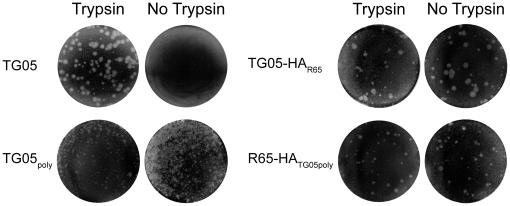
Highly pathogenic avian influenza viruses (HPAIV) originate from avirulent precursors but differ from all other influenza viruses by the presence of a polybasic cleavage site in their hemagglutinins (HA) of subtype H5 or H7. In this study, we investigated the ability of a low-pathogenic avian H5N1 strain to transform into an HPAIV. Using reverse genetics, we replaced the monobasic HA cleavage site of the low-pathogenic strain A/Teal/Germany/Wv632/2005 (H5N1) (TG05) by a polybasic motif from an HPAIV (TG05(poly)). To elucidate the virulence potential of all viral genes of HPAIV, we generated two reassortants carrying the HA from the HPAIV A/Swan/Germany/R65/06 (H5N1) (R65) plus the remaining genes from TG05 (TG05-HA(R65)) or in reversed composition the mutated TG05 HA plus the R65 genes (R65-HA(TG05poly)). In vitro, TG05(poly) and both reassortants were able to replicate without the addition of trypsin, which is characteristic for HPAIV. Moreover, in contrast to avirulent TG05, the variants TG05(poly), TG05-HA(R65), and R65-HA(TG05poly) are pathogenic in chicken to an increasing degree. Whereas the HA cleavage site mutant TG05(poly) led to temporary non-lethal disease in all animals, the reassortant TG05-HA(R65) caused death in 3 of 10 animals. Furthermore, the reassortant R65-HA(TG05poly) displayed the highest lethality as 8 of 10 chickens died, resembling "natural" HPAIV strains. Taken together, acquisition of a polybasic HA cleavage site is only one necessary step for evolution of low-pathogenic H5N1 strains into HPAIV. However, these low-pathogenic strains may already have cryptic virulence potential. Moreover, besides the polybasic cleavage site, the additional virulence determinants of H5N1 HPAIV are located within the HA itself and in other viral proteins.
高致病性禽流感病毒 (HPAIV) 源自无毒性的前体,但与所有其他流感病毒不同的是,其血凝素 (HA) 的亚型 H5 或 H7 中存在一个多碱性切割位点。在这项研究中,我们研究了低致病性禽流感 H5N1 株转变为高致病性禽流感病毒的能力。我们使用反向遗传学,用高致病性禽流感病毒(HPAIV)的多碱性基序替换了低致病性菌株 A/Teal/Germany/Wv632/2005(H5N1)(TG05)的单碱性 HA 切割位点。为了阐明 HPAIV 所有病毒基因的毒力潜力,我们生成了两个重组体,一个携带 HPAIV A/Swan/Germany/R65/06(H5N1)(R65)的 HA,其余基因来自 TG05(TG05-HA(R65)),另一个则是相反的组成,即突变的 TG05 HA 加上 R65 基因(R65-HA(TG05poly))。在体外,TG05(poly) 和两种重组体都能够在不需要添加胰蛋白酶的情况下复制,这是 HPAIV 的特征。此外,与无毒性的 TG05 相比,变体 TG05(poly)、TG05-HA(R65) 和 R65-HA(TG05poly) 在鸡体内的致病性逐渐增加。虽然 HA 切割位点突变体 TG05(poly)导致所有动物出现暂时的非致死性疾病,但重组体 TG05-HA(R65)导致 10 只动物中的 3 只死亡。此外,重组体 R65-HA(TG05poly)的致死率最高,10 只鸡中有 8 只死亡,类似于“天然”HPAIV 株。总之,获得多碱性 HA 切割位点只是低致病性 H5N1 株演变为 HPAIV 的一个必要步骤。然而,这些低致病性菌株可能已经具有隐匿性的毒力潜力。此外,除了多碱性切割位点外,H5N1 HPAIV 的其他毒力决定因素位于 HA 本身和其他病毒蛋白中。



 Zotero 插件