Department of Internal Medicine, School of Medicine, Wayne State University, Detroit, MI 48201, USA.
Mol Cancer. 2010 Aug 6;9:212. doi: 10.1186/1476-4598-9-212.
Recent evidence suggests that epithelial cancers, including colorectal cancer are driven by a small sub-population of self-renewing, multi-potent cells termed cancer stem cells (CSCs) which are thought to be responsible for recurrence of cancer. One of the characteristics of CSCs is their ability to form floating spheroids under anchorage-independent conditions in a serum-free defined media. The current investigation was undertaken to examine the role of Wnt/beta-catenin pathway in regulating the growth and maintenance of colonospheres. Human colon cancer cells HCT-116 (p53 wild type; K-ras mutant), HCT-116 (p53 null; K-ras mutant) and HT-29 (p53 mutant) were used.
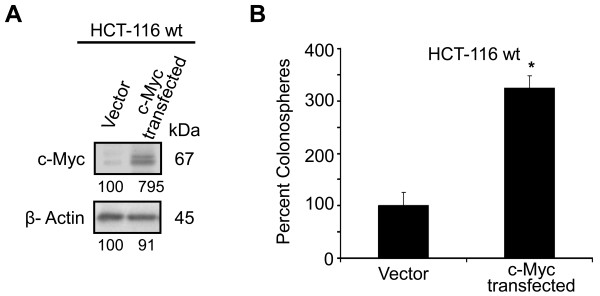
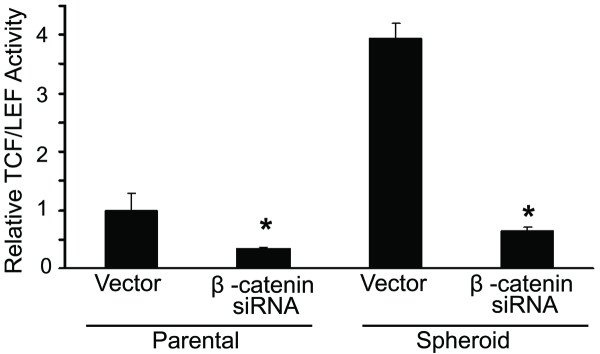
Colonospheres formed in vitro exhibited higher expression of colon CSCs markers LGR5, CD44, CD166 and Musashi-1 along with putative CSC marker EpCAM, compared to the corresponding parental cancer cells and also exhibit the ability to form spheroids under extreme limiting dilution, indicating the predominance of CSCs in colonospheres. Colonospheres formed by HCT-116 cells show over 80% of the cells to be CD44 positive, compared to <or= 1% in the corresponding parental cells. Additionally, colonospheres showed reduced membrane bound beta-catenin but had increased levels of total beta-catenin, cyclin-D1 and c-myc and down regulation of axin-1 and phosphorylated beta-catenin. Increased expression of beta-catenin was associated with a marked transcriptional activation of TCF/LEF. The latter was greatly decreased following down regulation of beta-catenin by the corresponding siRNA, leading to a marked reduction in CD44 positive cells as well as colonospheres formation. In contrast, upregulation of c-myc, a down-stream effector of TCF/LEF greatly augmented the formation of colonospheres.
Our data suggest that colonospheres formed by colon cancer cell lines are highly enriched in CSCs and that Wnt/beta-catenin pathway plays a critical role in growth and maintenance of colonospheres.
最近的证据表明,上皮癌,包括结直肠癌,是由一小部分自我更新、多能的细胞驱动的,这些细胞被称为癌症干细胞(CSCs),被认为是癌症复发的原因。CSCs 的一个特征是它们能够在无血清的定义培养基中在无锚定条件下形成漂浮的球体。目前的研究旨在研究 Wnt/β-catenin 通路在调节结肠球体的生长和维持中的作用。使用人结肠癌细胞系 HCT-116(野生型 p53;突变型 K-ras)、HCT-116(p53 缺失;突变型 K-ras)和 HT-29(p53 突变)。
体外形成的结肠球体表现出更高的结肠 CSCs 标志物 LGR5、CD44、CD166 和 Musashi-1 的表达,以及假定的 CSC 标志物 EpCAM,与相应的亲本癌细胞相比,并且还表现出在极端限制稀释下形成球体的能力,表明结肠球体中 CSCs 的优势。与相应的亲本细胞相比,HCT-116 细胞形成的结肠球体中超过 80%的细胞为 CD44 阳性。此外,结肠球体显示出减少的膜结合β-catenin,但具有增加的总β-catenin、细胞周期蛋白 D1 和 c-myc 的水平,以及 axin-1 和磷酸化β-catenin 的下调。β-catenin 的表达增加与 TCF/LEF 的显著转录激活相关。用相应的 siRNA 下调β-catenin 后,后者大大减少,导致 CD44 阳性细胞以及结肠球体形成的明显减少。相比之下,TCF/LEF 的下游效应物 c-myc 的上调大大增加了结肠球体的形成。
我们的数据表明,由结肠癌细胞系形成的结肠球体富含 CSCs,Wnt/β-catenin 通路在结肠球体的生长和维持中发挥关键作用。