Laboratory for Neurobiology and Gene Therapy, Molecular Medicine, K.U. Leuven, Belgium.
BMC Neurosci. 2010 Aug 9;11:92. doi: 10.1186/1471-2202-11-92.
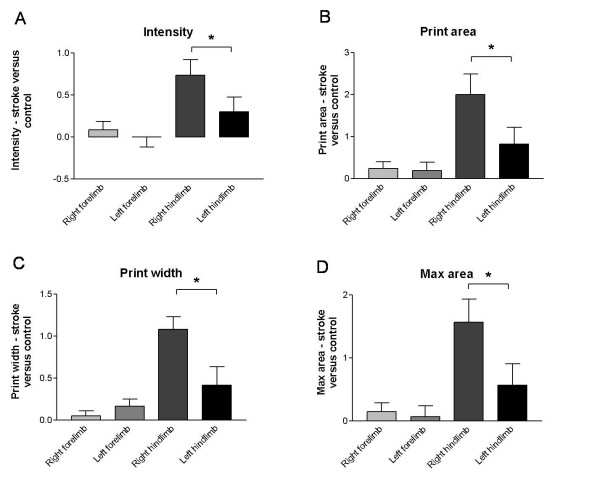
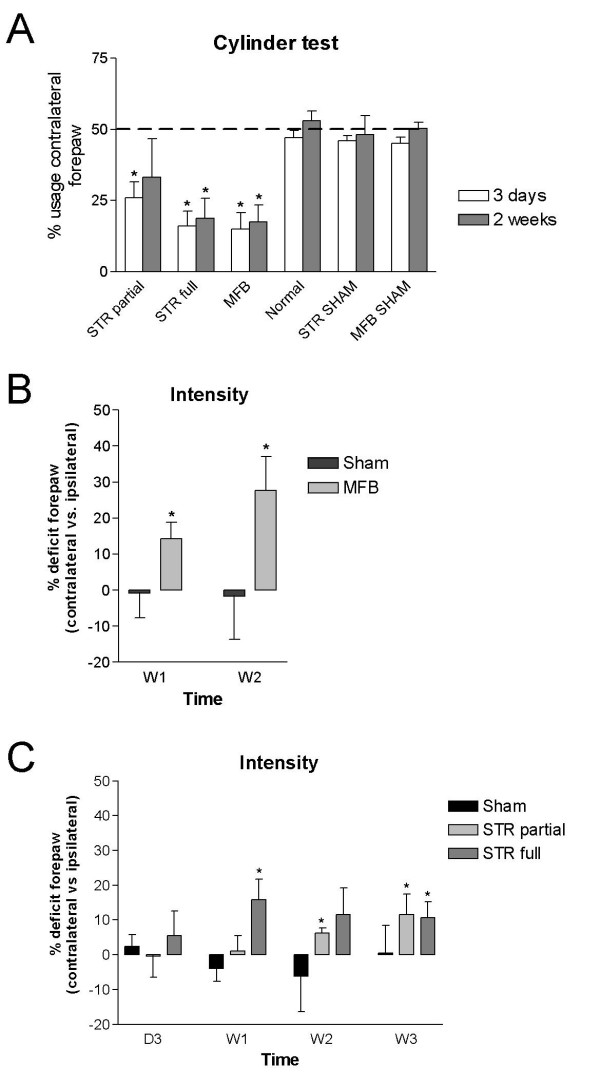
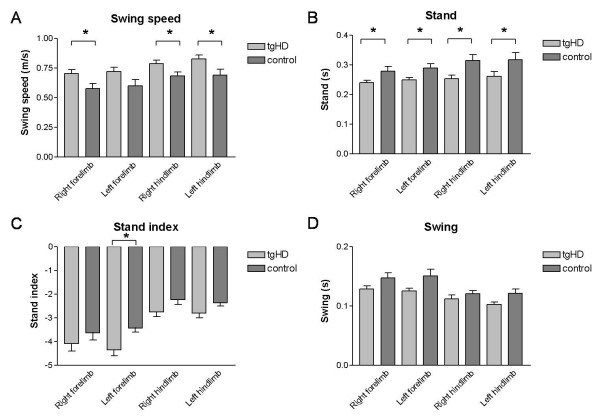
Accurate and reproducible behavioral tests in animal models are of major importance in the development and evaluation of new therapies for central nervous system disease. In this study we investigated for the first time gait parameters of rat models for Parkinson's disease (PD), Huntington's disease (HD) and stroke using the Catwalk method, a novel automated gait analysis test. Static and dynamic gait parameters were measured in all animal models, and these data were compared to readouts of established behavioral tests, such as the cylinder test in the PD and stroke rats and the rotarod tests for the HD group.
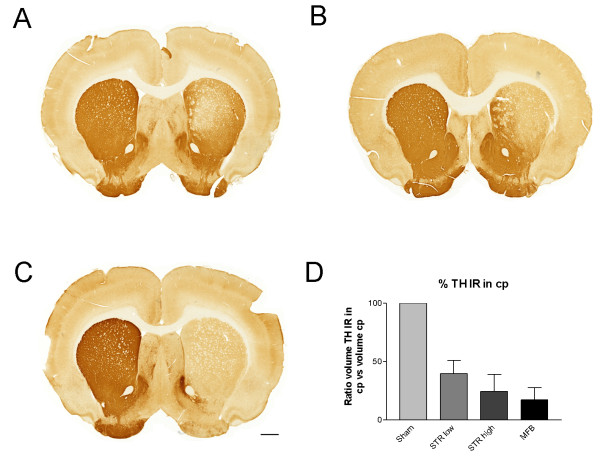
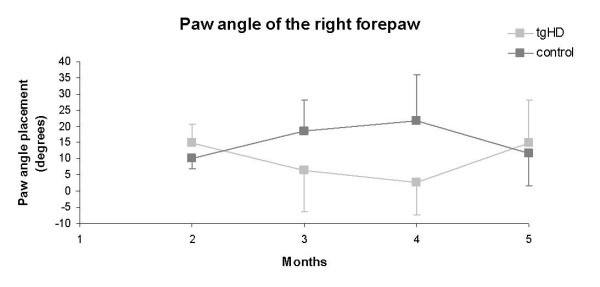
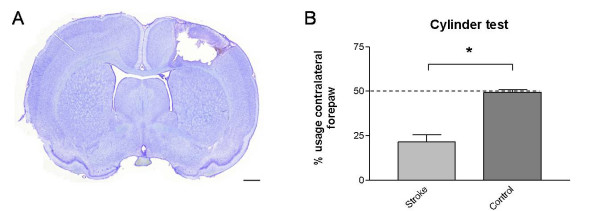
Hemiparkinsonian rats were generated by unilateral injection of the neurotoxin 6-hydroxydopamine in the striatum or in the medial forebrain bundle. For Huntington's disease, a transgenic rat model expressing a truncated huntingtin fragment with multiple CAG repeats was used. Thirdly, a stroke model was generated by a photothrombotic induced infarct in the right sensorimotor cortex. We found that multiple gait parameters were significantly altered in all three disease models compared to their respective controls. Behavioural deficits could be efficiently measured using the cylinder test in the PD and stroke animals, and in the case of the PD model, the deficits in gait essentially confirmed results obtained by the cylinder test. However, in the HD model and the stroke model the Catwalk analysis proved more sensitive than the rotarod test and also added new and more detailed information on specific gait parameters.
The automated quantitative gait analysis test may be a useful tool to study both motor impairment and recovery associated with various neurological motor disorders.
在中枢神经系统疾病的新疗法的开发和评估中,准确且可重复的动物模型行为测试至关重要。在这项研究中,我们首次使用 Catwalk 方法(一种新型自动化步态分析测试)研究了帕金森病 (PD)、亨廷顿病 (HD) 和中风的大鼠模型的步态参数。所有动物模型均测量了静态和动态步态参数,并将这些数据与已建立的行为测试(如 PD 和中风大鼠的圆筒测试以及 HD 组的转棒测试)的结果进行了比较。
通过在纹状体或中脑束单侧注射神经毒素 6-羟多巴胺生成偏侧帕金森病大鼠。对于亨廷顿病,使用表达具有多个 CAG 重复的截断亨廷顿片段的转基因大鼠模型。第三,通过光血栓诱导右侧感觉运动皮层梗死生成中风模型。我们发现,与各自的对照组相比,所有三种疾病模型的多个步态参数均发生了显著改变。使用 PD 和中风动物的圆筒测试可以有效地测量行为缺陷,并且在 PD 模型中,步态缺陷基本上证实了圆筒测试的结果。然而,在 HD 模型和中风模型中,Catwalk 分析比转棒测试更敏感,并且还提供了有关特定步态参数的新的更详细的信息。
自动定量步态分析测试可能是研究与各种神经运动障碍相关的运动障碍和恢复的有用工具。