Research Center of the Centre Hospitalier Universitaire de Québec, Québec, Canada.
J Eval Clin Pract. 2011 Aug;17(4):554-64. doi: 10.1111/j.1365-2753.2010.01515.x. Epub 2010 Aug 3.
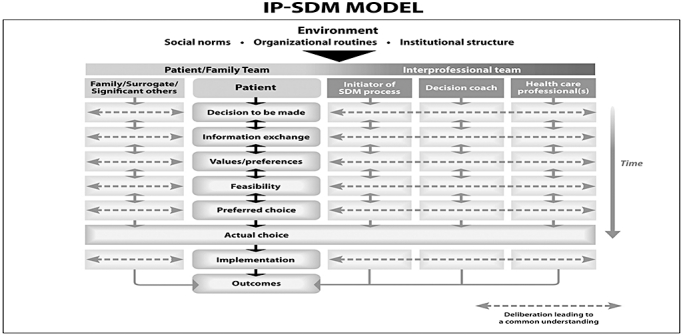
RATIONALE, AIMS AND OBJECTIVES: Following increased interest in having inter-professional (IP) health care teams engage patients in decision making, we developed a conceptual model for an IP approach to shared decision making (SDM) in primary care. We assessed the validity of the model with stakeholders in Canada.
In 15 individual interviews and 7 group interviews with 79 stakeholders, we asked them to: (1) propose changes to the IP-SDM model; (2) identify barriers and facilitators to the model's implementation in clinical practice; and (3) assess the model using a theory appraisal questionnaire. We performed a thematic analysis of the transcripts and a descriptive analysis of the questionnaires.
Stakeholders suggested placing the patient at its centre; extending the concept of family to include significant others; clarifying outcomes; highlighting the concept of time; merging the micro, meso and macro levels in one figure; and recognizing the influence of the environment and emotions. The most common barriers identified were time constraints, insufficient resources and an imbalance of power among health professionals. The most common facilitators were education and training in inter-professionalism and SDM, motivation to achieve an IP approach to SDM, and mutual knowledge and understanding of disciplinary roles. Most stakeholders considered that the concepts and relationships between the concepts were clear and rated the model as logical, testable, having clear schematic representation, and being relevant to inter-professional collaboration, SDM and primary care.
Stakeholders validated the new IP-SDM model for primary care settings and proposed few modifications. Future research should assess if the model helps implement SDM in IP clinical practice.
背景、目的和目标:随着人们对让跨专业(IP)医疗团队参与患者决策的兴趣日益增加,我们为初级保健中的跨专业共享决策(SDM)制定了一个概念模型。我们在加拿大的利益相关者中评估了该模型的有效性。
在 15 次个人访谈和 7 次小组访谈中,我们询问了 79 名利益相关者:(1)对 IP-SDM 模型提出修改建议;(2)确定模型在临床实践中实施的障碍和促进因素;(3)使用理论评估问卷评估模型。我们对记录进行了主题分析,并对问卷进行了描述性分析。
利益相关者建议将患者置于中心位置;将家庭的概念扩展到包括重要他人;澄清结果;突出时间概念;将微观、中观和宏观层面合并到一个图中;并认识到环境和情绪的影响。最常见的障碍是时间限制、资源不足和卫生专业人员之间权力失衡。最常见的促进因素是跨专业主义和 SDM 的教育和培训、实现跨专业 SDM 方法的动机,以及对学科角色的相互了解和理解。大多数利益相关者认为概念和概念之间的关系清晰,并认为该模型逻辑清晰、可测试、具有清晰的示意表示,并且与跨专业合作、SDM 和初级保健相关。
利益相关者验证了新的初级保健 IP-SDM 模型,并提出了一些修改建议。未来的研究应该评估该模型是否有助于在 IP 临床实践中实施 SDM。