Skalski Michael, Yi Qing, Kean Michelle J, Myers Dennis W, Williams Karla C, Burtnik Angela, Coppolino Marc G
Department of Molecular and Cellular Biology, University of Guleph, Guelph, ON N1G 2W1, Canada.
BMC Cell Biol. 2010 Aug 10;11:62. doi: 10.1186/1471-2121-11-62.
Intracellular membrane traffic is an essential component of the membrane remodeling that supports lamellipodium extension during cell adhesion. The membrane trafficking pathways that contribute to cell adhesion have not been fully elucidated, but recent studies have implicated SNARE proteins. Here, the functions of several SNAREs (SNAP23, VAMP3, VAMP4 and syntaxin13) are characterized during the processes of cell spreading and membrane ruffling.
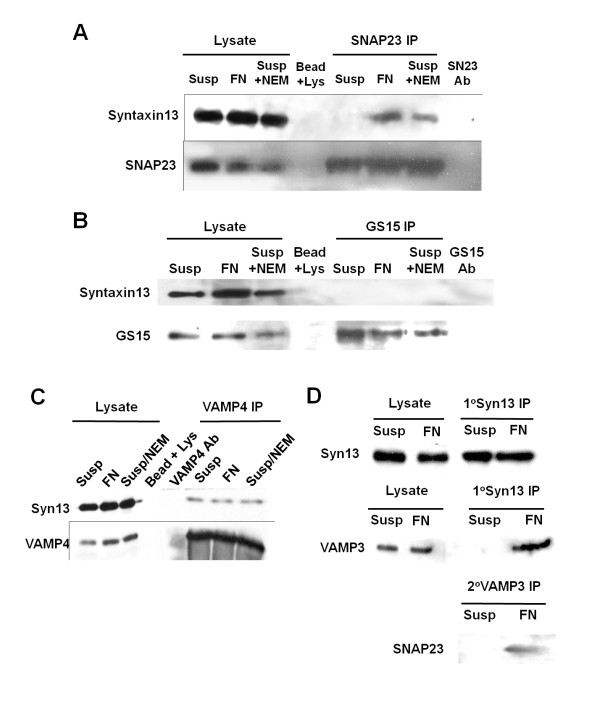
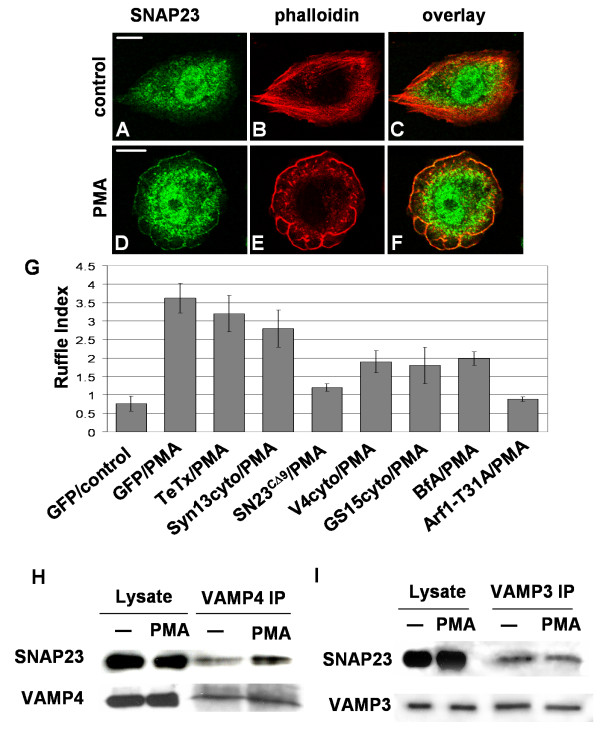
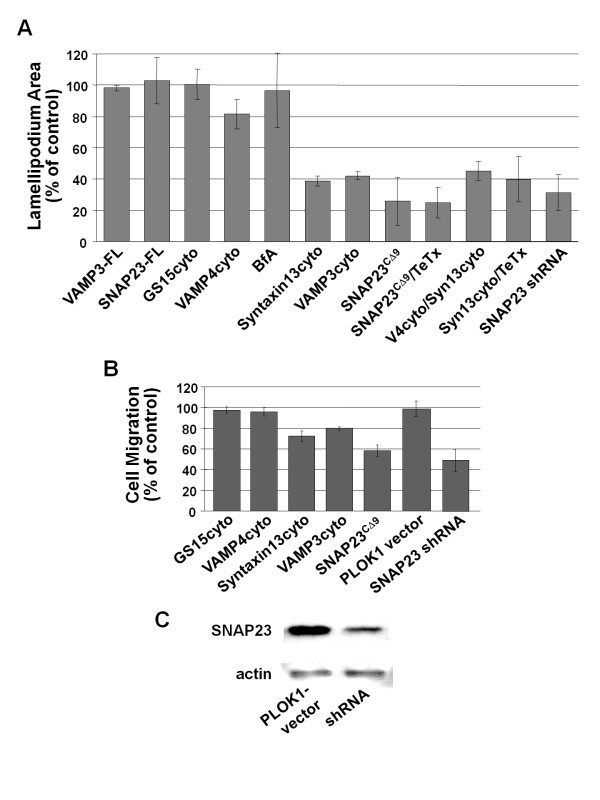
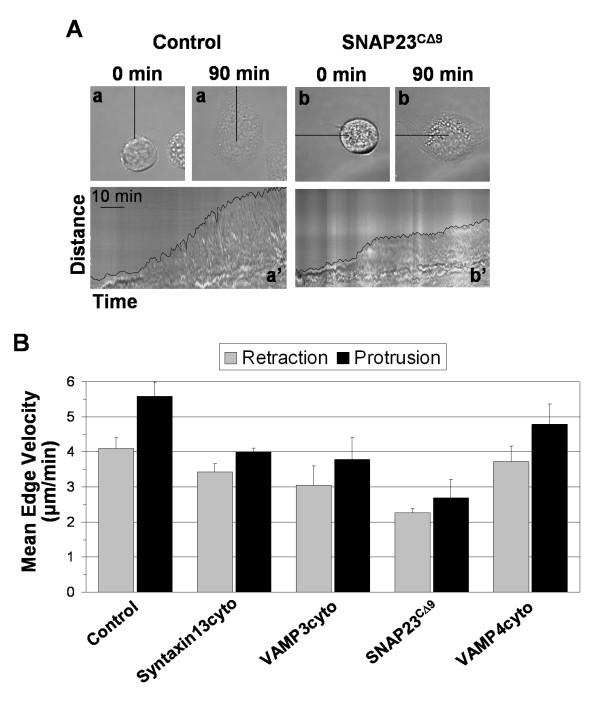
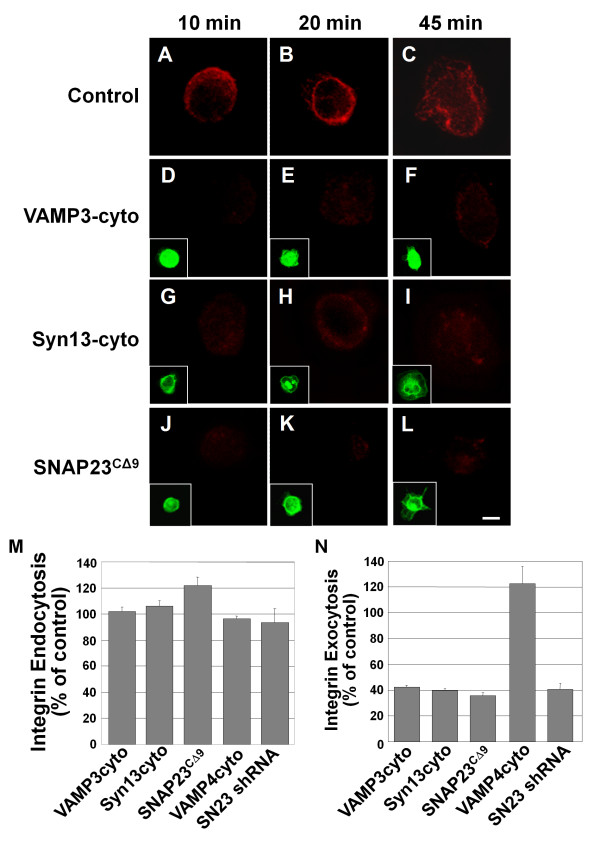
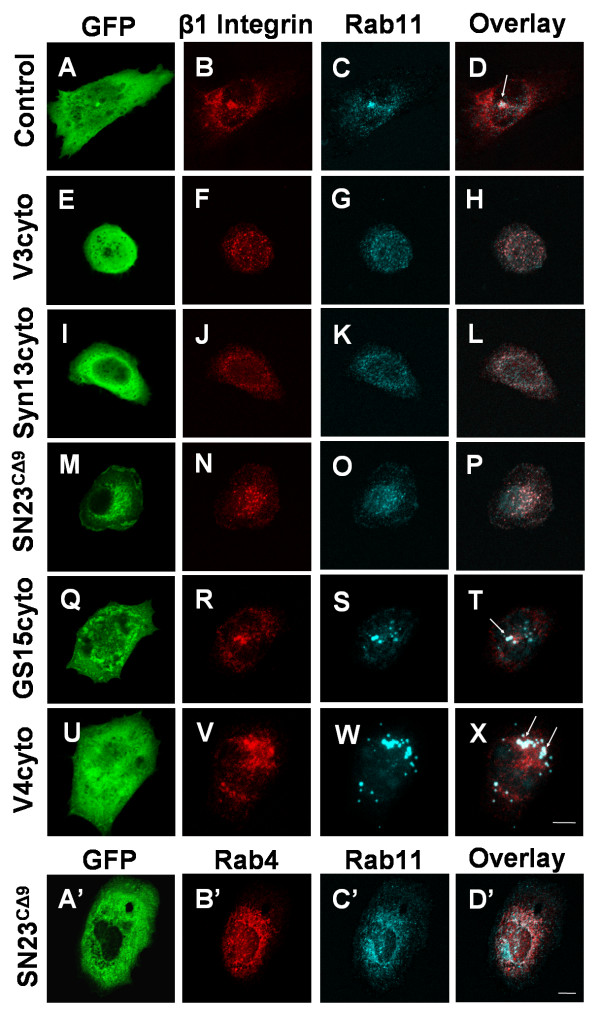
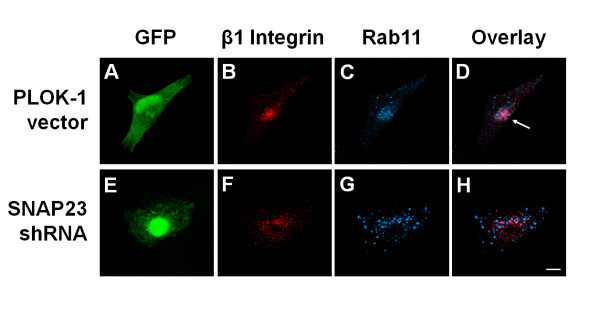
We report the first description of a SNARE complex, containing SNAP23, syntaxin13 and cellubrevin/VAMP3, that is induced by cell adhesion to an extracellular matrix. Impairing the function of the SNAREs in the complex using inhibitory SNARE domains disrupted the recycling endosome, impeded delivery of integrins to the cell surface, and reduced haptotactic cell migration and spreading. Blocking SNAP23 also inhibited the formation of PMA-stimulated, F-actin-rich membrane ruffles; however, membrane ruffle formation was not significantly altered by inhibition of VAMP3 or syntaxin13. In contrast, membrane ruffling, and not cell spreading, was sensitive to inhibition of two SNAREs within the biosynthetic secretory pathway, GS15 and VAMP4. Consistent with this, formation of a complex containing VAMP4 and SNAP23 was enhanced by treatment of cells with PMA. The results reveal a requirement for the function of a SNAP23-syntaxin13-VAMP3 complex in the formation of lamellipodia during cell adhesion and of a VAMP4-SNAP23-containing complex during PMA-induced membrane ruffling.
Our findings suggest that different SNARE-mediated trafficking pathways support membrane remodeling during ECM-induced lamellipodium extension and PMA-induced ruffle formation, pointing to important mechanistic differences between these processes.
细胞内膜运输是膜重塑的一个重要组成部分,在细胞黏附过程中支持片状伪足的延伸。虽然尚未完全阐明有助于细胞黏附的膜运输途径,但最近的研究表明SNARE蛋白与之相关。在此,我们对几种SNARE蛋白(SNAP23、VAMP3、VAMP4和 syntaxin13)在细胞铺展和膜褶皱形成过程中的功能进行了表征。
我们首次描述了一种由细胞与细胞外基质黏附诱导形成的SNARE复合体,该复合体包含SNAP23、syntaxin13和细胞ubrevin/VAMP3。使用抑制性SNARE结构域破坏该复合体中SNARE蛋白的功能,会破坏回收型内体,阻碍整合素向细胞表面的运输,并减少趋触性细胞迁移和铺展。阻断SNAP23也会抑制佛波酯(PMA)刺激的富含F-肌动蛋白的膜褶皱的形成;然而,抑制VAMP3或syntaxin13对膜褶皱的形成没有显著影响。相比之下,膜褶皱形成,而非细胞铺展,对生物合成分泌途径中的两种SNARE蛋白GS15和VAMP4的抑制敏感。与此一致的是,用PMA处理细胞会增强包含VAMP4和SNAP23的复合体的形成。这些结果揭示了在细胞黏附过程中形成片状伪足时需要SNAP23-syntaxin13-VAMP3复合体发挥功能,以及在PMA诱导的膜褶皱形成过程中需要包含VAMP4-SNAP23的复合体发挥功能。
我们的研究结果表明,不同的SNARE介导的运输途径在细胞外基质诱导的片状伪足延伸和PMA诱导的褶皱形成过程中支持膜重塑,这表明这些过程之间存在重要的机制差异。