Stockholm University, Sweden.
Ambio. 2010 May;39(3):257-65. doi: 10.1007/s13280-010-0033-4.
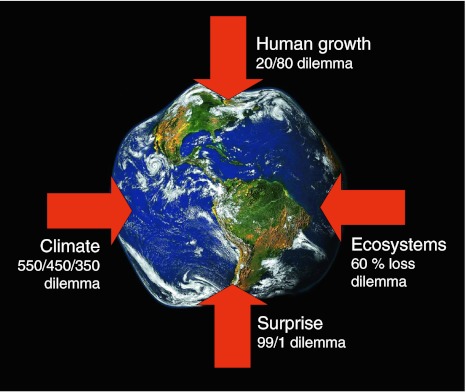
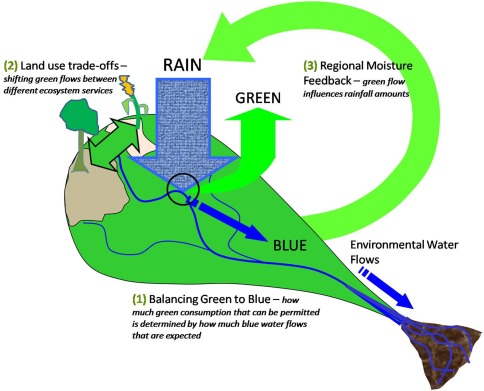
Humanity has entered a new phase of sustainability challenges, the Anthropocene, in which human development has reached a scale where it affects vital planetary processes. Under the pressure from a quadruple squeeze-from population and development pressures, the anthropogenic climate crisis, the anthropogenic ecosystem crisis, and the risk of deleterious tipping points in the Earth system-the degrees of freedom for sustainable human exploitation of planet Earth are severely restrained. It is in this reality that a new green revolution in world food production needs to occur, to attain food security and human development over the coming decades. Global freshwater resources are, and will increasingly be, a fundamental limiting factor in feeding the world. Current water vulnerabilities in the regions in most need of large agricultural productivity improvements are projected to increase under the pressure from global environmental change. The sustainability challenge for world agriculture has to be set within the new global sustainability context. We present new proposed sustainability criteria for world agriculture, where world food production systems are transformed in order to allow humanity to stay within the safe operating space of planetary boundaries. In order to secure global resilience and thereby raise the chances of planet Earth to remain in the current desired state, conducive for human development on the long-term, these planetary boundaries need to be respected. This calls for a triply green revolution, which not only more than doubles food production in many regions of the world, but which also is environmentally sustainable, and invests in the untapped opportunities to use green water in rainfed agriculture as a key source of future productivity enhancement. To achieve such a global transformation of agriculture, there is a need for more innovative options for water interventions at the landscape scale, accounting for both green and blue water, as well as a new focus on cross-scale interactions, feed-backs and risks for unwanted regime shifts in the agro-ecological landscape.
人类已经进入了可持续性挑战的新阶段,即人类世,在这个阶段,人类的发展已经达到了一个影响地球关键过程的规模。在人口和发展压力、人为气候危机、人为生态系统危机以及地球系统中有害临界点风险的四重挤压下,可持续地开发利用地球的自由度受到了严重限制。正是在这种现实下,需要在全球范围内掀起一场新的绿色革命,以确保未来几十年的粮食安全和人类发展。全球淡水资源已经并将越来越成为养活世界的基本限制因素。在全球环境变化的压力下,那些最需要大幅提高农业生产力的地区的当前水资源脆弱性预计将增加。世界农业的可持续性挑战必须放在新的全球可持续性背景下考虑。我们提出了新的世界农业可持续性标准,即在全球范围内,粮食生产系统需要进行变革,以使人类能够在地球边界的安全运行空间内活动。为了确保全球的弹性,从而提高地球保持当前理想状态的可能性,有利于人类的长期发展,这些地球边界需要得到尊重。这需要一场三重绿色革命,不仅要使世界上许多地区的粮食产量增加一倍以上,而且还要实现环境可持续性,并利用雨养农业中未开发的绿色水资源作为未来生产力提高的关键来源,发掘新的机会。为了实现农业的全球转型,需要在景观尺度上有更多创新的水干预选择,既要考虑绿水资源和蓝水资源,又要关注跨尺度的相互作用、反馈以及农业生态景观中不受欢迎的制度转变的风险。