Department of Biochemistry and Molecular Biology, Institute of Bioinformatics, University of Georgia, Athens 30602, GA, USA.
BMC Cancer. 2010 Aug 13;10:426. doi: 10.1186/1471-2407-10-426.
We are developing a cross-species comparison strategy to distinguish between cancer driver- and passenger gene alteration candidates, by utilizing the difference in genomic location of orthologous genes between the human and other mammals. As an initial test of this strategy, we conducted a pilot study with human colorectal cancer (CRC) and its mouse model C57BL/6J ApcMin/+, focusing on human 5q22.2 and 18q21.1-q21.2.
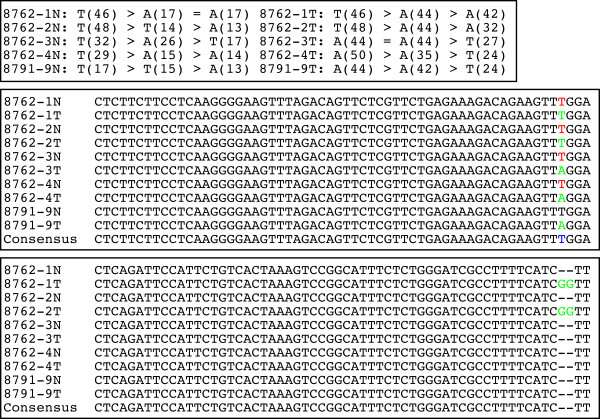
We first performed bioinformatics analysis on the evolution of 5q22.2 and 18q21.1-q21.2 regions. Then, we performed exon-targeted sequencing, real time quantitative polymerase chain reaction (qPCR), and real time quantitative reverse transcriptase PCR (qRT-PCR) analyses on a number of genes of both regions with both human and mouse colon tumors.
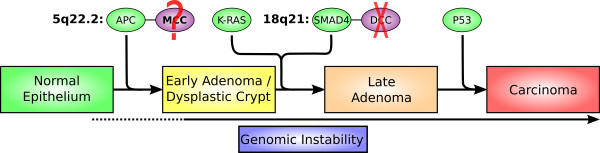
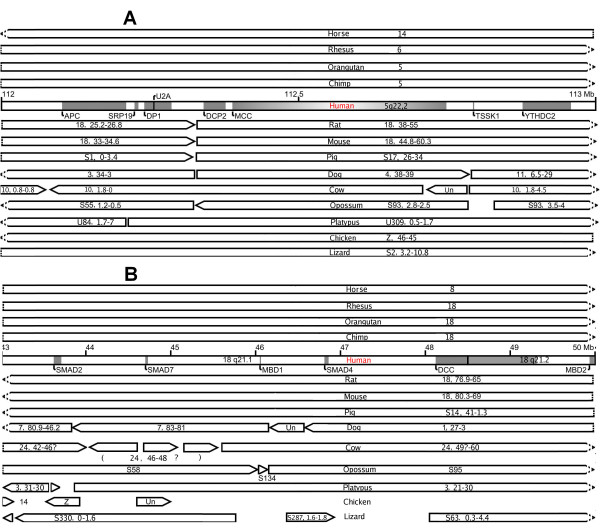
These two regions (5q22.2 and 18q21.1-q21.2) are frequently deleted in human CRCs and encode genuine colorectal tumor suppressors APC and SMAD4. They also encode genes such as MCC (mutated in colorectal cancer) with their role in CRC etiology unknown. We have discovered that both regions are evolutionarily unstable, resulting in genes that are clustered in each human region being found scattered at several distinct loci in the genome of many other species. For instance, APC and MCC are within 200 kb apart in human 5q22.2 but are 10 Mb apart in the mouse genome. Importantly, our analyses revealed that, while known CRC driver genes APC and SMAD4 were disrupted in both human colorectal tumors and tumors from ApcMin/+ mice, the questionable MCC gene was disrupted in human tumors but appeared to be intact in mouse tumors.
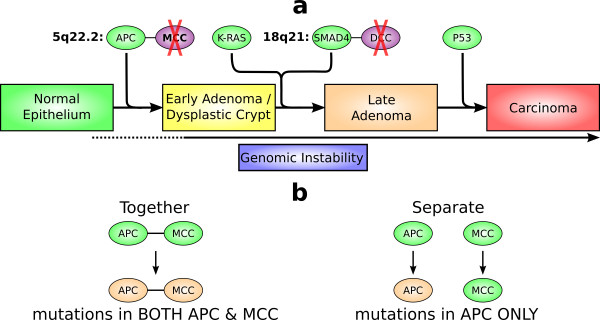
These results indicate that MCC may not actually play any causative role in early colorectal tumorigenesis. We also hypothesize that its disruption in human CRCs is likely a mere result of its close proximity to APC in the human genome. Expanding this pilot study to the entire genome may identify more questionable genes like MCC, facilitating the discovery of new CRC driver gene candidates.
我们正在开发一种跨物种比较策略,通过利用人类和其他哺乳动物之间同源基因在基因组位置上的差异,来区分癌症驱动基因和乘客基因改变候选物。作为该策略的初步测试,我们对人结直肠癌(CRC)及其小鼠模型 C57BL/6J ApcMin/+进行了一项试点研究,重点关注人类 5q22.2 和 18q21.1-q21.2 区域。
我们首先对 5q22.2 和 18q21.1-q21.2 区域的进化进行了生物信息学分析。然后,我们对这两个区域的许多基因进行了人结肠癌和鼠结肠癌的外显子靶向测序、实时定量聚合酶链反应(qPCR)和实时定量逆转录聚合酶链反应(qRT-PCR)分析。
这两个区域(5q22.2 和 18q21.1-q21.2)在人类 CRC 中经常缺失,并编码真正的结直肠肿瘤抑制因子 APC 和 SMAD4。它们还编码 MCC(结直肠癌突变)等基因,但其在 CRC 发病机制中的作用尚不清楚。我们发现这两个区域的进化不稳定,导致在每个人类区域聚类的基因在许多其他物种的基因组中散布在几个不同的位置。例如,APC 和 MCC 在人类 5q22.2 中相距 200 kb,但在小鼠基因组中相距 10 Mb。重要的是,我们的分析表明,虽然已知的 CRC 驱动基因 APC 和 SMAD4 在人结直肠肿瘤和 ApcMin/+小鼠的肿瘤中均被破坏,但可疑的 MCC 基因在人肿瘤中被破坏,但在鼠肿瘤中似乎完整。
这些结果表明,MCC 可能实际上并未在早期结直肠肿瘤发生中起任何因果作用。我们还假设,其在人类 CRC 中的破坏很可能仅仅是由于其在人类基因组中与 APC 接近所致。将这项试点研究扩展到整个基因组可能会发现更多像 MCC 这样的可疑基因,从而促进新的 CRC 驱动基因候选物的发现。