Sydney School of Public Health, Edward Ford Building (A27), University of Sydney, NSW 2006, Australia.
BMC Public Health. 2010 Aug 16;10:485. doi: 10.1186/1471-2458-10-485.
Antenatal care aims to prevent maternal and perinatal mortality and morbidity. In Indonesia, at least four antenatal visits are recommended during pregnancy. However, this service has been underutilized. This study aimed to examine factors associated with underutilization of antenatal care services in Indonesia.
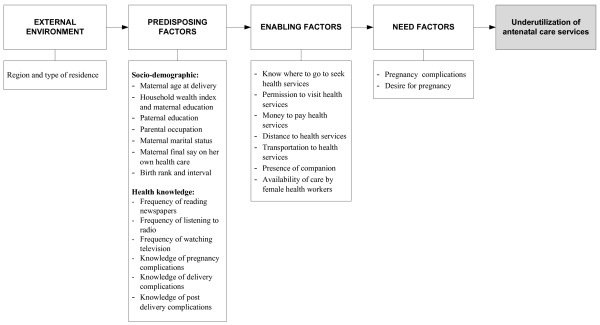
We used data from Indonesia Demographic and Health Survey (IDHS) 2002/2003 and 2007. Information of 26,591 singleton live-born infants of the mothers' most recent birth within five years preceding each survey was examined. Twenty-three potential risk factors were identified and categorized into four main groups, external environment, predisposing, enabling, and need factors. Logistic regression models were used to examine the association between all potential risk factors and underutilization of antenatal services. The Population Attributable Risk (PAR) was calculated for selected significant factors associated with the outcome.
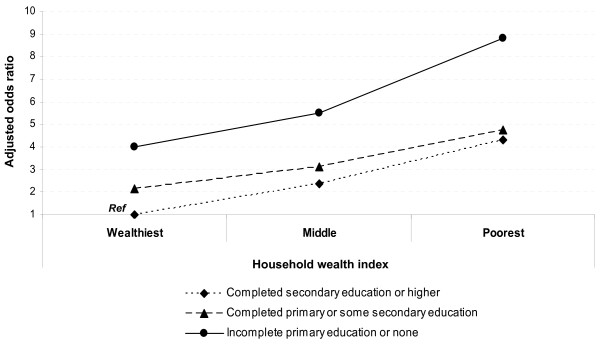
Factors strongly associated with underutilization of antenatal care services were infants from rural areas and from outer Java-Bali region, infants from low household wealth index and with low maternal education level, and high birth rank infants with short birth interval of less than two years. Other associated factors identified included mothers reporting distance to health facilities as a major problem, mothers less exposed to mass media, and mothers reporting no obstetric complications during pregnancy. The PAR showed that 55% of the total risks for underutilization of antenatal care services were attributable to the combined low household wealth index and low maternal education level.
Strategies to increase the accessibility and availability of health care services are important particularly for communities in rural areas. Financial support that enables mothers from poor households to use health services will be beneficial. Health promotion programs targeting mothers with low education are vital to increase their awareness about the importance of antenatal services.
产前护理旨在预防孕产妇和围产期死亡和发病。在印度尼西亚,建议孕妇至少进行四次产前检查。然而,这项服务的利用率一直很低。本研究旨在探讨印度尼西亚产前护理服务利用率低的相关因素。
我们使用了 2002/2003 年和 2007 年印度尼西亚人口与健康调查(IDHS)的数据。检查了每个调查前五年内母亲最近一次分娩的 26591 名单胎活产婴儿的信息。确定了 23 个潜在的危险因素,并将其分为四个主要组,即外部环境、倾向、使能和需求因素。使用逻辑回归模型检查所有潜在危险因素与产前服务利用率之间的关系。为与结果相关的选定重要因素计算了人群归因风险(PAR)。
与产前护理服务利用率低强烈相关的因素包括来自农村地区和爪哇-巴厘岛以外地区的婴儿、来自低家庭财富指数和低母亲教育水平的婴儿,以及出生间隔不到两年的高出生顺序婴儿。其他相关因素包括报告医疗设施距离为主要问题的母亲、较少接触大众媒体的母亲以及报告怀孕期间无产科并发症的母亲。PAR 显示,产前护理服务利用率低的总风险中有 55%归因于家庭财富指数低和母亲教育水平低的综合因素。
增加医疗保健服务的可及性和可用性的策略非常重要,特别是对于农村地区的社区。为贫困家庭的母亲提供经济支持,使她们能够使用卫生服务将是有益的。针对教育程度低的母亲开展的健康促进计划对于提高她们对产前服务重要性的认识至关重要。