Department of Statistics, College of Natural and Computational Science, Mizan-Tepi University, Tepi, Ethiopia.
ScientificWorldJournal. 2021 Oct 25;2021:7146452. doi: 10.1155/2021/7146452. eCollection 2021.
Antenatal care visit is the service given to pregnant women to have a safe pregnancy and a healthy baby. The main objective of this study was to identify potential factors for the barriers in the number of antenatal care visits.
Data for this study was taken from the 2016 Ethiopian demographic health survey. All childbearing women from rural parts of Ethiopia were considered in this study, and the count regression model was used to explore the major risk factors for the barriers in the number of antenatal care service visits.
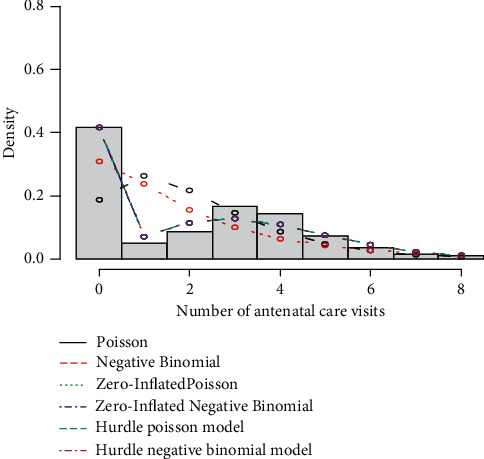
Nearly 42% of pregnant mothers did not visit antenatal care services, and only 1% of the mothers attended antenatal care service visits eight times and above. From hurdle Poisson regression model results, women having previous pregnancy complication (AOR = 1.16; ≤ 0.001); husbands with primary education (AOR = 1.02; =0.004), secondary education (AOR = 1.117; ≤ 0.0001), and higher education (AOR = 1.191; ≤ 0.001); middle wealth index (AOR = 1.08; =0.006); richer wealth index (AOR = 1.10; ≤ 0.001); maternal age 35-49 (AOR = 0.690; ≤ 0.001); being exposed to media access (AOR = 1.745; =0.019); having distance problem (AOR = 0.75; =0.013); planned pregnancy (AOR = 1.42; =0.002); and mothers with primary education (AOR = 1.85; ≤ 0.001) and secondary (AOR = 2.387; ≤ 0.001) were statistically associated with barriers in the number of ANC service visits.
As indicated in the findings, there is underutilization of the antenatal care service visits regarding rural women in Ethiopia. Having a low education level, no media access, distance problem from the health facility, and not planned pregnancy decrease the rate of antenatal care service visits. To fill this discrepancy, the concerned bodies including government and nongovernmental organizations should work on the identified factors in the rural parts of the country to save children and mothers.
产前护理访问是为孕妇提供的服务,旨在确保安全妊娠和生育健康婴儿。本研究的主要目的是确定影响产前护理访问次数的潜在障碍因素。
本研究的数据来自 2016 年埃塞俄比亚人口与健康调查。研究考虑了来自埃塞俄比亚农村地区的所有生育妇女,使用计数回归模型探索了影响产前护理服务访问次数障碍的主要风险因素。
近 42%的孕妇没有接受产前护理服务,只有 1%的母亲接受了 8 次及以上的产前护理服务访问。来自 hurdle Poisson 回归模型的结果显示,有既往妊娠并发症的妇女(AOR=1.16;≤0.001);丈夫接受过小学教育(AOR=1.02;=0.004)、中学教育(AOR=1.117;≤0.0001)和高等教育(AOR=1.191;≤0.001);中等财富指数(AOR=1.08;=0.006);更富裕的财富指数(AOR=1.10;≤0.001);母亲年龄在 35-49 岁(AOR=0.690;≤0.001);接触媒体(AOR=1.745;=0.019);存在距离问题(AOR=0.75;=0.013);计划妊娠(AOR=1.42;=0.002);母亲接受过小学教育(AOR=1.85;≤0.001)和中学教育(AOR=2.387;≤0.001)与产前护理服务访问次数的障碍有统计学关联。
研究结果表明,埃塞俄比亚农村妇女对产前护理服务的利用率较低。教育程度低、没有媒体接触、距离卫生机构远以及非计划妊娠会降低产前护理服务的利用率。为了弥补这一差距,包括政府和非政府组织在内的有关机构应在该国农村地区针对已确定的因素开展工作,以拯救儿童和母亲。