Campbell Ewan M, Budge Giles E, Bowman Alan S
School of Biological Sciences (Zoology), University of Aberdeen, Tillydrone Avenue, Aberdeen AB24 2TZ, UK.
Parasit Vectors. 2010 Aug 16;3:73. doi: 10.1186/1756-3305-3-73.
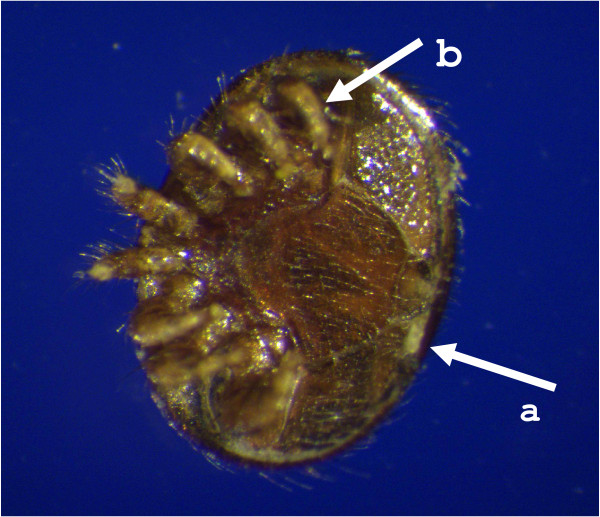
The parasitic mite Varroa destructor is considered the major pest of the European honey bee (Apis mellifera) and responsible for declines in honey bee populations worldwide. Exploiting the full potential of gene sequences becoming available for V. destructor requires adaptation of modern molecular biology approaches to this non-model organism. Using a mu-class glutathione S-transferase (VdGST-mu1) as a candidate gene we investigated the feasibility of gene knockdown in V. destructor by double-stranded RNA-interference (dsRNAi).
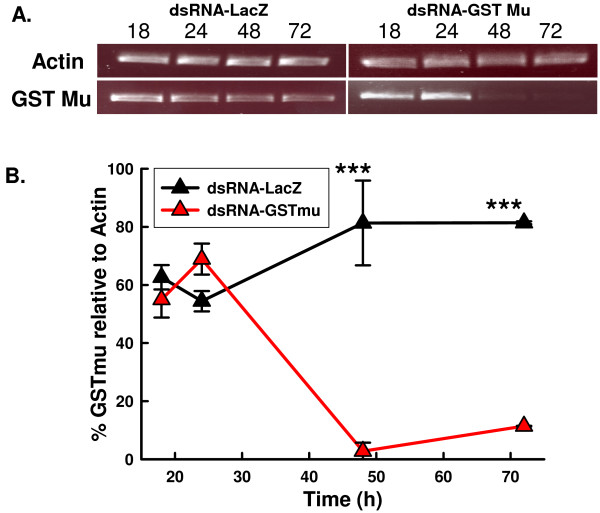
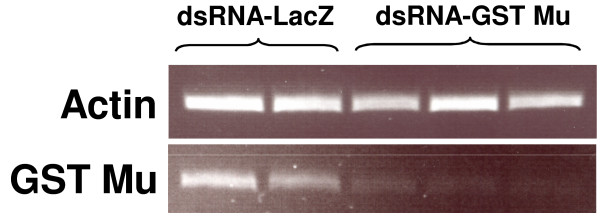
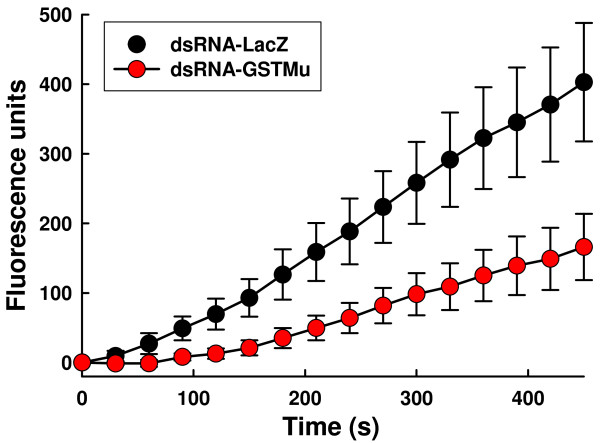
Intra-haemocoelic injection of dsRNA-VdGST-mu1 resulted in 97% reduction in VdGST-mu1 transcript levels 48 h post-injection compared to mites injected with a bolus of irrelevant dsRNA (LacZ). This gene suppression was maintained to, at least, 72 h. Total GST catalytic activity was reduced by 54% in VdGST-mu1 gene knockdown mites demonstrating the knockdown was effective at the translation step as well as the transcription steps. Although near total gene knockdown was achieved by intra-haemocoelic injection, only half of such treated mites survived this traumatic method of dsRNA administration and less invasive methods were assessed. V. destructor immersed overnight in 0.9% NaCl solution containing dsRNA exhibited excellent reduction in VdGST-mu1 transcript levels (87% compared to mites immersed in dsRNA-LacZ). Importantly, mites undergoing the immersion approach had greatly improved survival (75-80%) over 72 h, approaching that of mites not undergoing any treatment.
Our findings on V. destructor are the first report of gene knockdown in any mite species and demonstrate that the small size of such organisms is not a major impediment to applying gene knockdown approaches to the study of such parasitic pests. The immersion in dsRNA solution method provides an easy, inexpensive, relatively high throughput method of gene silencing suitable for studies in V. destructor, other small mites and immature stages of ticks.
寄生螨狄斯瓦螨被认为是欧洲蜜蜂(西方蜜蜂)的主要害虫,也是全球蜜蜂数量减少的原因。要充分利用狄斯瓦螨可用基因序列的全部潜力,需要使现代分子生物学方法适用于这种非模式生物。我们以一个μ类谷胱甘肽S-转移酶(VdGST-mu1)作为候选基因,研究了通过双链RNA干扰(dsRNAi)在狄斯瓦螨中进行基因敲低的可行性。
与注射无关双链RNA(LacZ)的螨相比,血腔注射dsRNA-VdGST-mu1后48小时,VdGST-mu1转录水平降低了97%。这种基因抑制至少维持到72小时。在VdGST-mu1基因敲低的螨中,总谷胱甘肽S-转移酶催化活性降低了54%,这表明基因敲低在翻译步骤以及转录步骤都是有效的。尽管通过血腔注射几乎实现了完全的基因敲低,但只有一半接受这种处理的螨在这种创伤性的dsRNA给药方法中存活下来,因此我们评估了侵入性较小的方法。将狄斯瓦螨在含有dsRNA的0.9%氯化钠溶液中浸泡过夜,VdGST-mu1转录水平显著降低(与浸泡在dsRNA-LacZ中的螨相比降低了87%)。重要的是,采用浸泡方法的螨在72小时内的存活率大大提高(75%-至80%),接近未接受任何处理的螨的存活率。
我们关于狄斯瓦螨的研究结果是任何螨类物种中基因敲低的首次报道,表明这类生物的小尺寸并不是将基因敲低方法应用于此类寄生害虫研究的主要障碍。浸泡在dsRNA溶液中的方法提供了一种简单、廉价、相对高通量的基因沉默方法,适用于狄斯瓦螨、其他小型螨类和蜱虫未成熟阶段的研究。