Department of Pathophysiology and Therapeutics of Diabetic Vascular Complications, Kurume University School of Medicine, Kurume, Japan.
Oxid Med Cell Longev. 2010 Mar-Apr;3(2):101-8. doi: 10.4161/oxim.3.2.11148.
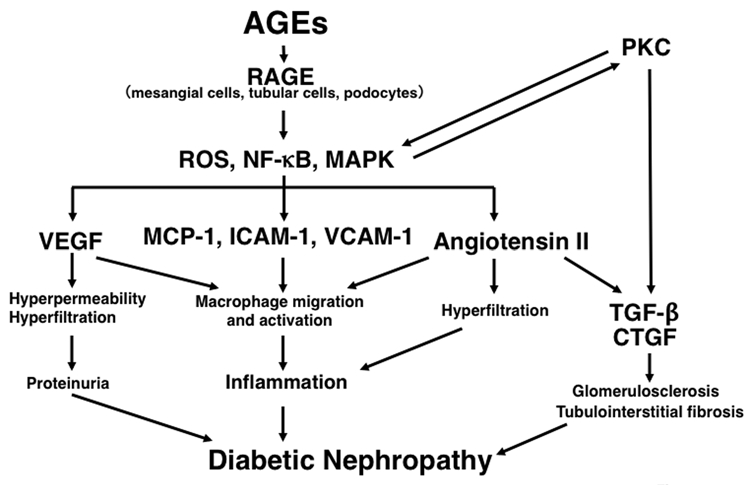
About 246 million people worldwide have diabetes in 2007. The global figure of people with diabetes is projected to increase to 370 million in 2030. As the prevalence of diabetes has risen to epidemic proportions worldwide, diabetic nephropathy has become one of the most challenging health problems. Therapeutic options such as strict blood glucose and blood pressure controls are effective for preventing diabetic nephropathy, but are far from satisfactory, and the number of diabetic patients on end-stage renal disease is still increasing. Therefore, a novel therapeutic strategy that could halt the progression of diabetic nephropathy should be developed. There is accumulating evidence that advanced glycation end products (AGEs), senescent macroprotein derivatives formed at an accelerated rate under diabetes, play a role in diabetic nephropathy via oxidative stress generation. In this paper, we review the pathophysiological role of AGEs and their receptor (RAGE)-oxidative stress system in diabetic nephropathy.
2007 年,全球约有 2.46 亿人患有糖尿病。预计到 2030 年,全球糖尿病患者人数将增至 3.7 亿。随着糖尿病在全球的患病率上升到流行程度,糖尿病肾病已成为最具挑战性的健康问题之一。严格控制血糖和血压等治疗选择对预防糖尿病肾病有效,但远非令人满意,而且终末期肾病的糖尿病患者人数仍在增加。因此,应该开发一种新的治疗策略来阻止糖尿病肾病的进展。越来越多的证据表明,在糖尿病下以加速速度形成的晚期糖基化终产物 (AGEs) 和衰老的大蛋白衍生物,通过产生氧化应激在糖尿病肾病中发挥作用。在本文中,我们综述了 AGEs 及其受体 (RAGE)-氧化应激系统在糖尿病肾病中的病理生理作用。