McKay Douglas R, Fawzy Hosam F, McKay Kathryn M, Nitsch Romy, Mahoney James L
Department of Surgery, Queen's University, Kingston, Ontario, Canada.
J Cardiothorac Surg. 2010 Aug 18;5:64. doi: 10.1186/1749-8090-5-64.
Plate and screw fixation is a recent addition to the sternal wound treatment armamentarium. Patients undergoing cardiac and major vascular surgery have a higher risk of postoperative arrest than other elective patients. Those who undergo sternotomy for either cardiac or major vascular procedures are at a higher risk of postoperative arrest. Sternal plate design allows quick access to the mediastinum facilitating open cardiac massage, but chest compressions are the mainstay of re-establishing cardiac output in the event of arrest. The response of sternal plates and the chest wall to compressions when plated has not been studied. The safety of performing this maneuver is unknown. This study intends to demonstrate compressions are safe after sternal plating.
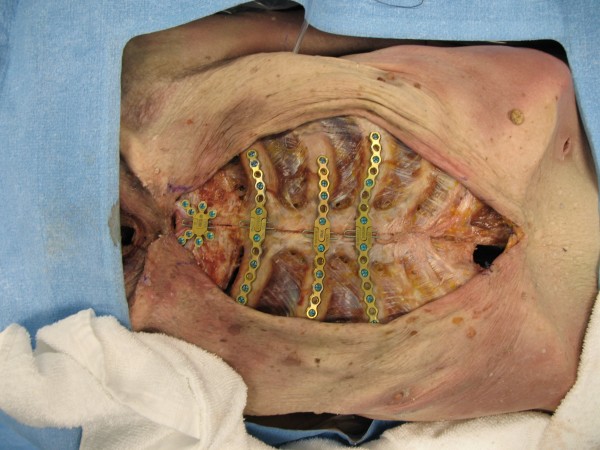
We investigated the effect of chest compressions on the plated sternum using a human cadaveric model. Cadavers were plated, an arrest was simulated, and an experienced physician performed a simulated resuscitation. Intrathoracic pressure was monitored throughout to ensure the plates encountered an appropriate degree of force. The hardware and viscera were evaluated for failure and trauma respectively.
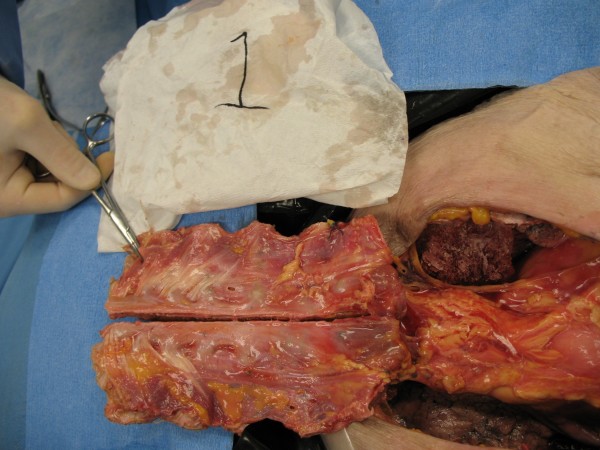
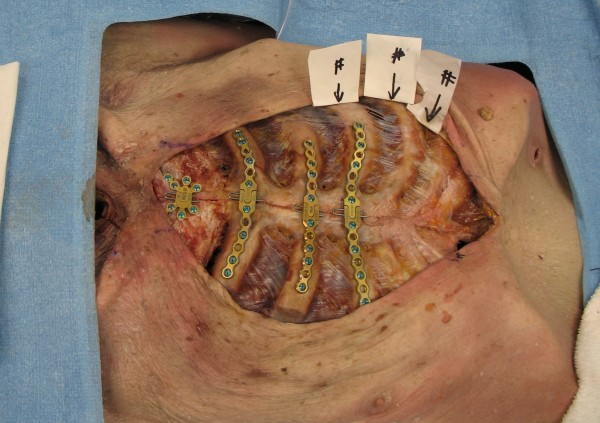
No hardware failure or obvious visceral trauma was observed. Rib fractures beyond the boundaries of the plates were noted but the incidence was comparable to control and to the fracture incidence after resuscitation previously cited in the literature.
From this work we believe chest compressions are safe for the patient with sternal plates when proper plating technique is used. We advocate the use of this life-saving maneuver as part of an ACLS resuscitation in the event of an arrest for rapidly re-establishing circulation.
钢板和螺钉固定是胸骨伤口治疗手段中的一项新方法。接受心脏和大血管手术的患者术后心脏骤停的风险高于其他择期手术患者。因心脏或大血管手术而行胸骨切开术的患者术后心脏骤停风险更高。胸骨板设计便于快速进入纵隔以利于进行开胸心脏按压,但在心脏骤停时胸外按压仍是恢复心输出量的主要手段。胸骨板和胸壁在固定后对按压的反应尚未得到研究。进行这种操作的安全性尚不清楚。本研究旨在证明胸骨固定术后进行按压是安全的。
我们使用人体尸体模型研究胸外按压对固定胸骨的影响。对尸体进行固定,模拟心脏骤停,由一名经验丰富的医生进行模拟复苏。在整个过程中监测胸内压力,以确保钢板受到适当程度的力。分别评估硬件和内脏的损坏及损伤情况。
未观察到硬件故障或明显的内脏损伤。注意到钢板范围以外的肋骨骨折,但发生率与对照组以及文献中先前引用的复苏后骨折发生率相当。
基于这项研究,我们认为在采用适当的固定技术时,胸外按压对胸骨固定患者是安全的。我们提倡在心脏骤停时将这种挽救生命的操作作为高级心血管生命支持(ACLS)复苏的一部分,以迅速恢复循环。