UCL Institute of Cognitive Neuroscience, University College London, UK.
Curr Biol. 2010 Sep 28;20(18):1626-30. doi: 10.1016/j.cub.2010.07.027. Epub 2010 Aug 19.
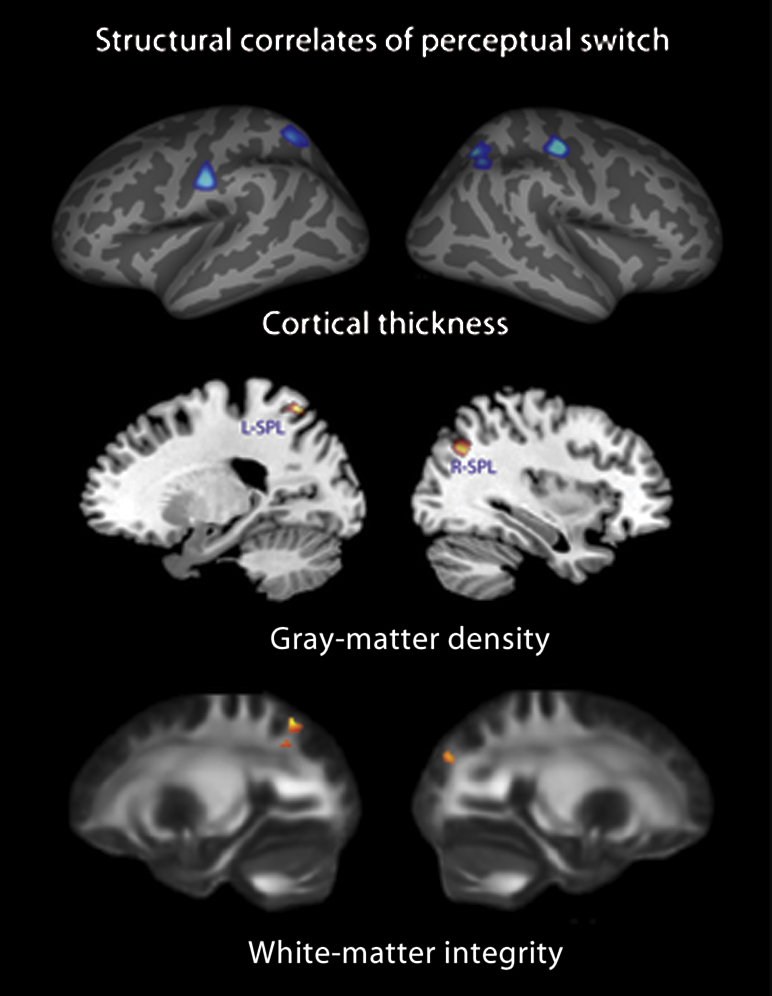
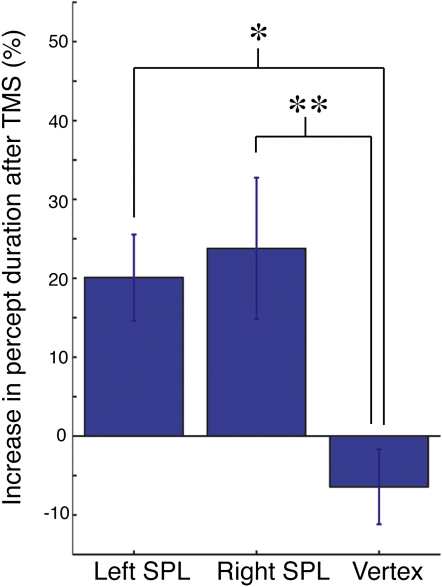
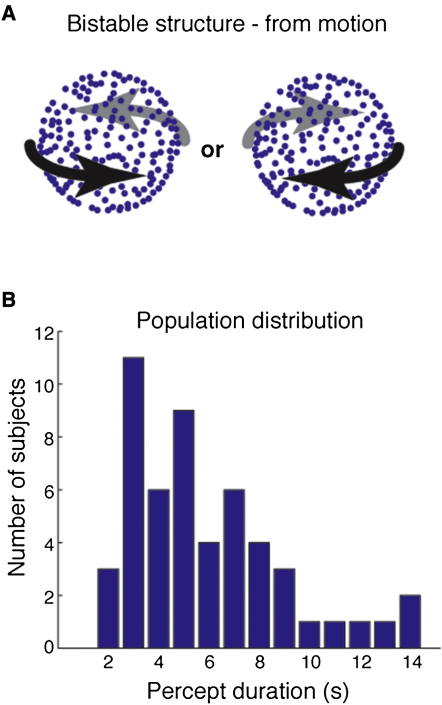
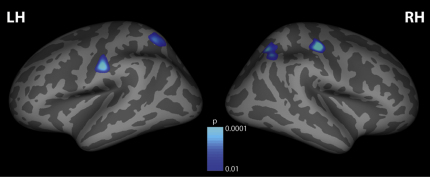
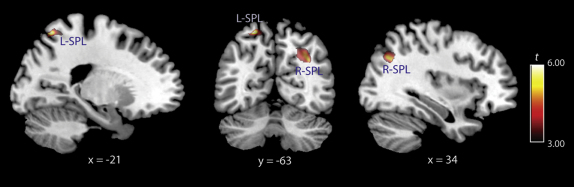
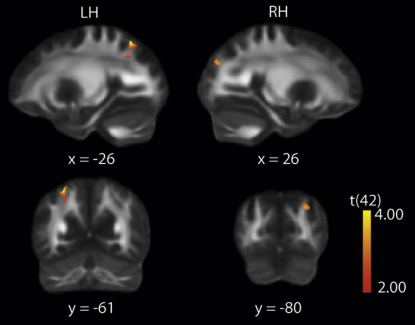
When visual input has conflicting interpretations, conscious perception can alternate spontaneously between competing interpretations [1]. There is a large amount of unexplained variability between individuals in the rate of such spontaneous alternations in perception [2-5]. We hypothesized that variability in perceptual rivalry might be reflected in individual differences in brain structure, because brain structure can exhibit systematic relationships with an individual's cognitive experiences and skills [6-9]. To test this notion, we examined in a large group of individuals how cortical thickness, local gray-matter density, and local white-matter integrity correlate with individuals' alternation rate for a bistable, rotating structure-from-motion stimulus [10]. All of these macroscopic measures of brain structure consistently revealed that the structure of bilateral superior parietal lobes (SPL) could account for interindividual variability in perceptual alternation rate. Furthermore, we examined whether the bilateral SPL regions play a causal role in the rate of perceptual alternations by using transcranial magnetic stimulation (TMS) and found that transient disruption of these areas indeed decreases the rate of perceptual alternations. These findings demonstrate a direct relationship between structure of SPL and individuals' perceptual switch rate.
当视觉输入存在相互冲突的解释时,意识知觉可以在竞争解释之间自发地交替[1]。在这种知觉自发交替的速度上,个体之间存在大量无法解释的可变性[2-5]。我们假设,知觉竞争的可变性可能反映在个体大脑结构的差异上,因为大脑结构可以与个体的认知经验和技能表现出系统的关系[6-9]。为了验证这一观点,我们在一大群个体中研究了大脑皮层厚度、局部灰质密度和局部白质完整性如何与个体对双稳态、旋转运动结构刺激的交替率相关[10]。这些大脑结构的宏观测量都一致表明,双侧顶叶上回(SPL)的结构可以解释知觉交替率的个体间差异。此外,我们通过经颅磁刺激(TMS)检查了双侧 SPL 区域是否在知觉交替率中起因果作用,发现这些区域的短暂干扰确实会降低知觉交替率。这些发现表明 SPL 的结构与个体的知觉转换率之间存在直接关系。