Department of Cancer Biology, City of Hope National Medical Center and Beckman Research Institute, Duarte, California, USA.
Nat Chem Biol. 2010 Oct;6(10):766-73. doi: 10.1038/nchembio.422. Epub 2010 Aug 22.
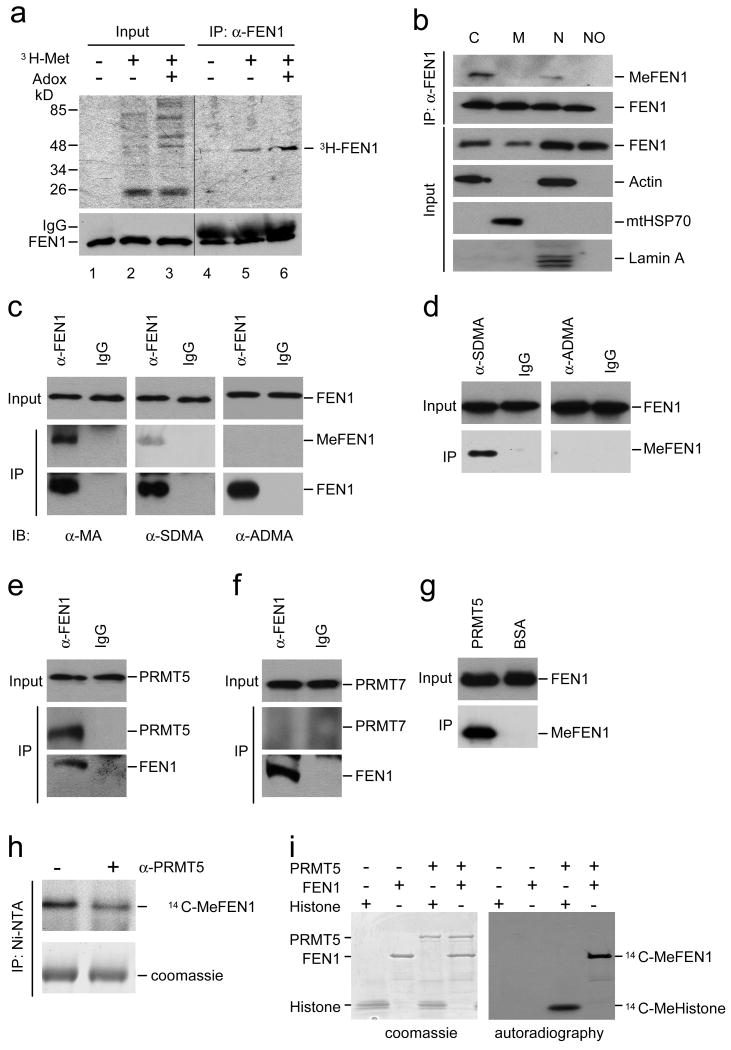
Flap endonuclease 1 (FEN1), a structure-specific endo- and exonuclease, has multiple functions that determine essential biological processes, such as cell proliferation and cell death. As such, the enzyme must be precisely regulated to execute each of its functions with the right timing and in a specific subcellular location. Here we report that FEN1 is methylated at arginine residues, primarily at Arg192. The methylation suppresses FEN1 phosphorylation at Ser187. The methylated form, but not the phosphorylated form, of FEN1 strongly interacts with proliferating cell nuclear antigen (PCNA), ensuring the 'on' and 'off' timing of its reaction. Mutations of FEN1 disrupting arginine methylation and PCNA interaction result in unscheduled phosphorylation and a failure to localize to DNA replication or repair foci. This consequently leads to a defect in Okazaki fragment maturation, a delay in cell cycle progression, impairment of DNA repair and a high frequency of genome-wide mutations.
核酸内切酶 1(FEN1)是一种结构特异性的内切酶和外切酶,具有多种功能,这些功能决定了重要的生物学过程,如细胞增殖和细胞死亡。因此,为了执行每种功能,该酶必须进行精确的调节,使其在正确的时间和特定的亚细胞位置发挥作用。在这里,我们报告 FEN1 可以在精氨酸残基上发生甲基化,主要是 Arg192。甲基化抑制 FEN1 在 Ser187 上的磷酸化。FEN1 的甲基化形式,但不是磷酸化形式,与增殖细胞核抗原(PCNA)强烈相互作用,确保其反应的“开”和“关”时间。FEN1 中破坏精氨酸甲基化和 PCNA 相互作用的突变导致非计划性磷酸化和无法定位到 DNA 复制或修复焦点。这会导致冈崎片段成熟缺陷、细胞周期进程延迟、DNA 修复受损以及全基因组突变频率增加。