
醋酸-靛胭脂染色内镜对早期胃癌的诊断价值:不同组织学分型的应用价值。
Acetic acid-indigo carmine chromoendoscopy for delineating early gastric cancers: its usefulness according to histological type.
机构信息
Department of Internal Medicine, Pusan National University School of Medicine and Medical Research Institute, Pusan National University Hospital, Busan, Korea.
出版信息
BMC Gastroenterol. 2010 Aug 23;10:97. doi: 10.1186/1471-230X-10-97.
BACKGROUND
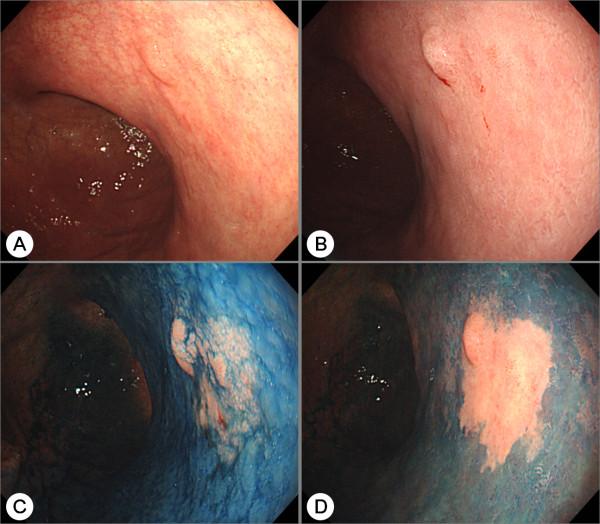
Endoscopic treatments, such as endoscopic submucosal dissection (ESD) and laparoscopic gastrectomy, are increasingly used to treat a subset of patients with early gastric cancer (EGC). To achieve successful outcomes, it is very important to accurately determine the lateral extent of the tumor. Therefore, we investigated the diagnostic performance of chromoendoscopy using indigo carmine dye added to acetic acid (AI chromoendoscopy) in delineating differentiated or undifferentiated adenocarcinomas in patients with EGC.
METHODS
We prospectively included 151 lesions of 141 patients that had an endoscopic diagnosis of EGC. All the lesions were examined by conventional endoscopy and AI chromoendoscopy before ESD or laparoscopic gastrectomy. The border clarification between the lesion and the normal mucosa was classified as distinct or indistinct before and after AI chromoendoscopy.
RESULTS
The borders of the lesions were distinct in 66.9% (101/151) with conventional endoscopy and in 84.1% (127/151) with AI chromoendoscopy (P < 0.001). Compared with conventional endoscopy, AI chromoendoscopy clarified the border in a significantly higher percentage of differentiated adenocarcinomas (74/108 [68.5%] vs 97/108 [89.8%], respectively, P < 0.001). However, the border clarification rate for undifferentiated adenocarcinomas did not differ between conventional endoscopy and AI chromoendoscopy (27/43 [62.8%] vs 30/43 [70.0%], respectively, P = 0.494).
CONCLUSIONS
AI chromoendoscopy is useful in determining the lateral extent of EGCs. However, its usefulness is reduced in undifferentiated adenocarcinomas.
背景
内镜治疗,如内镜黏膜下剥离术(ESD)和腹腔镜胃切除术,越来越多地用于治疗早期胃癌(EGC)的一部分患者。为了取得成功的结果,准确确定肿瘤的侧向范围非常重要。因此,我们研究了在 EGC 患者中使用靛胭脂加醋酸(AI 染色内镜)进行染色内镜对分化或未分化腺癌的诊断性能。
方法
我们前瞻性纳入了 141 例患者的 151 个 EGC 内镜诊断病变。所有病变在 ESD 或腹腔镜胃切除术前均行常规内镜和 AI 染色内镜检查。AI 染色内镜前后,病变与正常黏膜交界的清晰度分为清晰和不清晰。
结果
常规内镜下病变边界清晰者占 66.9%(101/151),AI 染色内镜下为 84.1%(127/151)(P<0.001)。与常规内镜相比,AI 染色内镜在分化腺癌中更能明确边界,其清晰度分别为 74/108(68.5%)和 97/108(89.8%)(P<0.001)。然而,常规内镜和 AI 染色内镜在未分化腺癌中边界清晰度无差异,分别为 27/43(62.8%)和 30/43(70.0%)(P=0.494)。
结论
AI 染色内镜有助于确定 EGC 的侧向范围。然而,在未分化腺癌中其作用降低。


 Zotero 插件