Department of Medicine I, Martin-Luther-University Halle-Wittenberg, Germany.
BMC Cancer. 2010 Aug 24;10:457. doi: 10.1186/1471-2407-10-457.
Thymostimulin is a thymic peptide fraction with immune-mediated cytotoxicity against hepatocellular carcinoma (HCC) in vitro and palliative efficacy in advanced HCC in two independent phase II trials. The aim of this study was to assess the efficacy of thymostimulin in a phase III trial.
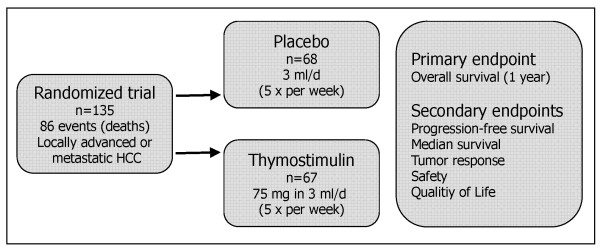
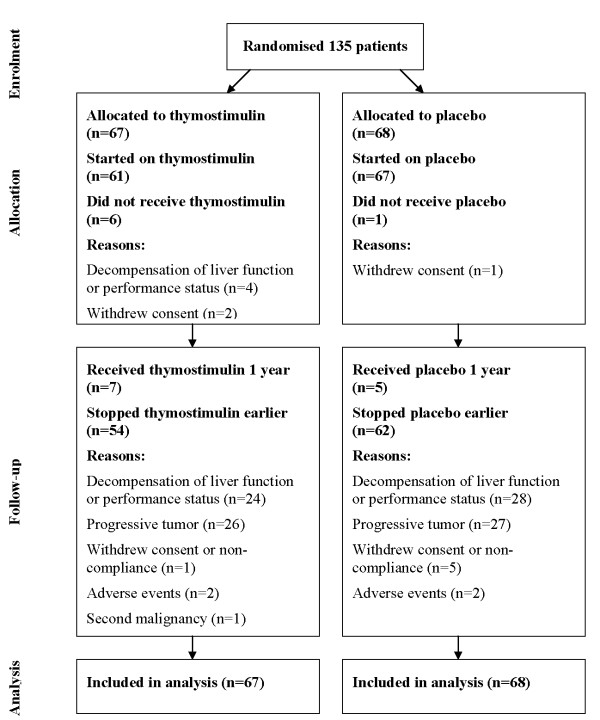
The study was designed as a prospective randomised, placebo-controlled, double-blind, multicenter clinical phase III trial. Between 10/2002 and 03/2005, 135 patients with locally advanced or metastasised HCC (Karnofsky >or=60%/Child-Pugh <or= 12) were randomised to receive thymostimulin 75 mg s.c. 5x/week or placebo stratified according to liver function. Primary endpoint was twelve-month survival, secondary endpoints overall survival (OS), time to progression (TTP), tumor response, safety and quality of life. A subgroup analysis according to liver function, KPS and tumor stage (Okuda, CLIP and BCLC) formed part of the protocol.
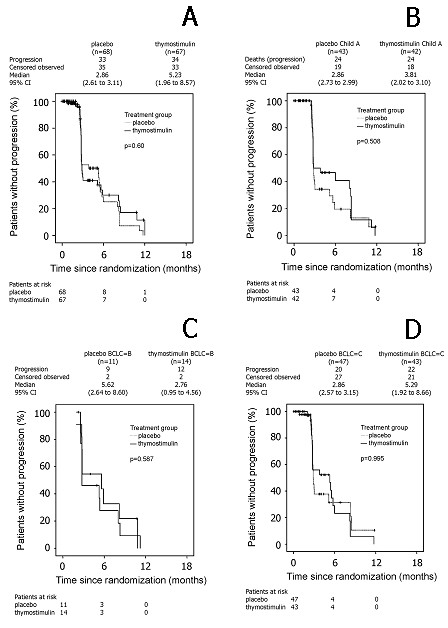
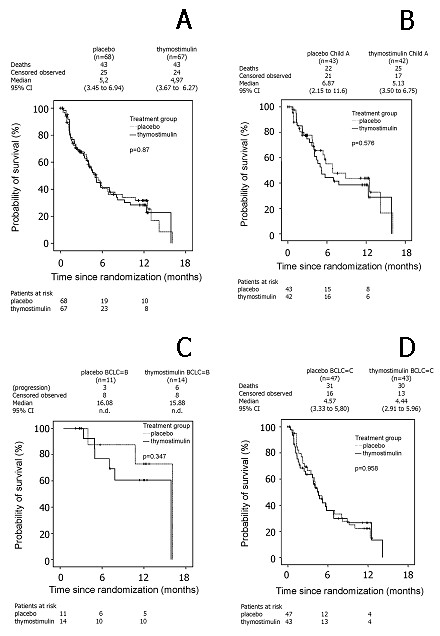
Twelve-month survival was 28% [95%CI 17-41; treatment] and 32% [95%CI 19-44; control] with no significant differences in median OS (5.0 [95% CI 3.7-6.3] vs. 5.2 [95% CI 3.5-6.9] months; p = 0.87, HR = 1.04 [95% CI 0.7-1.6]) or TTP (5.3 [95%CI 2.0-8.6] vs. 2.9 [95%CI 2.6-3.1] months; p = 0.60, HR = 1.13 [95% CI 0.7-1.8]). Adjustment for liver function, Karnofsky status or tumor stage did not affect results. While quality of life was similar in both groups, fewer patients on thymostimulin suffered from accumulating ascites and renal failure.
In our phase III trial, we found no evidence of any benefit to thymostimulin in the treatment of advanced HCC and there is therefore no justification for its use as single-agent treatment. The effect of thymostimulin on hepato-renal function requires further confirmation.
Current Controlled Trials ISRCTN64487365.
胸腺肽是一种胸腺肽片段,具有体外杀伤肝癌细胞的免疫介导细胞毒性作用,在两项独立的 II 期临床试验中对晚期肝癌具有姑息疗效。本研究旨在评估胸腺肽在 III 期临床试验中的疗效。
该研究设计为前瞻性随机、安慰剂对照、双盲、多中心临床 III 期试验。2002 年 10 月至 2005 年 3 月期间,共纳入 135 例局部晚期或转移性肝癌(Karnofsky 评分≥60%/Child-Pugh 评分≤12)患者,按肝功能分层随机分为胸腺肽 75mg 皮下注射 5 次/周组或安慰剂组。主要终点为 12 个月生存率,次要终点包括总生存期(OS)、无进展生存期(TTP)、肿瘤反应、安全性和生活质量。根据肝功能、KPS 和肿瘤分期(Okuda、CLIP 和 BCLC)进行亚组分析是该方案的一部分。
12 个月生存率分别为 28%(95%CI 17-41;治疗组)和 32%(95%CI 19-44;对照组),中位 OS 无显著差异(5.0 [95%CI 3.7-6.3] vs. 5.2 [95%CI 3.5-6.9] 个月;p=0.87,HR=1.04 [95%CI 0.7-1.6])或 TTP(5.3 [95%CI 2.0-8.6] vs. 2.9 [95%CI 2.6-3.1] 个月;p=0.60,HR=1.13 [95%CI 0.7-1.8])。调整肝功能、Karnofsky 状态或肿瘤分期均未影响结果。虽然两组生活质量相似,但胸腺肽组发生累积腹水和肾功能衰竭的患者较少。
在我们的 III 期临床试验中,我们没有发现胸腺肽在治疗晚期肝癌方面有任何益处的证据,因此没有理由将其作为单一药物治疗。胸腺肽对肝肾功能的影响需要进一步证实。
当前对照试验 ISRCTN64487365。