Paediatric Centre Albina Patiño, Department of Gastroenterology and Nutrition, Cochabamba, Bolivia.
BMC Infect Dis. 2010 Aug 25;10:253. doi: 10.1186/1471-2334-10-253.
Evidence suggests that probiotics reduce rotavirus diarrhoea duration. Although there are several probiotic strains potentially useful, daily practice is often limited by the type and number of products locally available. In general, information about combined products is scarce. In this study we compare the effect of two probiotic products in the treatment of diarrhoea in children less than 2 years of age.
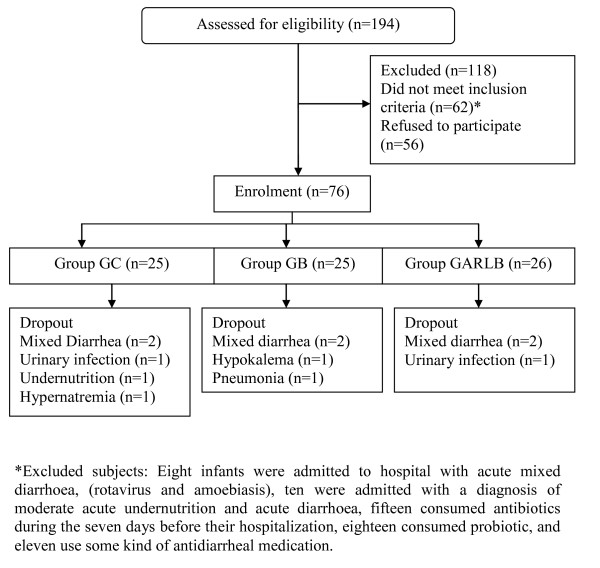
A Randomized double-blind controlled clinical trial in children hospitalized for acute rotavirus diarrhoea, in the Paediatric Centre Albina Patino, Cochabamba, Bolivia.Participants were children aged 1 - 23 months, who were randomly assigned to receive one of three treatments: Oral rehydration therapy plus placebo; Oral rehydration solution plus Saccharomyces boulardii; or Oral rehydration solution plus a compound containing Lactobacillus acidophilus, Lactobacillus rhamnosus, Bifidobacterium longum and Saccharomyces boulardii. Sample size was 20 per group and the outcomes were duration of diarrhoea, of fever, of vomiting and of hospitalization.
64 cases finished the protocol. On admission, patients' characteristics were similar. Median duration of diarrhoea (p = 0.04) in children who received the single species product (58 hours) was shorter than in controls (84.5 hrs). Comparing children that received the single probiotic product and controls showed shorter duration of fever (18 vs 67 hrs) (p = 0.0042) and the mixed probiotic of vomiting (0 vs 42.5 hrs) (p = 0.041). There was no effect on duration of hospitalization (p = 0.31). When experimental groups were merged, statistical significance of changes increased (total duration of diarrhoea, fever and vomiting P = 0.025, P = 0.025 and P = 0.014, respectively).
Both products decreased the duration of diarrhoea compared to oral rehydration solution alone. This decrease was significant only for the single species product which also decreased the duration of fever. With the multiple species product there was no vomiting subsequent to the initiation of treatment. The quantity of probiotic bacteria needed for optimum treatment of gastroenteritis remains to be determined, particularly when multiple species are included in the product.Trial registration: ClinicalTrials.gov ID: NCT00981877Link: https://register.clinicaltrials.gov/prs/app/action/SelectProtocol/sid/S0002653/selectaction/View/ts/2/uid/U0000N04
Clinical trials NCT ID: NCT00981877.
有证据表明益生菌可缩短轮状病毒腹泻的病程。虽然有几种潜在有效的益生菌株,但日常实践往往受到当地可用产品的类型和数量的限制。一般来说,关于联合产品的信息很少。在这项研究中,我们比较了两种益生菌产品在治疗 2 岁以下儿童腹泻中的效果。
在玻利维亚科恰班巴 Albina Patino 儿科中心,对因急性轮状病毒腹泻住院的儿童进行了一项随机双盲对照临床试验。参与者为 1-23 个月大的儿童,他们被随机分配接受三种治疗之一:口服补液治疗加安慰剂;口服补液溶液加酿酒酵母;或口服补液溶液加含有嗜酸乳杆菌、鼠李糖乳杆菌、长双歧杆菌和酿酒酵母的复方。每组样本量为 20 例,结局为腹泻、发热、呕吐和住院时间。
64 例完成了方案。入院时,患者的特征相似。接受单一物种产品(58 小时)的儿童腹泻持续时间中位数(p = 0.04)短于对照组(84.5 小时)。与对照组相比,接受单一益生菌产品的儿童发热持续时间(18 小时与 67 小时)(p = 0.0042)和混合益生菌呕吐持续时间(0 小时与 42.5 小时)(p = 0.041)更短。住院时间无差异(p = 0.31)。当实验组合并时,变化的统计学意义增加(总腹泻持续时间、发热和呕吐的 P 值分别为 0.025、0.025 和 0.014)。
与单独口服补液溶液相比,两种产品均缩短了腹泻持续时间。只有单一物种产品的缩短有统计学意义,该产品还缩短了发热持续时间。使用多种物种产品后,治疗开始后无呕吐。仍需确定最佳治疗胃肠炎所需的益生菌数量,特别是当产品中包含多种物种时。
ClinicalTrials.gov 编号:NCT00981877。
临床试验 NCT 编号:NCT00981877。