Division of Preventive Medicine, Department of Medicine, Brigham and Women's Hospital, Harvard Medical School, Boston, MA, USA.
BMJ. 2010 Aug 24;341:c3659. doi: 10.1136/bmj.c3659.
To examine the association between migraine and migraine aura status with risk of haemorrhagic stroke.
Prospective cohort study.
Women's Health Study, United States.
27,860 women aged >or=45 who were free from stroke or other major disease at baseline and had provided information on self reported migraine, aura status, and lipid values.
Time to first haemorrhagic stroke and subtypes of haemorrhagic stroke.
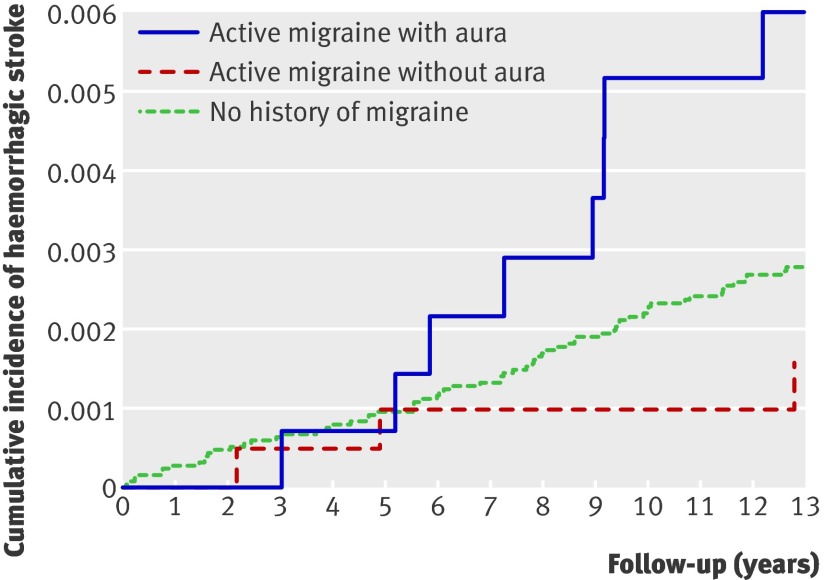
At baseline, 5130 (18%) women reported any history of migraine; of the 3612 with active migraine (migraine in the previous year), 1435 (40%) described having aura. During a mean of 13.6 years of follow-up, 85 haemorrhagic strokes were confirmed after review of medical records. Compared with women without a history of migraine, there was no increased risk of haemorrhagic stroke in those who reported any history of migraine (adjusted hazard ratio 0.98, 95% confidence interval 0.56 to 1.71, P=0.93). In contrast, risk was increased in women with active migraine with aura (2.25, 1.11 to 4.54, P=0.024). The age adjusted increased risk was stronger for intracerebral haemorrhage (2.78, 1.09 to 7.07, P=0.032) and for fatal events (3.56, 1.23 to 10.31, P=0.02). Four additional haemorrhagic stroke events were attributable to migraine with aura per 10 000 women per year. Women who reported active migraine without aura had no increased risk for haemorrhagic stroke.
Migraine with aura might, in addition to ischaemic events, also be a risk factor for haemorrhagic stroke. The relatively low number of events and attributable risk should caution against definitive conclusions and call for further confirmation of these observations.
探讨偏头痛和偏头痛先兆状态与出血性卒中风险的关系。
前瞻性队列研究。
美国妇女健康研究。
27860 名年龄大于或等于 45 岁的女性,在基线时无卒中或其他重大疾病,且提供了关于自我报告偏头痛、先兆状态和血脂值的信息。
首次出血性卒中的时间和出血性卒中的亚型。
在基线时,5130 名(18%)女性报告有偏头痛史;在 3612 名有活动性偏头痛(过去 1 年中有偏头痛)的女性中,1435 名(40%)描述有先兆。在平均 13.6 年的随访期间,经病历回顾后确认了 85 例出血性卒中。与无偏头痛史的女性相比,有偏头痛史的女性出血性卒中风险没有增加(调整后的危险比为 0.98,95%置信区间为 0.56 至 1.71,P=0.93)。相比之下,有活动性偏头痛且有先兆的女性风险增加(2.25,1.11 至 4.54,P=0.024)。对于颅内出血(2.78,1.09 至 7.07,P=0.032)和致命事件(3.56,1.23 至 10.31,P=0.02),年龄调整后的风险增加更为显著。每年每 10000 名女性中,偏头痛合并先兆可额外归因于 4 例出血性卒中事件。无先兆的活动性偏头痛女性出血性卒中风险无增加。
偏头痛伴先兆除了与缺血性事件有关外,也可能是出血性卒中的一个危险因素。事件数量相对较少且归因风险较低,应谨慎得出结论,并呼吁进一步证实这些观察结果。