Adelborg Kasper, Szépligeti Szimonetta Komjáthiné, Holland-Bill Louise, Ehrenstein Vera, Horváth-Puhó Erzsébet, Henderson Victor W, Sørensen Henrik Toft
Department of Clinical Epidemiology, Aarhus University Hospital, Denmark
Department of Clinical Epidemiology, Aarhus University Hospital, Denmark.
BMJ. 2018 Jan 31;360:k96. doi: 10.1136/bmj.k96.
To examine the risks of myocardial infarction, stroke (ischaemic and haemorrhagic), peripheral artery disease, venous thromboembolism, atrial fibrillation or atrial flutter, and heart failure in patients with migraine and in a general population comparison cohort.
Nationwide, population based cohort study.
All Danish hospitals and hospital outpatient clinics from 1995 to 2013.
51 032 patients with migraine and 510 320 people from the general population matched on age, sex, and calendar year.
Comorbidity adjusted hazard ratios of cardiovascular outcomes based on Cox regression analysis.
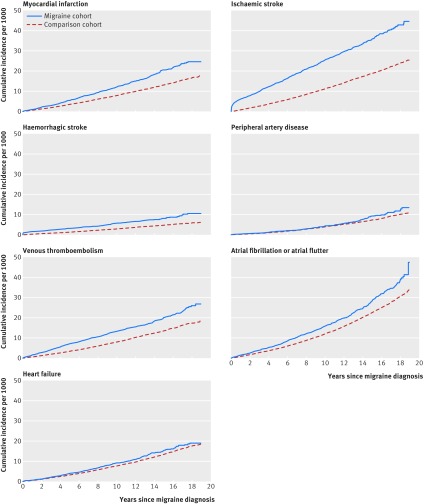
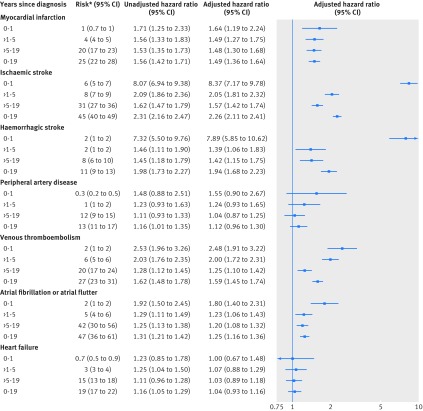
Higher absolute risks were observed among patients with incident migraine than in the general population across most outcomes and follow-up periods. After 19 years of follow-up, the cumulative incidences per 1000 people for the migraine cohort compared with the general population were 25 17 for myocardial infarction, 45 25 for ischaemic stroke, 11 6 for haemorrhagic stroke, 13 11 for peripheral artery disease, 27 18 for venous thromboembolism, 47 34 for atrial fibrillation or atrial flutter, and 19 18 for heart failure. Correspondingly, migraine was positively associated with myocardial infarction (adjusted hazard ratio 1.49, 95% confidence interval 1.36 to 1.64), ischaemic stroke (2.26, 2.11 to 2.41), and haemorrhagic stroke (1.94, 1.68 to 2.23), as well as venous thromboembolism (1.59, 1.45 to 1.74) and atrial fibrillation or atrial flutter (1.25, 1.16 to 1.36). No meaningful association was found with peripheral artery disease (adjusted hazard ratio 1.12, 0.96 to 1.30) or heart failure (1.04, 0.93 to 1.16). The associations, particularly for stroke outcomes, were stronger during the short term (0-1 years) after diagnosis than the long term (up to 19 years), in patients with aura than in those without aura, and in women than in men. In a subcohort of patients, the associations persisted after additional multivariable adjustment for body mass index and smoking.
Migraine was associated with increased risks of myocardial infarction, ischaemic stroke, haemorrhagic stroke, venous thromboembolism, and atrial fibrillation or atrial flutter. Migraine may be an important risk factor for most cardiovascular diseases.
研究偏头痛患者与普通人群对照队列中心肌梗死、中风(缺血性和出血性)、外周动脉疾病、静脉血栓栓塞、心房颤动或心房扑动以及心力衰竭的风险。
全国性的基于人群的队列研究。
1995年至2013年丹麦所有医院及医院门诊。
51032例偏头痛患者以及510320名来自普通人群、年龄、性别和年份相匹配的个体。
基于Cox回归分析的心血管疾病合并症调整风险比。
在大多数结局和随访期内,新发偏头痛患者的绝对风险高于普通人群。随访19年后,偏头痛队列与普通人群相比,每1000人中的累积发病率分别为:心肌梗死25对17、缺血性中风45对25、出血性中风11对6、外周动脉疾病13对11、静脉血栓栓塞27对18、心房颤动或心房扑动47对34、心力衰竭19对18。相应地,偏头痛与心肌梗死(调整后风险比1.49,95%置信区间1.36至1.64)、缺血性中风(2.26,2.11至2.41)、出血性中风(1.94,1.68至2.23)、静脉血栓栓塞(1.59,1.45至1.74)以及心房颤动或心房扑动(1.25,1.16至1.36)呈正相关。未发现与外周动脉疾病(调整后风险比1.12,0.96至1.30)或心力衰竭(1.04,0.93至1.16)有显著关联。这些关联,尤其是中风结局,在诊断后的短期(0至1年)比长期(长达19年)更强,有先兆的患者比无先兆的患者更强,女性比男性更强。在一个患者亚组中,在对体重指数和吸烟进行额外多变量调整后,这些关联仍然存在。
偏头痛与心肌梗死、缺血性中风、出血性中风、静脉血栓栓塞以及心房颤动或心房扑动的风险增加相关。偏头痛可能是大多数心血管疾病的重要危险因素。