National Institute for Environmental Health Science, Durham, North Carolina, USA.
Arthritis Care Res (Hoboken). 2011 Feb;63(2):184-94. doi: 10.1002/acr.20335.
Farming and agricultural pesticide use has been associated with 2 autoimmune rheumatic diseases, rheumatoid arthritis (RA) and systemic lupus erythematosus (SLE). However, risk associated with other residential or work place insecticide use is unknown.
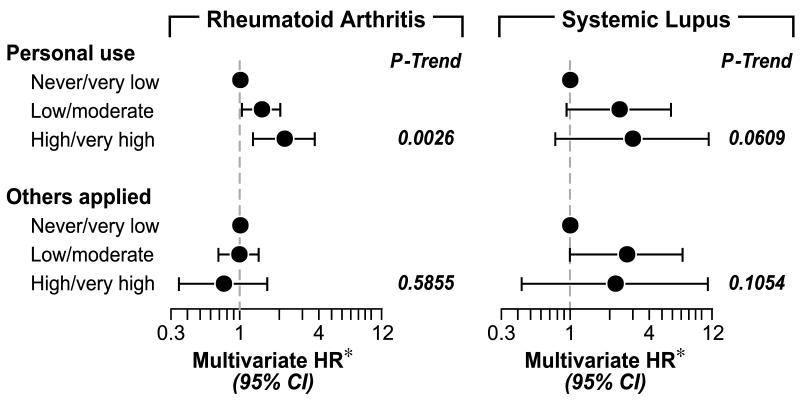
We analyzed data from the Women's Health Initiative Observational Study (n=76,861 postmenopausal women, ages 50-79 years). Incident cases (n=213: 178 for RA, 27 for SLE, and 8 for both) were identified based on self-report and use of disease-modifying antirheumatic drugs at year 3 of followup. We examined self-reported residential or work place insecticide use (personally mixing/applying by self and application by others) in relation to RA/SLE risk, overall and in relation to farm history. Hazard ratios (HRs) and 95% confidence intervals (95% CIs) were adjusted for age, race, region, education, occupation, smoking, reproductive factors, asthma, other autoimmune diseases, and comorbidities.
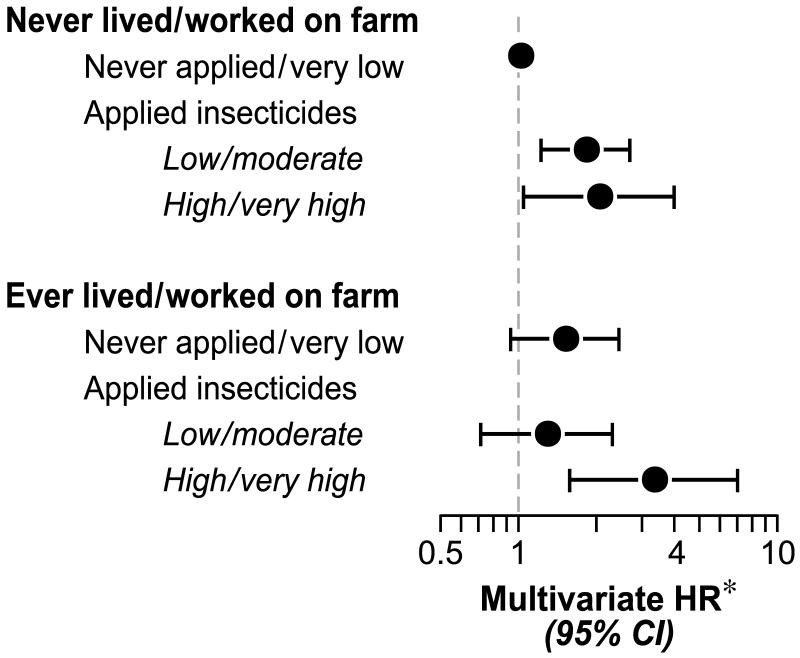
Compared with never used, personal use of insecticides was associated with increased RA/SLE risk, with significant trends for greater frequency (HR 2.04, 95% CI 1.17-3.56 for ≥6 times/year) and duration (HR 1.97, 95% CI 1.20-3.23 for ≥20 years). Risk was also associated with long-term insecticide application by others (HR 1.85, 95% CI 1.07-3.20 for ≥20 years) and frequent application by others among women with a farm history (HR 2.73, 95% CI 1.10-6.78 for ≥6 times/year).
These results suggest residential and work place insecticide exposure is associated with the risk of autoimmune rheumatic diseases in postmenopausal women. Although these findings require replication in other populations, they support a role for environmental pesticide exposure in the development of autoimmune rheumatic diseases.
农业和农业农药的使用与 2 种自身免疫性风湿性疾病——类风湿关节炎(RA)和系统性红斑狼疮(SLE)有关。然而,其他住宅或工作场所杀虫剂使用相关的风险尚不清楚。
我们分析了妇女健康倡议观察研究(n=76861 名绝经后妇女,年龄 50-79 岁)的数据。根据自我报告和 3 年随访时使用疾病修饰抗风湿药物,确定了 213 例新发病例(178 例 RA,27 例 SLE,8 例 RA 和 SLE)。我们研究了住宅或工作场所杀虫剂的自我报告使用情况(亲自混合/应用和他人应用)与 RA/SLE 风险的关系,包括总体情况以及与农场历史的关系。风险比(HRs)和 95%置信区间(95%CI)通过年龄、种族、地区、教育程度、职业、吸烟、生育因素、哮喘、其他自身免疫性疾病和合并症进行调整。
与从未使用过的人相比,个人使用杀虫剂与 RA/SLE 风险增加有关,使用频率更高(HR 2.04,95%CI 1.17-3.56,每年≥6 次)和使用时间更长(HR 1.97,95%CI 1.20-3.23,≥20 年)的趋势更明显。其他人长期应用杀虫剂(HR 1.85,95%CI 1.07-3.20,≥20 年)和有农场史的妇女中他人频繁应用杀虫剂(HR 2.73,95%CI 1.10-6.78,每年≥6 次)也与风险相关。
这些结果表明,住宅和工作场所杀虫剂暴露与绝经后妇女自身免疫性风湿性疾病的风险相关。尽管这些发现需要在其他人群中复制,但它们支持环境农药暴露在自身免疫性风湿性疾病发展中的作用。