• 文献检索
  • 文档翻译
  • 深度研究
  • 学术资讯
  • Suppr Zotero 插件Zotero 插件
  • 邀请有礼
  • 套餐&价格
  • 历史记录
应用&插件
Suppr Zotero 插件Zotero 插件浏览器插件Mac 客户端Windows 客户端微信小程序
定价
高级版会员购买积分包购买API积分包
服务
文献检索文档翻译深度研究API 文档MCP 服务
关于我们
关于 Suppr公司介绍联系我们用户协议隐私条款
关注我们

Suppr 超能文献

核心技术专利:CN118964589B侵权必究
粤ICP备2023148730 号-1Suppr @ 2026

文献检索

告别复杂PubMed语法,用中文像聊天一样搜索,搜遍4000万医学文献。AI智能推荐,让科研检索更轻松。

立即免费搜索

文件翻译

保留排版,准确专业,支持PDF/Word/PPT等文件格式,支持 12+语言互译。

免费翻译文档

深度研究

AI帮你快速写综述,25分钟生成高质量综述,智能提取关键信息,辅助科研写作。

立即免费体验

恶性皮肤癌中 c-Src 和 c-Yes 的表达升高。

Elevated c-Src and c-Yes expression in malignant skin cancers.

机构信息

Molecular Cancer Research Center, College of Medicine, Soonchunhyang University, Chunan, Korea.

出版信息

J Exp Clin Cancer Res. 2010 Aug 27;29(1):116. doi: 10.1186/1756-9966-29-116.

DOI:10.1186/1756-9966-29-116
PMID:20796316
原文链接:https://pmc.ncbi.nlm.nih.gov/articles/PMC2936336/
Abstract

BACKGROUND

Src family kinases (SFKs) play an important role in cancer proliferation, survival, motility, invasiveness, metastasis, and angiogenesis. Among the SFKs, c-Src and c-Yes are particularly over-expressed or hyper-activated in many human epithelial cancers. However, only a few studies have attempted to define the expression and role of c-Src and c-Yes in cutaneous carcinomas.

OBJECTIVES

To investigate the expression of c-Src and c-Yes in cutaneous carcinomas to include malignant melanoma (MM), squamous cell carcinoma (SCC) and basal cell carcinoma (BCC).

METHODS

We examined 6 normal skin tissues and 18 malignant skin tumor tissues using western blotting for the expression of c-Src and c-Yes. In another set, 16 specimens of MM, 16 SCCs and 16 BCCs were analyzed for the expression of c-Src and c-Yes using immunohistochemical staining.

RESULTS

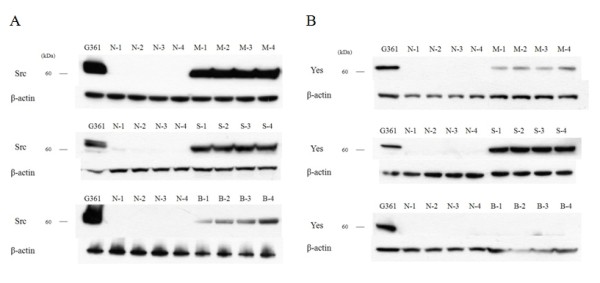
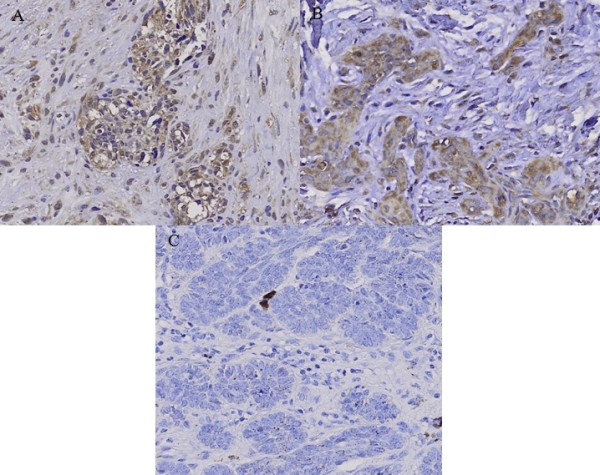
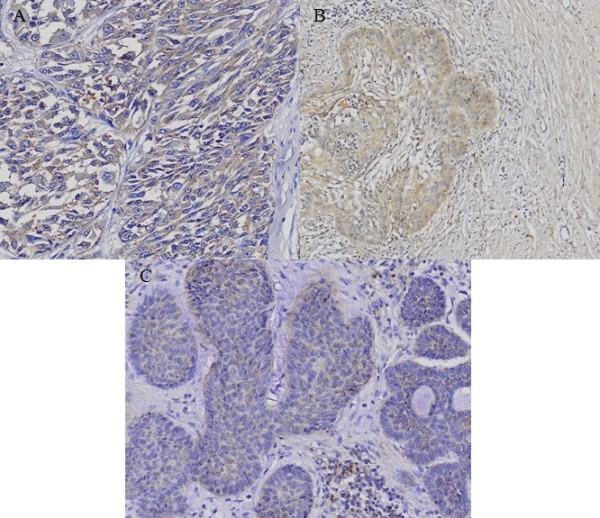
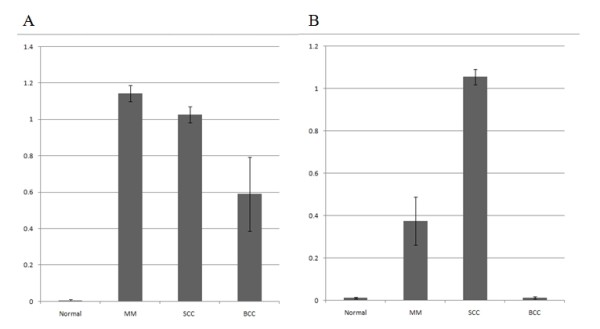
Western blotting showed that c-Src was expressed in all malignant skin tumors, but not in normal skin, while c-Yes was expressed in MM and SCC, but not in BCC and normal skin. Immunohistochemical staining results of c-Src and c-Yes in MM, SCC, and BCC mirrored those of the western blot analysis.

CONCLUSIONS

c-Src, rather than c-Yes, plays a key role in the proliferation and progression of malignant skin cancers.

摘要

背景

Src 家族激酶(SFKs)在癌症的增殖、存活、迁移、侵袭、转移和血管生成中发挥着重要作用。在 SFKs 中,c-Src 和 c-Yes 在许多人类上皮癌中表达过度或过度激活。然而,只有少数研究试图定义 c-Src 和 c-Yes 在皮肤癌中的表达和作用。

目的

研究 c-Src 和 c-Yes 在皮肤癌中的表达,包括恶性黑色素瘤(MM)、鳞状细胞癌(SCC)和基底细胞癌(BCC)。

方法

我们使用 Western blot 检测了 6 例正常皮肤组织和 18 例恶性皮肤肿瘤组织中 c-Src 和 c-Yes 的表达。在另一组中,我们使用免疫组织化学染色分析了 16 例 MM、16 例 SCC 和 16 例 BCC 中 c-Src 和 c-Yes 的表达。

结果

Western blot 显示 c-Src 在所有恶性皮肤肿瘤中均有表达,但在正常皮肤中没有表达,而 c-Yes 仅在 MM 和 SCC 中表达,而在 BCC 和正常皮肤中没有表达。MM、SCC 和 BCC 中 c-Src 和 c-Yes 的免疫组织化学染色结果与 Western blot 分析结果一致。

结论

c-Src 而非 c-Yes 在恶性皮肤癌的增殖和进展中发挥关键作用。
https://cdn.ncbi.nlm.nih.gov/pmc/blobs/3ab1/2936336/f34421b03272/1756-9966-29-116-5.jpg
https://cdn.ncbi.nlm.nih.gov/pmc/blobs/3ab1/2936336/2716c31b06d8/1756-9966-29-116-1.jpg
https://cdn.ncbi.nlm.nih.gov/pmc/blobs/3ab1/2936336/276a2b7cfe57/1756-9966-29-116-2.jpg
https://cdn.ncbi.nlm.nih.gov/pmc/blobs/3ab1/2936336/90971834f467/1756-9966-29-116-3.jpg
https://cdn.ncbi.nlm.nih.gov/pmc/blobs/3ab1/2936336/0923fb1d60b2/1756-9966-29-116-4.jpg
https://cdn.ncbi.nlm.nih.gov/pmc/blobs/3ab1/2936336/f34421b03272/1756-9966-29-116-5.jpg
https://cdn.ncbi.nlm.nih.gov/pmc/blobs/3ab1/2936336/2716c31b06d8/1756-9966-29-116-1.jpg
https://cdn.ncbi.nlm.nih.gov/pmc/blobs/3ab1/2936336/276a2b7cfe57/1756-9966-29-116-2.jpg
https://cdn.ncbi.nlm.nih.gov/pmc/blobs/3ab1/2936336/90971834f467/1756-9966-29-116-3.jpg
https://cdn.ncbi.nlm.nih.gov/pmc/blobs/3ab1/2936336/0923fb1d60b2/1756-9966-29-116-4.jpg
https://cdn.ncbi.nlm.nih.gov/pmc/blobs/3ab1/2936336/f34421b03272/1756-9966-29-116-5.jpg

相似文献

1
Elevated c-Src and c-Yes expression in malignant skin cancers.恶性皮肤癌中 c-Src 和 c-Yes 的表达升高。
J Exp Clin Cancer Res. 2010 Aug 27;29(1):116. doi: 10.1186/1756-9966-29-116.
2
Elevated expression of protein tyrosine kinase c-Yes, but not c-Src, in human malignant melanoma.蛋白酪氨酸激酶c-Yes而非c-Src在人类恶性黑色素瘤中表达升高。
Oncogene. 1993 Oct;8(10):2637-44.
3
Greater expression of TC21/R-ras2 in highly aggressive malignant skin cancer.TC21/R-ras2 在高度侵袭性恶性皮肤癌中表达更高。
Int J Dermatol. 2011 Aug;50(8):956-60. doi: 10.1111/j.1365-4632.2010.04846.x.
4
Different expression patterns of calpain isozymes 1 and 2 (CAPN1 and 2) in squamous cell carcinomas (SCC) and basal cell carcinomas (BCC) of human skin.钙蛋白酶同工酶1和2(CAPN1和2)在人皮肤鳞状细胞癌(SCC)和基底细胞癌(BCC)中的不同表达模式。
J Pathol. 2003 Apr;199(4):509-16. doi: 10.1002/path.1308.
5
Nicotinamide N-methyltransferase in nonmelanoma skin cancers.非黑色素瘤皮肤癌中的烟酰胺 N-甲基转移酶。
Eur J Clin Invest. 2019 Dec;49(12):e13175. doi: 10.1111/eci.13175. Epub 2019 Oct 26.
6
Stimulation of the protein tyrosine kinase c-Yes but not c-Src by neurotrophins in human brain-metastatic melanoma cells.神经营养因子对人脑转移性黑色素瘤细胞中蛋白酪氨酸激酶c-Yes而非c-Src的刺激作用。
Oncogene. 1998 Jun 25;16(25):3253-60. doi: 10.1038/sj.onc.1201877.
7
Differential activation of pp60(c-src) and pp62(c-yes) in human colorectal carcinoma liver metastases.人结直肠癌肝转移中pp60(c-src)和pp62(c-yes)的差异激活
Clin Cancer Res. 1996 Aug;2(8):1397-404.
8
Analysis of cancer-associated fibroblasts and the epithelial-mesenchymal transition in cutaneous basal cell carcinoma, squamous cell carcinoma, and malignant melanoma.分析皮肤基底细胞癌、鳞状细胞癌和恶性黑色素瘤中的癌相关成纤维细胞和上皮-间充质转化。
Hum Pathol. 2018 Sep;79:1-8. doi: 10.1016/j.humpath.2018.03.006. Epub 2018 Mar 16.
9
Src activity increases and Yes activity decreases during mitosis of human colon carcinoma cells.在人结肠癌细胞有丝分裂过程中,Src活性增加而Yes活性降低。
Mol Cell Biol. 1995 May;15(5):2374-82. doi: 10.1128/MCB.15.5.2374.
10
Distribution of c-yes-1 gene product in various cells and tissues.c-yes-1基因产物在各种细胞和组织中的分布。
Br J Cancer. 1991 Apr;63(4):508-13. doi: 10.1038/bjc.1991.121.

引用本文的文献

1
Molecular Pharmacology of Dasatinib Provides Unique Insights into the Mechanistic Basis of Success and Failure of Targeted Cancer Therapy.达沙替尼的分子药理学为深入了解靶向癌症治疗成败的机制基础提供了独特视角。
ACS Pharmacol Transl Sci. 2024 Dec 6;8(1):1-9. doi: 10.1021/acsptsci.4c00492. eCollection 2025 Jan 10.
2
Anti-tumor effects of tirbanibulin in squamous cell carcinoma cells are mediated via disruption of tubulin-polymerization.替比嘧啶在鳞状细胞癌细胞中的抗肿瘤作用是通过破坏微管聚合来介导的。
Arch Dermatol Res. 2024 Jun 7;316(7):341. doi: 10.1007/s00403-024-03032-x.
3
Emerging Roles of YES1 in Cancer: The Putative Target in Drug Resistance.

本文引用的文献

1
Mislocalization of cell-cell adhesion complexes in tamoxifen-resistant breast cancer cells with elevated c-Src tyrosine kinase activity.在具有升高的c-Src酪氨酸激酶活性的他莫昔芬耐药乳腺癌细胞中,细胞间粘附复合物的定位错误。
Cancer Lett. 2009 Mar 18;275(2):204-12. doi: 10.1016/j.canlet.2008.10.022. Epub 2008 Nov 20.
2
Preclinical evaluation of dasatinib, a potent Src kinase inhibitor, in melanoma cell lines.强效Src激酶抑制剂达沙替尼在黑色素瘤细胞系中的临床前评估。
J Transl Med. 2008 Sep 29;6:53. doi: 10.1186/1479-5876-6-53.
3
Combined inhibition of PLC{gamma}-1 and c-Src abrogates epidermal growth factor receptor-mediated head and neck squamous cell carcinoma invasion.
YES1 在癌症中的新兴作用:耐药性的潜在靶点。
Int J Mol Sci. 2024 Jan 25;25(3):1450. doi: 10.3390/ijms25031450.
4
A renaissance for YES in cancer.癌症 YES 基因研究再现生机。
Oncogene. 2023 Nov;42(46):3385-3393. doi: 10.1038/s41388-023-02860-x. Epub 2023 Oct 17.
5
Real-world experience with histological confirmation of clinical response of squamous cell carcinoma to topical tirbanibulin.鳞状细胞癌对局部用替巴尼布林临床反应的组织学确认的真实世界经验。
JAAD Case Rep. 2023 Jul 14;40:141-144. doi: 10.1016/j.jdcr.2023.07.005. eCollection 2023 Oct.
6
Topical tirbanibulin resolves recalcitrant condyloma acuminata: Retrospective case series.外用替瑞布林治疗顽固性尖锐湿疣:回顾性病例系列研究
JAAD Case Rep. 2023 Apr 26;37:58-60. doi: 10.1016/j.jdcr.2023.04.011. eCollection 2023 Jul.
7
An immunomodulating peptide to counteract solar radiation-induced immunosuppression and DNA damage.一种免疫调节肽,可对抗太阳辐射诱导的免疫抑制和 DNA 损伤。
Sci Rep. 2023 Jul 20;13(1):11702. doi: 10.1038/s41598-023-38890-4.
8
Preventive Effect of Pharmaceutical Phytochemicals Targeting the Src Family of Protein Tyrosine Kinases and Aryl Hydrocarbon Receptor on Environmental Stress-Induced Skin Disease.靶向Src 家族蛋白酪氨酸激酶和芳香烃受体的药物植物化学物质对环境应激诱导的皮肤疾病的预防作用。
Int J Mol Sci. 2023 Mar 21;24(6):5953. doi: 10.3390/ijms24065953.
9
Tirbanibulin for Actinic Keratosis: Insights into the Mechanism of Action.替拉替尼治疗光化性角化病:作用机制洞察
Clin Cosmet Investig Dermatol. 2022 Nov 16;15:2495-2506. doi: 10.2147/CCID.S374122. eCollection 2022.
10
Rapid resolution of recalcitrant basal cell carcinoma of the ear with topical tirbanibulin.外用替巴尼布林可快速消退耳部难治性基底细胞癌
JAAD Case Rep. 2022 Aug 10;28:11-13. doi: 10.1016/j.jdcr.2022.07.035. eCollection 2022 Oct.
磷脂酶Cγ-1(PLCγ-1)和c-Src的联合抑制可消除表皮生长因子受体介导的头颈部鳞状细胞癌侵袭。
Clin Cancer Res. 2008 Jul 1;14(13):4336-44. doi: 10.1158/1078-0432.CCR-07-4857.
4
Combined inhibition of c-Src and epidermal growth factor receptor abrogates growth and invasion of head and neck squamous cell carcinoma.联合抑制c-Src和表皮生长因子受体可消除头颈部鳞状细胞癌的生长和侵袭。
Clin Cancer Res. 2008 Jul 1;14(13):4284-91. doi: 10.1158/1078-0432.CCR-07-5226.
5
Role of c-Src and focal adhesion kinase in progression and metastasis of estrogen receptor-positive breast cancer.c-Src和粘着斑激酶在雌激素受体阳性乳腺癌进展和转移中的作用
Biochem Biophys Res Commun. 2006 Mar 3;341(1):73-81. doi: 10.1016/j.bbrc.2005.12.164. Epub 2006 Jan 6.
6
Src kinases mediate STAT growth pathways in squamous cell carcinoma of the head and neck.Src激酶介导头颈部鳞状细胞癌中的STAT生长途径。
J Biol Chem. 2003 Aug 22;278(34):31574-83. doi: 10.1074/jbc.M303499200. Epub 2003 May 27.
7
Roles of activated Src and Stat3 signaling in melanoma tumor cell growth.活化的Src和Stat3信号传导在黑色素瘤肿瘤细胞生长中的作用。
Oncogene. 2002 Oct 10;21(46):7001-10. doi: 10.1038/sj.onc.1205859.
8
Elevated activity and expression of Src-family kinases in human breast carcinoma tissue versus matched non-tumor tissue.与配对的非肿瘤组织相比,人乳腺癌组织中Src家族激酶的活性和表达升高。
J Cancer Res Clin Oncol. 2001 Apr;127(4):226-30. doi: 10.1007/s004320000197.
9
Co-operative effect of c-Src tyrosine kinase and Stat3 in activation of hepatocyte growth factor expression in mammary carcinoma cells.c-Src酪氨酸激酶与Stat3在乳腺癌细胞中激活肝细胞生长因子表达的协同作用。
J Biol Chem. 2001 Apr 13;276(15):12395-403. doi: 10.1074/jbc.M010715200. Epub 2001 Jan 17.
10
Stimulation of the protein tyrosine kinase c-Yes but not c-Src by neurotrophins in human brain-metastatic melanoma cells.神经营养因子对人脑转移性黑色素瘤细胞中蛋白酪氨酸激酶c-Yes而非c-Src的刺激作用。
Oncogene. 1998 Jun 25;16(25):3253-60. doi: 10.1038/sj.onc.1201877.