Department of Veterinary Biosciences, University of Illinois, Urbana, Illinois 61802, USA.
Stem Cells. 2010 Oct;28(10):1882-92. doi: 10.1002/stem.508.
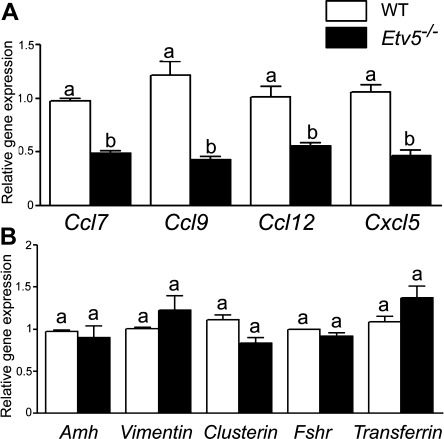
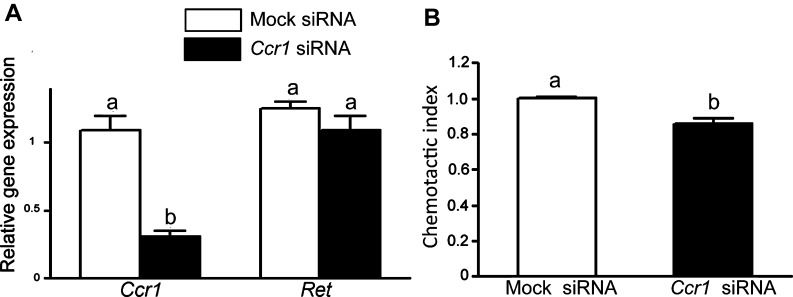
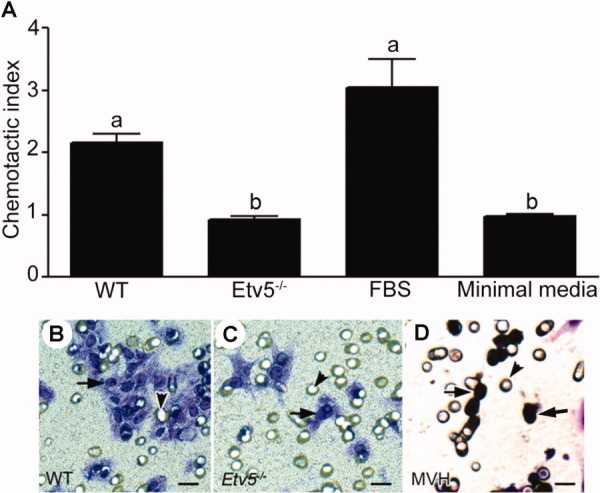
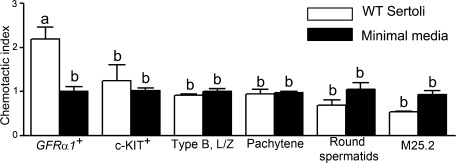
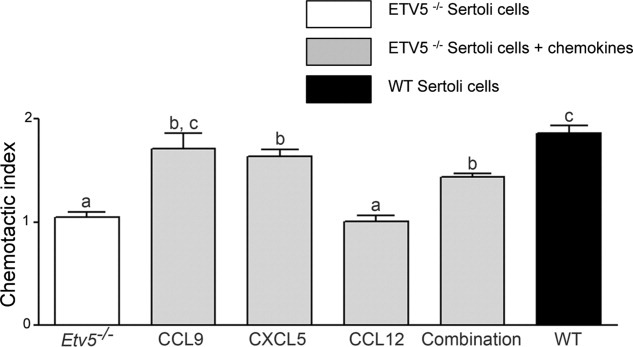
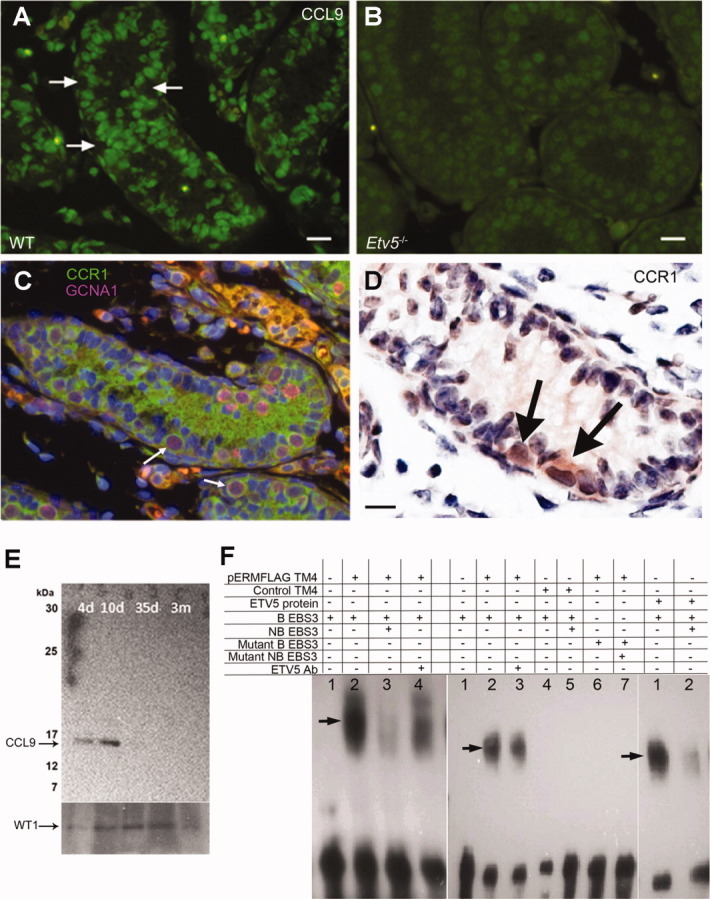
Spermatogonial stem cells are the only stem cells in the body that transmit genetic information to offspring. Although growth factors responsible for self-renewal of these cells are known, the factors and mechanisms that attract and physically maintain these cells within their microenvironment are poorly understood. Mice with targeted disruption of Ets variant gene 5 (Etv5) show total loss of stem/progenitor spermatogonia following the first wave of spermatogenesis, resulting in a Sertoli cell-only phenotype and aspermia. Microarray analysis of primary Sertoli cells from Etv5 knockout (Etv5(-/-)) versus wild-type (WT) mice revealed significant decreases in expression of several chemokines. Chemotaxis assays demonstrated that migration of stem/progenitor spermatogonia toward Etv5(-/-) Sertoli cells was significantly decreased compared to migration toward WT Sertoli cells. Interestingly, differentiating spermatogonia, spermatocytes, and round spermatids were not chemoattracted by WT Sertoli cells, whereas stem/progenitor spermatogonia showed a high and significant chemotactic index. Rescue assays using recombinant chemokines indicated that C-C-motif ligand 9 (CCL9) facilitates Sertoli cell chemoattraction of stem/progenitor spermatogonia, which express C-C-receptor type 1 (CCR1). In addition, there is protein-DNA interaction between ETV5 and Ccl9, suggesting that ETV5 might be a direct regulator of Ccl9 expression. Taken together, our data show for the first time that Sertoli cells are chemoattractive for stem/progenitor spermatogonia, and that production of specific chemokines is regulated by ETV5. Therefore, changes in chemokine production and consequent decreases in chemoattraction by Etv5(-/-) Sertoli cells helps to explain stem/progenitor spermatogonia loss in Etv5(-/-) mice.
精原干细胞是体内唯一将遗传信息传递给后代的干细胞。虽然已知有负责这些细胞自我更新的生长因子,但吸引并在其微环境中物理维持这些细胞的因子和机制还知之甚少。Ets 变体基因 5(Etv5)靶向敲除的小鼠在第一次精子发生后表现出精原干细胞/祖细胞的完全丧失,导致支持细胞仅有表型和无精子症。与野生型(WT)相比,Etv5 敲除(Etv5(-/-))小鼠的初级支持细胞的微阵列分析显示几种趋化因子的表达显著降低。趋化性测定表明,与向 WT 支持细胞的迁移相比,向 Etv5(-/-)支持细胞的精原干细胞/祖细胞的迁移明显减少。有趣的是,分化的精原细胞、精母细胞和圆形精子细胞不受 WT 支持细胞的趋化作用,而精原干细胞/祖细胞表现出高且显著的趋化指数。使用重组趋化因子的挽救测定表明,C-C 基序配体 9(CCL9)促进了支持细胞对精原干细胞/祖细胞的趋化作用,后者表达 C-C-受体 1(CCR1)。此外,ETV5 和 Ccl9 之间存在蛋白-DNA 相互作用,表明 ETV5 可能是 Ccl9 表达的直接调节剂。总之,我们的数据首次表明支持细胞对精原干细胞/祖细胞具有趋化性,并且特定趋化因子的产生受 ETV5 调节。因此,趋化因子产生的变化以及随后 Etv5(-/-)支持细胞的趋化吸引力降低有助于解释 Etv5(-/-)小鼠中精原干细胞/祖细胞的丧失。