Zheng Yi, Liu Yaohua, Ge Jinying, Wang Xiaoyuan, Liu Lijuan, Bu Zhigao, Liu Ping
Department of Ophthalmology, The First Affiliated Hospital of Harbin Medical University, Harbin, PR China.
Mol Vis. 2010 Aug 4;16:1467-74.
Oxidative damage induced by H(2)O(2) treatment can irreversibly damage the lens epithelium, resulting in cell death and cataract. Whether the effects of oxidative stress could be attenuated in cultured human lens epithelial cells by incubation with resveratrol (RES) is still unknown. In the present study, we examined the function of resveratrol in protecting human lens epithelial B-3 (HLEB-3) cells against H(2)O(2) induced cell death and cell apoptosis, its role in reducing H(2)O(2) induced intracellular reactive oxygen species (ROS) accumulation, and investigated the mechanism by which resveratrol underlies the effect.
HLEB-3 cells, a human lens epithelial cell line, were exposed to 100 muM H(2)O(2) with or without RES pre-treatment at different concentrations for different time duration. Cell viabilities were monitored by 4-[3-[4-iodophenyl]-2-4(4-nitrophenyl)-2H-5-tetrazolio-1,3-benzene disulfonate] (WST-1) assay. The apoptosis rate and ROS generation were detected by flow cytometric analysis. Expression levels of superoxide dismutases-1 (SOD-1), catalase, and heme oxygenase-1 (HO-1) proteins were measured by western-blotting analysis. p38 and c-jun N terminal kinase (JNK) activation was also evaluated by western-blotting analysis.
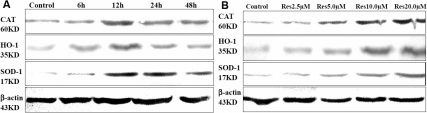
Resveratrol clearly reduced H(2)O(2) induced cell apoptosis and ROS accumulation; protected HLEB-3 cells from H(2)O(2) induced oxidative damage, and increased the expression levels of SOD-1, catalase, and HO-1. Further studies showed that RES also inhibited H(2)O(2) induced p38 and JNK phosphorylation.
These findings suggested that RES protected HLEB-3 cells from H(2)O(2) induced oxidative damage, presumably by inducing three antioxidative enzymes including catalase, SOD-1, and HO-1.
过氧化氢(H₂O₂)处理诱导的氧化损伤可不可逆地损害晶状体上皮,导致细胞死亡和白内障。白藜芦醇(RES)孵育是否能减轻培养的人晶状体上皮细胞中的氧化应激影响尚不清楚。在本研究中,我们检测了白藜芦醇在保护人晶状体上皮B - 3(HLEB - 3)细胞免受H₂O₂诱导的细胞死亡和细胞凋亡中的作用,其在减少H₂O₂诱导的细胞内活性氧(ROS)积累中的作用,并研究了白藜芦醇发挥作用的机制。
人晶状体上皮细胞系HLEB - 3细胞,在不同浓度的白藜芦醇预处理或未预处理的情况下,暴露于100μM H₂O₂不同时间。通过4 - [3 - [4 - 碘苯基] - 2 - 4(4 - 硝基苯基)- 2H - 5 - 四氮唑 - 1,3 - 苯二磺酸盐](WST - 1)检测法监测细胞活力。通过流式细胞术分析检测凋亡率和ROS生成。通过蛋白质印迹分析测量超氧化物歧化酶 - 1(SOD - 1)、过氧化氢酶和血红素加氧酶 - 1(HO - 1)蛋白的表达水平。也通过蛋白质印迹分析评估p38和c - jun N末端激酶(JNK)的激活情况。
白藜芦醇明显减少H₂O₂诱导的细胞凋亡和ROS积累;保护HLEB - 3细胞免受H₂O₂诱导的氧化损伤,并增加SOD - 1、过氧化氢酶和HO - 1的表达水平。进一步研究表明,白藜芦醇还抑制H₂O₂诱导的p38和JNK磷酸化。
这些发现表明,白藜芦醇保护HLEB - 3细胞免受H₂O₂诱导的氧化损伤,可能是通过诱导包括过氧化氢酶、SOD - 1和HO - 1在内的三种抗氧化酶。