Dong Xin, Li Zhongrui, Wang Wei, Zhang Wenjie, Liu Shuizhong, Zhang Xiaomei, Fang Jun, Maeda Hiroshi, Matsukura Makoto
Department of Ophthalmology, The First Affiliated Hospital of Harbin Medical University, Harbin, Heilongjiang Province, P.R. China.
Mol Vis. 2011;17:2040-8. Epub 2011 Jul 27.
Oxidative stress damage to retinal pigment epithelial (RPE) cells is thought to play a critical role in the pathogenesis of age-related macular degeneration (AMD). This study was conducted to investigate the protective effect of canolol against oxidative stress-induced cell death in ARPE-19 cells and its underlying mechanism.
ARPE-19 cells, a human retinal pigment epithelial cell line, were subjected to oxidative stress with 150 μM t-butyl hydroxide (t-BH) in the presence/absence of canolol in different concentrations. Cell viabilities were monitored by a 3-(4, 5-dimethylthiazol-2-yl)-2, 5 diphenyl tetrazolium bromide (MTT) assay. The apoptosis was measured by flow cytometry using Annexin V-FITC and PI staining and intracellular reactive oxygen species (ROS) levels were measured by a fluorescence spectrophotometer. Gene expression of NF-E2-related factor (Nrf-2), heme oxygenase-1 (HO-1), catalase and glutathione S-transferase-pi (GST-pi) were measured by a reverse transcription polymerase chain reaction (RT-PCR) assay. Activation of the extracellular signal regulated kinase (ERK) protein was evaluated by western blot analysis.
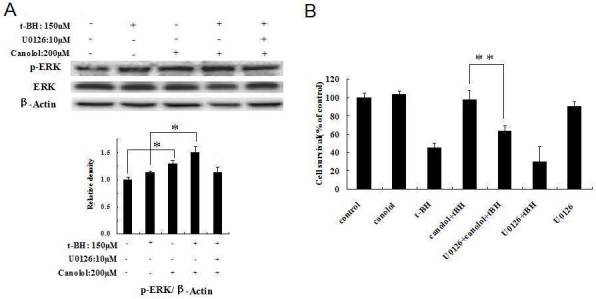
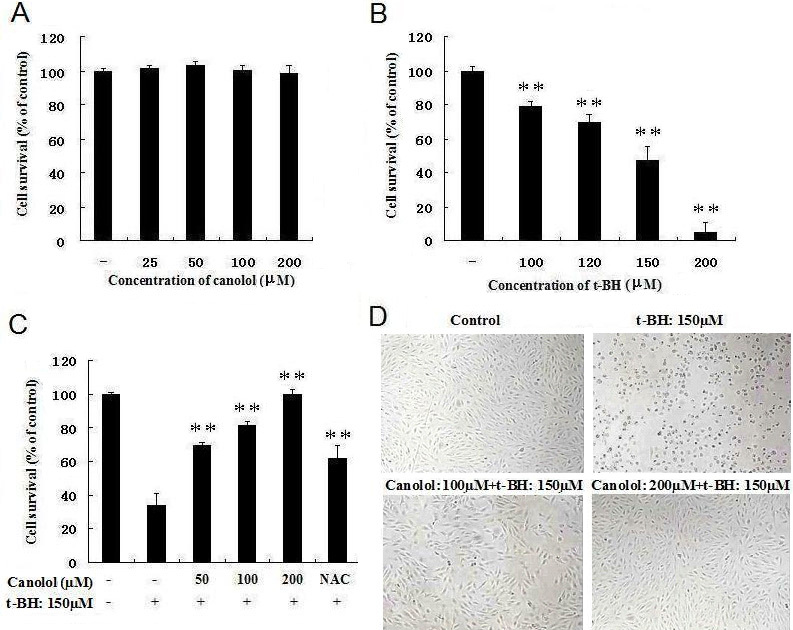
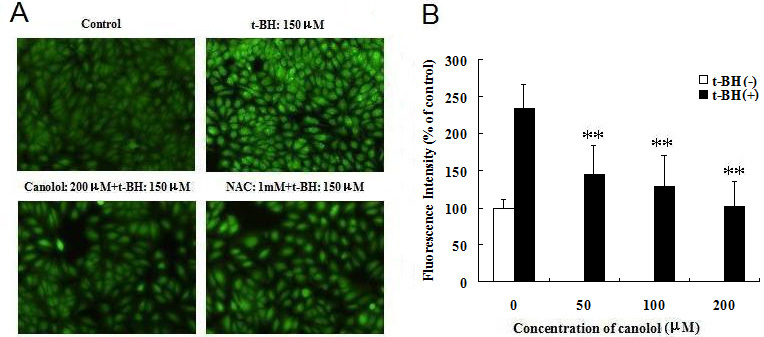
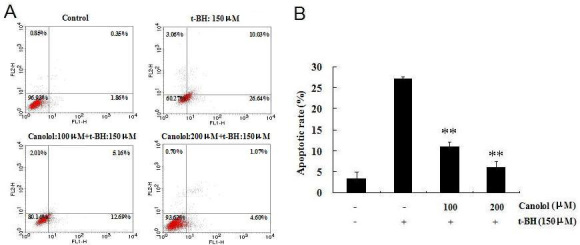
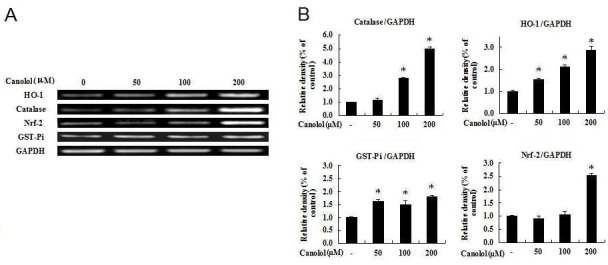
Canolol showed relatively high safety for ARPE-19 cells and recovered the cell death caused by t-BH dose-dependently at a concentration of 50-200 μM. Canolol also reduced t-BH-induced intracellular ROS generation and thus protected ARPE-19 cells from cell apoptosis. HO-1, catalase, GST-pi, and Nrf-2 were elevated in ARPE-19 cells after treatment with different concentrations of canolol for 24 h. Finally, canolol was found to activate extracellular signal regulated kinase (ERK) phosphorylation in ARPE-19 cells under the condition, with or without t-BH.
Canolol protected ARPE-19 cells from t-BH-induced oxidative damage and the protective mechanism was associated, at least partly, with the upregulation (activation) of antioxidative enzymes, probably through an ERK mediated pathway. This suggests that canolol offers a remarkable protective effect against oxidative damage of RPE cells and may have a therapeutic effect on AMD and other oxidative stress-related retinal diseases.
氧化应激对视网膜色素上皮(RPE)细胞的损伤被认为在年龄相关性黄斑变性(AMD)的发病机制中起关键作用。本研究旨在探讨菜油甾醇对氧化应激诱导的ARPE - 19细胞死亡的保护作用及其潜在机制。
人视网膜色素上皮细胞系ARPE - 19细胞,在存在/不存在不同浓度菜油甾醇的情况下,用150μM叔丁醇(t - BH)进行氧化应激处理。通过3 -(4,5 - 二甲基噻唑 - 2 - 基)- 2,5 - 二苯基溴化四氮唑(MTT)法监测细胞活力。使用膜联蛋白V - FITC和碘化丙啶(PI)染色通过流式细胞术测量细胞凋亡,并通过荧光分光光度计测量细胞内活性氧(ROS)水平。通过逆转录聚合酶链反应(RT - PCR)测定法测量NF - E2相关因子(Nrf - 2)、血红素加氧酶 - 1(HO - 1)、过氧化氢酶和谷胱甘肽S - 转移酶 - π(GST - π)的基因表达。通过蛋白质印迹分析评估细胞外信号调节激酶(ERK)蛋白的激活。
菜油甾醇对ARPE - 19细胞显示出相对较高的安全性,并在50 - 200μM浓度下剂量依赖性地恢复了由t - BH引起的细胞死亡。菜油甾醇还减少了t - BH诱导的细胞内ROS生成,从而保护ARPE - 19细胞免于细胞凋亡。用不同浓度的菜油甾醇处理24小时后,ARPE - 19细胞中的HO - 1、过氧化氢酶、GST - π和Nrf - 2升高。最后,发现在有或没有t - BH的条件下,菜油甾醇均可激活ARPE - 19细胞中的细胞外信号调节激酶(ERK)磷酸化。
菜油甾醇保护ARPE - 19细胞免受t - BH诱导的氧化损伤,其保护机制至少部分与抗氧化酶的上调(激活)有关,可能是通过ERK介导的途径。这表明菜油甾醇对RPE细胞的氧化损伤具有显著的保护作用,并且可能对AMD和其他与氧化应激相关的视网膜疾病具有治疗作用。