Department of Cell Biology, Neurobiology and Anatomy, Medical College of Wisconsin, Milwaukee, Wisconsin, United States of America.
PLoS One. 2010 Aug 16;5(8):e12177. doi: 10.1371/journal.pone.0012177.
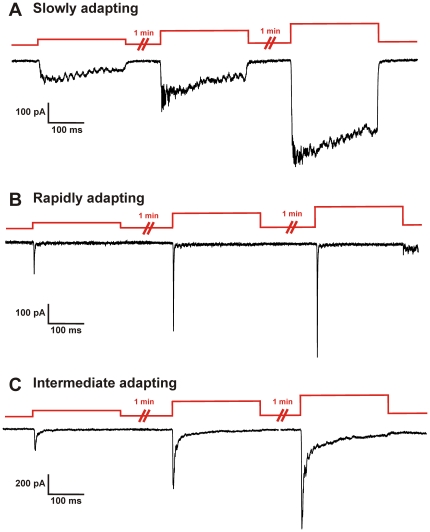
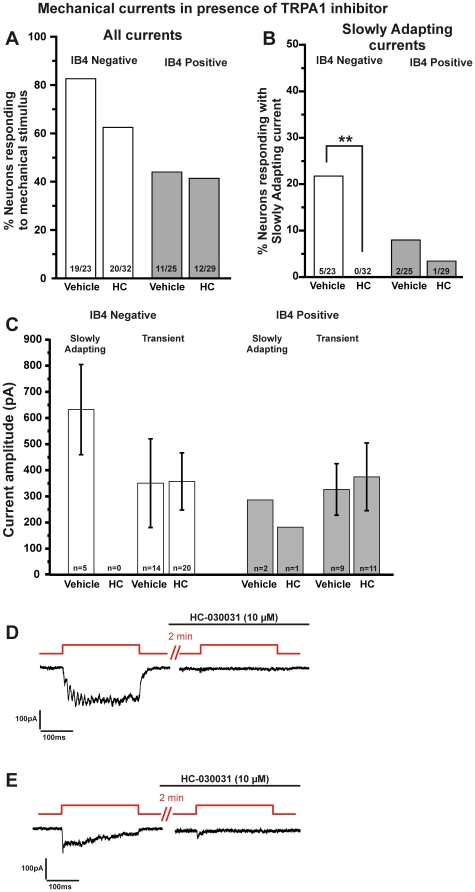
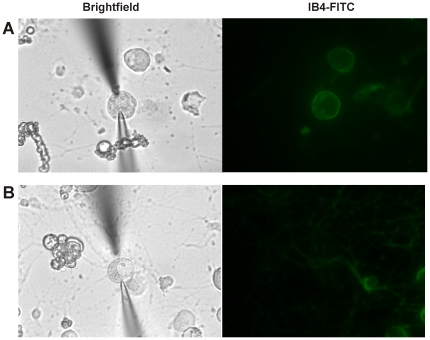
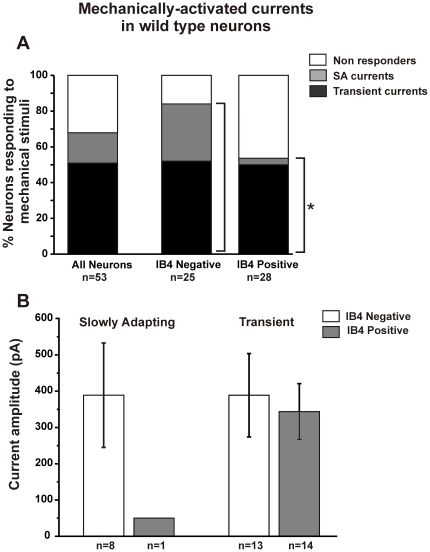
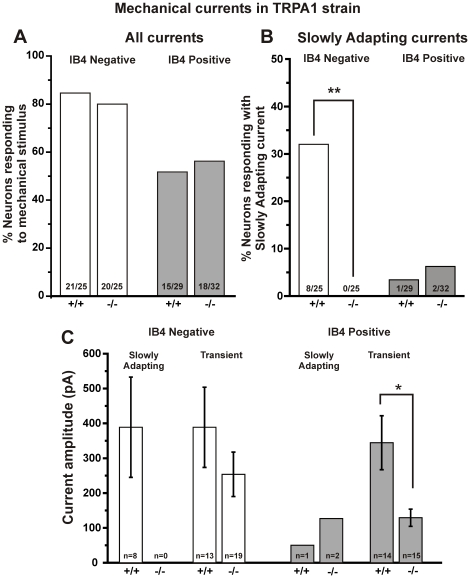
Mechanosensitive channels serve as essential sensors for cells to interact with their environment. The identity of mechanosensitive channels that underlie somatosensory touch transduction is still a mystery. One promising mechanotransduction candidate is the Transient Receptor Potential Ankyrin 1 (TRPA1) ion channel. To determine the role of TRPA1 in the generation of mechanically-sensitive currents, we used dorsal root ganglion (DRG) neuron cultures from adult mice and applied rapid focal mechanical stimulation (indentation) to the soma membrane. Small neurons (diameter <27 microm) were studied because TRPA1 is functionally present in these neurons which largely give rise to C-fiber afferents in vivo. Small neurons were classified by isolectin B4 binding. Mechanically-activated inward currents were classified into two subtypes: Slowly Adapting and Transient. First, significantly more IB4 negative neurons (84%) responded to mechanical stimulation than IB4 positive neurons (54%). Second, 89% of Slowly Adapting currents were present in IB4 negative neurons whereas only 11% were found in IB4 positive neurons. Third, Slowly Adapting currents were completely absent in IB4 negative neurons from TRPA1-/- mice. Consistent with this, Slowly Adapting currents were abolished in wild type IB4 negative neurons stimulated in the presence of a TRPA1 antagonist, HC-030031. In addition, the amplitude of Transient mechanically-activated currents in IB4 positive neurons from TRPA1-/- mice was reduced by over 60% compared to TRPA1+/+ controls; however, a similar reduction did not occur in wild-type neurons treated with HC-030031. Transfection of TRPA1 in HEK293 cells did not significantly alter the proportion or magnitude of mechanically-activated currents in HEK293 cells, indicating that TRPA1 alone is not sufficient to confer mechanical sensitivity.These parallel genetic and pharmacological data demonstrate that TRPA1 mediates the Slowly Adapting mechanically-activated currents in small-diameter IB4 negative neurons from adult mice. The TRPA1 protein may also contribute to a complex that mediates Transient mechanically-activated currents in small IB4 positive C fiber type neurons.
机械敏感通道作为细胞与环境相互作用的重要传感器。基础感觉触觉转导的机械敏感通道的身份仍然是个谜。一个有前途的机械转导候选者是瞬时受体电位锚蛋白 1(TRPA1)离子通道。为了确定 TRPA1 在产生机械敏感电流中的作用,我们使用成年小鼠背根神经节(DRG)神经元培养物,并对体膜施加快速焦点机械刺激(压痕)。研究了小神经元(直径 <27 微米),因为 TRPA1 在这些神经元中具有功能,这些神经元在体内主要产生 C 纤维传入。小神经元通过异硫氰酸荧光素 B4 结合进行分类。机械激活内向电流分为两种亚型:缓慢适应和瞬时。首先,机械刺激对 IB4 阴性神经元(84%)的反应明显多于 IB4 阳性神经元(54%)。其次,89%的缓慢适应电流存在于 IB4 阴性神经元中,而仅在 IB4 阳性神经元中发现 11%。第三,TRPA1-/- 小鼠的 IB4 阴性神经元中完全没有缓慢适应电流。与此一致的是,在存在 TRPA1 拮抗剂 HC-030031 的情况下,野生型 IB4 阴性神经元中缓慢适应电流被消除。此外,TRPA1-/- 小鼠的 IB4 阳性神经元中瞬态机械激活电流的幅度与 TRPA1+/+ 对照相比降低了 60%以上;然而,在用 HC-030031 处理的野生型神经元中没有发生类似的降低。在 HEK293 细胞中转染 TRPA1 并没有显著改变 HEK293 细胞中机械激活电流的比例或幅度,表明 TRPA1 本身不足以赋予机械敏感性。这些平行的遗传和药理学数据表明,TRPA1 介导成年小鼠小直径 IB4 阴性神经元中的缓慢适应机械激活电流。TRPA1 蛋白也可能有助于介导小 IB4 阳性 C 纤维类型神经元中瞬态机械激活电流的复合物。