Rho GTPases in Stem Cells Group, Institute of Medical Biology, Singapore.
PLoS One. 2010 Aug 25;5(8):e12409. doi: 10.1371/journal.pone.0012409.
Rnd3 (RhoE) protein belongs to the unique branch of Rho family GTPases that has low intrinsic GTPase activity and consequently remains constitutively active [1], [2]. The current consensus is that Rnd1 and Rnd3 function as important antagonists of RhoA signaling primarily by activating the ubiquitous p190 RhoGAP [3], but not by inhibiting the ROCK family kinases.
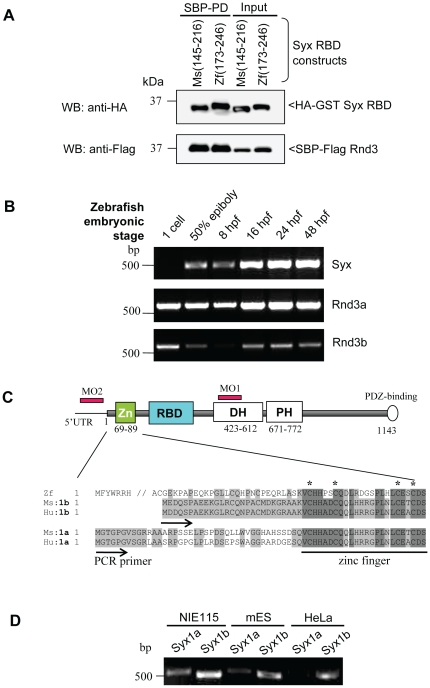
METHODOLOGY/PRINCIPAL FINDINGS: Rnd3 is abundant in mouse embryonic stem (mES) cells and in an unbiased two-step affinity purification screen we identified a new Rnd3 target, termed synectin-binding RhoA exchange factor (Syx), by mass spectrometry. The Syx interaction with Rnd3 does not occur through the Syx DH domain but utilizes a region similar to the classic Raf1 Ras-binding domain (RBD), and most closely related to those in RGS12 and RGS14. We show that Syx behaves as a genuine effector of Rnd3 (and perhaps Rnd1), with binding characteristics similar to p190-RhoGAP. Morpholino-oligonucleotide knockdown of Syx in zebrafish at the one cell stage resulted in embryos with shortened anterior-posterior body axis: this phenotype was effectively rescued by introducing mouse Syx1b mRNA. A Rnd3-binding defective mutant of Syx1b mutated in the RBD (E164A/R165D) was more potent in rescuing the embryonic defects than wild-type Syx1b, showing that Rnd3 negatively regulates Syx activity in vivo.
CONCLUSIONS/SIGNIFICANCE: This study uncovers a well defined Rnd3 effector Syx which is widely expressed and directly impacts RhoA activation. Experiments conducted in vivo indicate that Rnd3 negatively regulates Syx, and that as a RhoA-GEF it plays a key role in early embryonic cell shape changes. Thus a connection to signaling via the planar cell polarity pathway is suggested.
Rnd3(RhoE)蛋白属于 Rho 家族 GTP 酶的独特分支,其内在 GTP 酶活性较低,因此持续处于组成性激活状态[1,2]。目前的共识是,Rnd1 和 Rnd3 主要通过激活普遍存在的 p190RhoGAP[3],而不是通过抑制 ROCK 家族激酶,作为 RhoA 信号的重要拮抗剂发挥作用。
方法/主要发现:Rnd3 在小鼠胚胎干细胞(mES)中含量丰富,在一项无偏两步骤亲和纯化筛选中,我们通过质谱鉴定出一种新的 Rnd3 靶标,称为联会蛋白结合 RhoA 交换因子(Syx)。Syx 与 Rnd3 的相互作用不是通过 Syx DH 结构域发生的,而是利用类似于经典 Raf1 Ras 结合结构域(RBD)的区域,与 RGS12 和 RGS14 最为相似。我们表明,Syx 作为 Rnd3(也许还有 Rnd1)的真正效应物发挥作用,其结合特性与 p190-RhoGAP 相似。在斑马鱼的单细胞阶段用 Syx 的 Morpholino 寡核苷酸敲低,导致胚胎的前-后体轴缩短:该表型可以通过引入小鼠 Syx1b mRNA 有效挽救。Syx1b 的 RBD(E164A/R165D)中的 Rnd3 结合缺陷突变体比野生型 Syx1b 更有效地挽救胚胎缺陷,表明 Rnd3 在体内负调节 Syx 活性。
结论/意义:本研究揭示了一种明确的 Rnd3 效应物 Syx,它广泛表达并直接影响 RhoA 的激活。体内实验表明,Rnd3 负调节 Syx,作为 RhoA-GEF,它在早期胚胎细胞形态变化中发挥关键作用。因此,提示与平面细胞极性途径的信号转导有关。