Ifakara Health Institute, Ifakara and Dar es Salaam, Tanzania.
Malar J. 2010 Sep 3;9:253. doi: 10.1186/1475-2875-9-253.
Efforts to ease administration and enhance acceptability of the oral anti-malarial artemether-lumefantrine (A-L) crushed tablet to infants and children triggered the development of a novel dispersible tablet of A-L. During early development of this new formulation, two studies were performed in healthy subjects, one to evaluate the palatability of three flavours of A-L, and a second one to compare the bioavailability of active principles between the dispersible tablet and the tablet (administered crushed and intact).
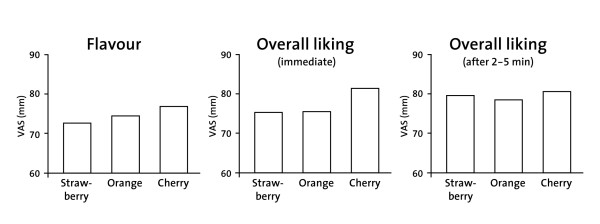
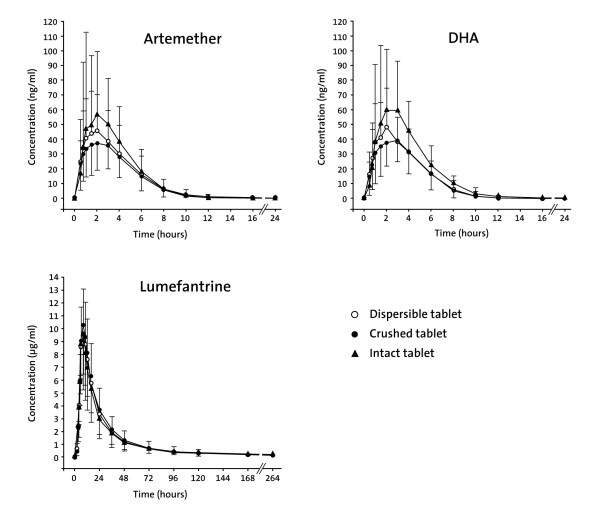
Study 1 was performed in 48 healthy schoolchildren in Tanzania. Within 1 day, all subjects tasted a strawberry-, orange- and cherry-flavoured oral A-L suspension for 10 seconds (without swallowing) in a randomized, single-blind, crossover fashion. The palatability of each formulation was rated using a visual analogue scale (VAS). Study 2 was an open, randomized crossover trial in 48 healthy adults given single doses of A-L (80 mg artemether + 480 mg lumefantrine) with food. The objectives were to compare the bioavailability of artemether, dihydroartemisinin (DHA) and lumefantrine between the dispersible tablet and the tablet administered crushed (primary objective) and intact (secondary objective).
Study 1 showed no statistically significant difference in VAS scores between the three flavours but cherry had the highest score in several ratings (particularly for overall liking). Study 2 demonstrated that the dispersible and crushed tablets delivered bioequivalent artemether, DHA and lumefantrine systemic exposure (area under the curve [AUC]); mean ± SD AUC0-tlast were 208 ± 113 vs 195 ± 93 h.ng/ml for artemether, 206 ± 81 vs 199 ± 84 h.ng/ml for DHA and 262 ± 107 vs 291 ± 106 h x μg/ml for lumefantrine. Bioequivalence was also shown for peak plasma concentrations (Cmax) of DHA and lumefantrine. Compared with the intact tablet, the dispersible tablet resulted in bioequivalent lumefantrine exposure, but AUC and Cmax values of artemether and DHA were 20-35% lower.
Considering that cherry was the preferred flavour, and that the novel A-L dispersible tablet demonstrated similar pharmacokinetic performances to the tablet administered crushed, a cherry-flavoured A-L dispersible tablet formulation was selected for further development and testing in a large efficacy and safety study in African children with malaria.
为了简化口服抗疟药蒿甲醚-本芴醇(A-L)片剂的使用并提高其可接受性,我们研发了一种新型的 A-L 分散片。在这种新配方的早期开发过程中,我们在健康受试者中进行了两项研究,第一项研究评估了 A-L 的三种口味的可口性,第二项研究比较了分散片和片剂(粉碎后服用)之间的活性成分生物利用度。
第一项研究在坦桑尼亚的 48 名健康学龄儿童中进行。在 1 天内,所有受试者以随机、单盲、交叉的方式,将草莓味、橘子味和樱桃味的口服 A-L 混悬液各品尝 10 秒(不吞咽)。采用视觉模拟评分(VAS)来评估每种配方的可口性。第二项研究是一项在 48 名健康成年人中进行的开放性、随机交叉试验,他们服用了含有食物的 A-L(80mg 蒿甲醚+480mg 本芴醇)单剂量。主要目的是比较分散片和粉碎后片剂的生物利用度(主要目的)和完整片剂的生物利用度(次要目的)。
第一项研究表明,三种口味之间的 VAS 评分无统计学差异,但樱桃味在多项评价中得分最高(特别是整体喜好)。第二项研究表明,分散片和粉碎后片剂的蒿甲醚、二氢青蒿素(DHA)和本芴醇系统暴露(AUC)相似;平均±SD AUC0-tlast 分别为 208±113 和 195±93 h.ng/ml (蒿甲醚)、206±81 和 199±84 h.ng/ml (DHA)以及 262±107 和 291±106 h x μg/ml (本芴醇)。DHA 和本芴醇的达峰血浆浓度(Cmax)也显示出生物等效性。与完整片剂相比,分散片使本芴醇的暴露生物等效,但蒿甲醚和 DHA 的 AUC 和 Cmax 值低 20-35%。
鉴于樱桃味是首选口味,且新型 A-L 分散片的药代动力学表现与粉碎后服用的片剂相似,因此选择了一种樱桃味 A-L 分散片用于在非洲疟疾儿童中进行更大规模的疗效和安全性研究。