Department of Pharmacology and Neuroscience, University of North Texas Health Science Center at Fort Worth, Fort Worth, TX 76107, USA.
J Neuroinflammation. 2010 Sep 9;7:53. doi: 10.1186/1742-2094-7-53.
Neuroinflammation is a complex process involving cells from the immune system and the central nerve system (CNS). Polymorphonuclear neutrophils (PMN) are the most abundant class of white blood cells, and typically the first type of leukocyte recruited to sites of inflammation. In the CNS, astrocytes are the most abundant glial cell population and participate in the local innate immune response triggered by a variety of insults. In the present study, we investigated the impacts of astrocytes on PMN function.
Primary astrocyte cultures were derived from postnatal C57BL/6 mice and primary neutrophils were isolated from 8 to 12 weeks old C57BL/6 mice. PMNs respiratory burst was analyzed by H2DCFDA assay. For phagocytosis assay, neutrophils were incubated with FITC-labeled E. coli and the phagocytosis of E coli was determined by flow cytometer. PMNs degranulation was determined by myeloperoxidase assay. Cytokine expression was determined by real-time PCR. To determine the involvement of different signaling pathway, protein lysates were prepared and western blots were conducted to assess the activation of Akt, Erk1/2, and p38.
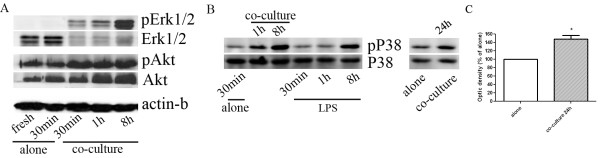
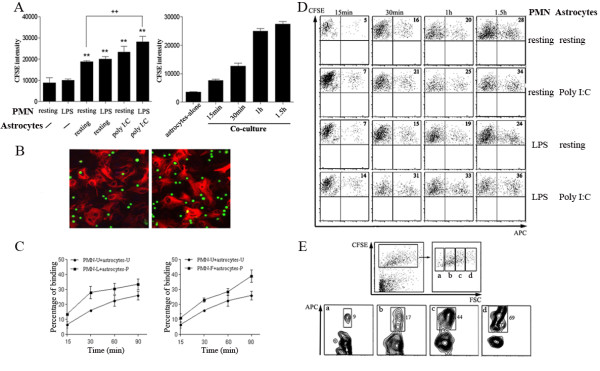
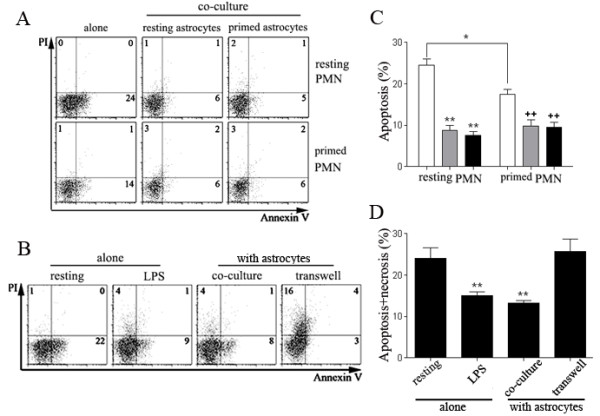
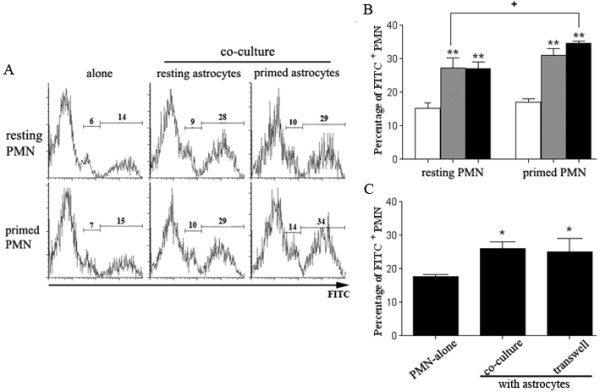
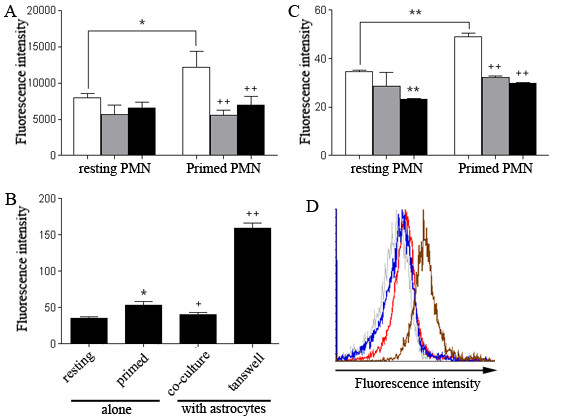
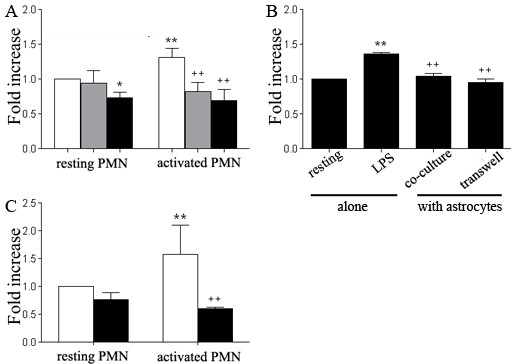
Using ex vivo neutrophils and primary astrocyte cultures, our study demonstrated that astrocytes differentially regulate neutrophil functions, depending upon whether the interactions between the two cell types are direct or indirect. Upon direct cell-cell contact, astrocytes attenuate neutrophil apoptosis, respiratory bust, and degranulation, while enhancing neutrophil phagocytic capability and pro-inflammatory cytokine expression. Through indirect interaction with neutrophils, astrocytes attenuate apoptosis and enhance necrosis in neutrophils, augment neutrophil phagocytosis and respiratory burst, and inhibit neutrophil degranulation. In addition, astrocytes could augment Akt, Erk1/2, and p38 activation in neutrophils.
Astrocytes differentially regulate neutrophil functions through direct or indirect interactions between the two cell types. The diversified actions of astrocytes on neutrophils might provide protection against potential microbial infections given compromised blood-brain barrier integrity under certain neuropathological conditions. The complex actions of astrocytes on neutrophils could provide further insight to harness the inflammatory response to promote CNS repair.
神经炎症是一个涉及免疫系统和中枢神经系统(CNS)细胞的复杂过程。多形核粒细胞(PMN)是白细胞中最丰富的一类,通常是第一种被招募到炎症部位的白细胞。在中枢神经系统中,星形胶质细胞是最丰富的神经胶质细胞群体,参与各种损伤引发的局部固有免疫反应。在本研究中,我们研究了星形胶质细胞对 PMN 功能的影响。
原代星形胶质细胞培养物来源于出生后 C57BL/6 小鼠,原代中性粒细胞分离自 8 至 12 周龄 C57BL/6 小鼠。通过 H2DCFDA 测定法分析 PMN 呼吸爆发。对于吞噬作用测定,将中性粒细胞与 FITC 标记的大肠杆菌孵育,并通过流式细胞仪测定大肠杆菌的吞噬作用。通过髓过氧化物酶测定法测定 PMN 脱粒。通过实时 PCR 测定细胞因子表达。为了确定不同信号通路的参与,制备蛋白裂解物并进行 Western blot 以评估 Akt、Erk1/2 和 p38 的激活。
使用离体中性粒细胞和原代星形胶质细胞培养物,我们的研究表明,星形胶质细胞根据两种细胞类型之间的相互作用是直接的还是间接的,从而差异调节中性粒细胞的功能。在直接细胞-细胞接触中,星形胶质细胞减弱中性粒细胞凋亡、呼吸爆发和脱粒,同时增强中性粒细胞吞噬能力和促炎细胞因子表达。通过与中性粒细胞的间接相互作用,星形胶质细胞减弱中性粒细胞凋亡并增强中性粒细胞坏死,增强中性粒细胞吞噬作用和呼吸爆发,抑制中性粒细胞脱粒。此外,星形胶质细胞可增强中性粒细胞中 Akt、Erk1/2 和 p38 的激活。
星形胶质细胞通过两种细胞类型之间的直接或间接相互作用差异调节中性粒细胞的功能。星形胶质细胞对中性粒细胞的多样化作用可能为潜在的微生物感染提供保护,因为在某些神经病理学条件下血脑屏障完整性受损。星形胶质细胞对中性粒细胞的复杂作用可以进一步深入了解利用炎症反应来促进中枢神经系统修复。