Noordhuizen Suzanne, de Graaf Paul, Sieben Inge
Tilburg University, Tilburg, Netherlands.
Soc Indic Res. 2010 Oct;99(1):163-181. doi: 10.1007/s11205-010-9574-y. Epub 2010 Jan 16.
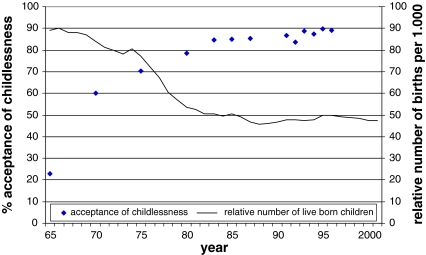
Within a relatively short period of 30 years, public acceptance of voluntary childlessness has increased enormously in the Netherlands. In this paper, we address two research questions, which we answer with data from 13 waves of the repeated cross-sectional survey Cultural Change in the Netherlands (CCN, 1965-1996). First, we investigate to what extent the increasing permissiveness is due to cohort replacement and to intra-cohort change. We find that between 1965 and 1980 the change is primarily due to intra-cohort (period) effects, whereas cohort replacement has become more important since 1980. Second, we address the question which social categories constitute the 10% of the population who do not accept voluntary childlessness. Church attendance-and not religiosity or religious socialization-turns out to be the most important factor. Low levels of income and education also negatively affect the acceptance of voluntary childless.
在短短30年的时间里,荷兰公众对自愿不育的接受程度大幅提高。在本文中,我们提出了两个研究问题,并利用荷兰文化变迁重复横断面调查(CCN,1965 - 1996年)13轮的数据进行解答。首先,我们研究宽容度增加在多大程度上归因于代际更替和代内变化。我们发现,1965年至1980年间的变化主要归因于代内(时期)效应,而自1980年以来代际更替变得更为重要。其次,我们探讨哪些社会类别构成了不接受自愿不育的10%的人口。结果表明,去教堂做礼拜——而非宗教信仰或宗教社会化——是最重要的因素。低收入和低教育水平也对自愿不育的接受产生负面影响。