Baker Laura D, Cross Donna J, Minoshima Satoshi, Belongia Dana, Watson G Stennis, Craft Suzanne
Geriatric Research, Education, and Clinical Center, Veterans Affairs Puget Sound Health Care System, Seattle, WA, USA.
Arch Neurol. 2011 Jan;68(1):51-7. doi: 10.1001/archneurol.2010.225. Epub 2010 Sep 13.
Insulin resistance is a causal factor in prediabetes (PD) and type 2 diabetes (T2D) and increases the risk of developing Alzheimer disease (AD). Reductions in cerebral glucose metabolic rate (CMRglu) as measured by fludeoxyglucose F 18-positron emission tomography (FDG-PET) in parietotemporal, frontal, and cingulate cortices are associated with increased AD risk and can be observed years before dementia onset.
To examine whether greater homeostasis model assessment insulin resistance (HOMA-IR) is associated with reduced resting CMRglu in areas vulnerable in AD in cognitively normal adults with newly diagnosed PD or T2D (PD/T2D), and to determine whether adults with PD/T2D have abnormal patterns of CMRglu during a memory encoding task.
Randomized crossover design of resting and activation FDG-PET.
University imaging center and Veterans Affairs clinical research unit.
Twenty-three older adults (mean [SEM] age, 74.4 [1.4] years) with no prior diagnosis of diabetes but who met American Diabetes Association glycemic criteria for PD (n = 11) or diabetes (n = 12) based on fasting or 2-hour oral glucose tolerance test (OGTT) glucose values and 6 adults (mean [SEM] age, 74.3 [2.8] years) with normal fasting glucose values and glucose tolerance. No participant met Petersen criteria for mild cognitive impairment.
Fasting participants underwent resting and cognitive activation FDG-PET imaging on separate days. Following a 30-minute transmission scan, subjects received an intravenous injection of 5 mCi of FDG, and the emission scan commenced 40 minutes after injection. In the activation condition, a 35-minute memory encoding task was initiated at the time of tracer injection. Subjects were instructed to remember a repeating list of 20 words randomly presented in series through earphones. Delayed free recall was assessed once the emission scan was complete.
The HOMA-IR value was calculated using fasting glucose and insulin values obtained during OGTT screening and then correlated with CMRglu values obtained during the resting scan. Resting CMRglu values were also subtracted from CMRglu values obtained during the memory encoding activation scan to examine task-related patterns of CMRglu.
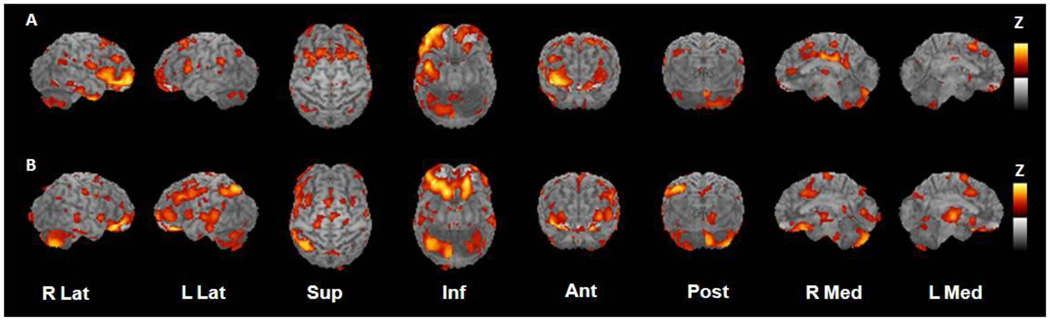
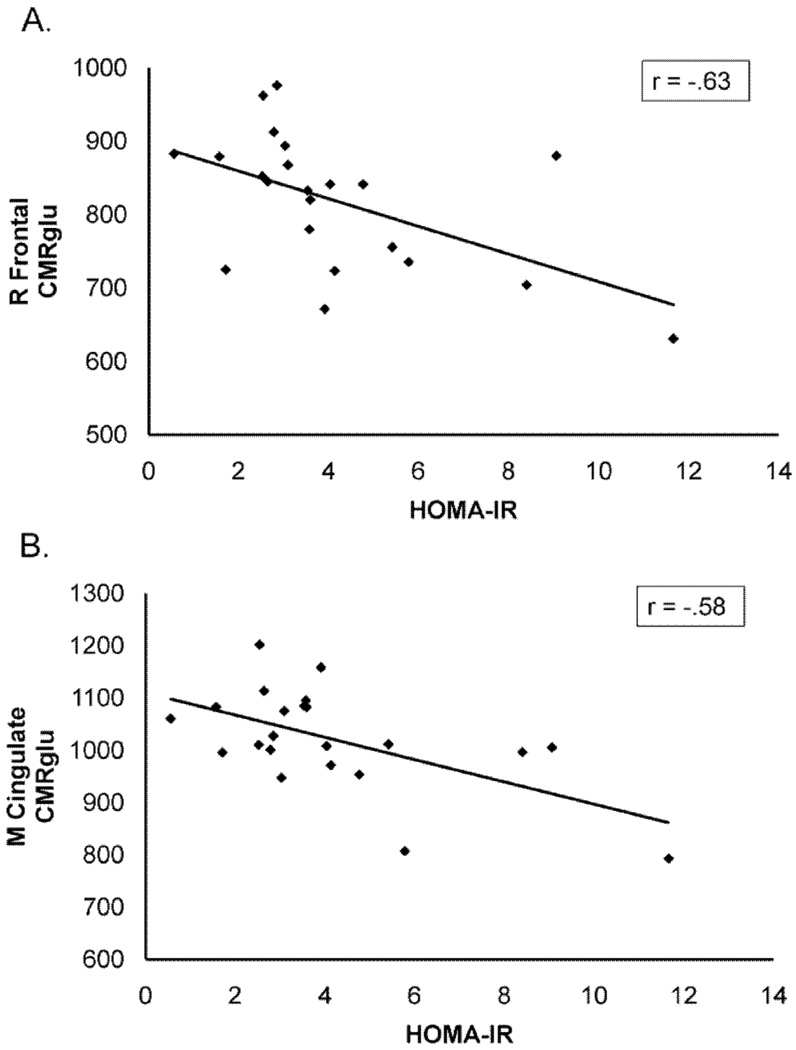
Greater insulin resistance was associated with an AD-like pattern of reduced CMRglu in frontal, parietotemporal, and cingulate regions in adults with PD/T2D. The relationship between CMRglu and HOMA-IR was independent of age, 2-hour OGTT glucose concentration, or apolipoprotein E ε4 allele carriage. During the memory encoding task, healthy adults showed activation in right anterior and inferior prefrontal cortices, right inferior temporal cortex, and medial and posterior cingulate regions. Adults with PD/T2D showed a qualitatively different pattern during the memory encoding task, characterized by more diffuse and extensive activation, and recalled fewer items on the delayed memory test.
Insulin resistance may be a marker of AD risk that is associated with reduced CMRglu and subtle cognitive impairments at the earliest stage of disease, even before the onset of mild cognitive impairment.

胰岛素抵抗是糖尿病前期(PD)和2型糖尿病(T2D)的致病因素,并增加患阿尔茨海默病(AD)的风险。通过氟脱氧葡萄糖F 18正电子发射断层扫描(FDG-PET)测量的顶颞叶、额叶和扣带回皮质的脑葡萄糖代谢率(CMRglu)降低与AD风险增加相关,且可在痴呆症发作前数年观察到。
研究在新诊断为PD或T2D(PD/T2D)的认知正常成年人中,更高的稳态模型评估胰岛素抵抗(HOMA-IR)是否与AD易损区域静息CMRglu降低相关,并确定PD/T2D成年人在记忆编码任务期间CMRglu模式是否异常。
静息和激活FDG-PET的随机交叉设计。
大学成像中心和退伍军人事务临床研究单位。
23名老年人(平均[标准误]年龄,74.4[1.4]岁),既往无糖尿病诊断,但根据空腹或2小时口服葡萄糖耐量试验(OGTT)血糖值符合美国糖尿病协会PD(n = 11)或糖尿病(n = 12)的血糖标准,以及6名空腹血糖值和葡萄糖耐量正常的成年人(平均[标准误]年龄,74.3[2.8]岁)。没有参与者符合轻度认知障碍的彼得森标准。
空腹参与者在不同日期接受静息和认知激活FDG-PET成像。在30分钟的透射扫描后,受试者静脉注射5 mCi的FDG,并在注射后40分钟开始发射扫描。在激活状态下,在示踪剂注射时开始一项35分钟的记忆编码任务。受试者被指示记住通过耳机随机连续呈现的20个单词的重复列表。发射扫描完成后评估延迟自由回忆。
使用OGTT筛查期间获得的空腹血糖和胰岛素值计算HOMA-IR值,然后将其与静息扫描期间获得的CMRglu值相关联。还从记忆编码激活扫描期间获得的CMRglu值中减去静息CMRglu值,以检查CMRglu的任务相关模式。
在患有PD/T2D的成年人中,更高的胰岛素抵抗与额叶、顶颞叶和扣带回区域CMRglu降低的AD样模式相关。CMRglu与HOMA-IR之间的关系独立于年龄、2小时OGTT血糖浓度或载脂蛋白Eε4等位基因携带情况。在记忆编码任务期间,健康成年人在右侧前额叶皮质前部和下部、右侧颞叶皮质下部以及扣带回区域内侧和后部表现出激活。患有PD/T2D的成年人在记忆编码任务期间表现出质的不同模式,其特征是激活更广泛和弥散,并且在延迟记忆测试中回忆的项目更少。
胰岛素抵抗可能是AD风险的标志物,与CMRglu降低和疾病最早阶段(甚至在轻度认知障碍发作之前)的细微认知障碍相关。