Plant-Microbe Interactions, Department of Biology, Faculty of Science, Utrecht University, P.O. Box 80056, 3508 TB, Utrecht, The Netherlands.
Planta. 2010 Nov;232(6):1423-32. doi: 10.1007/s00425-010-1265-z. Epub 2010 Sep 14.
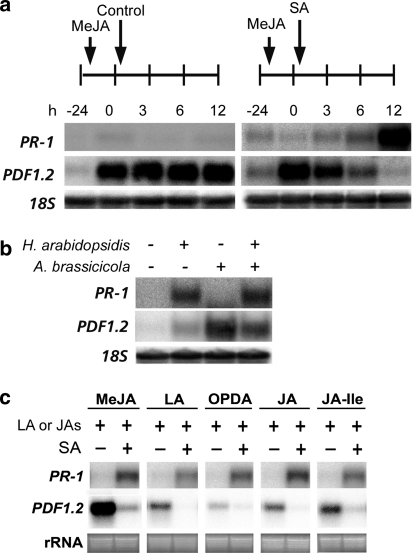
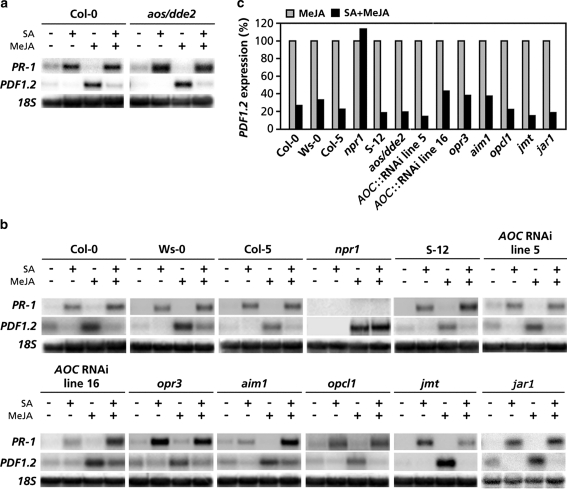
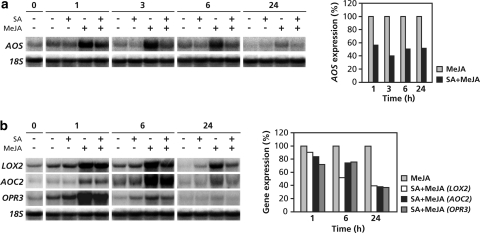
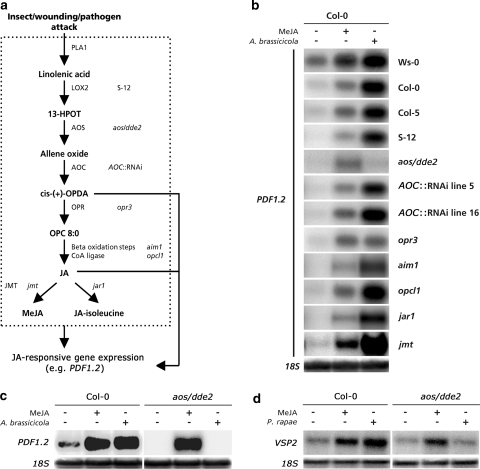
Jasmonates (JAs) and salicylic acid (SA) are plant hormones that play pivotal roles in the regulation of induced defenses against microbial pathogens and insect herbivores. Their signaling pathways cross-communicate providing the plant with a regulatory potential to finely tune its defense response to the attacker(s) encountered. In Arabidopsis thaliana, SA strongly antagonizes the jasmonic acid (JA) signaling pathway, resulting in the downregulation of a large set of JA-responsive genes, including the marker genes PDF1.2 and VSP2. Induction of JA-responsive marker gene expression by different JA derivatives was equally sensitive to SA-mediated suppression. Activation of genes encoding key enzymes in the JA biosynthesis pathway, such as LOX2, AOS, AOC2, and OPR3 was also repressed by SA, suggesting that the JA biosynthesis pathway may be a target for SA-mediated antagonism. To test this, we made use of the mutant aos/dde2, which is completely blocked in its ability to produce JAs because of a mutation in the ALLENE OXIDE SYNTHASE gene. Mutant aos/dde2 plants did not express the JA-responsive marker genes PDF1.2 or VSP2 in response to infection with the necrotrophic fungus Alternaria brassicicola or the herbivorous insect Pieris rapae. Bypassing JA biosynthesis by exogenous application of methyl jasmonate (MeJA) rescued this JA-responsive phenotype in aos/dde2. Application of SA suppressed MeJA-induced PDF1.2 expression to the same level in the aos/dde2 mutant as in wild-type Col-0 plants, indicating that SA-mediated suppression of JA-responsive gene expression is targeted at a position downstream of the JA biosynthesis pathway.
茉莉酸(JAs)和水杨酸(SA)是植物激素,在调节对微生物病原体和昆虫食草动物的诱导防御中起着关键作用。它们的信号通路交叉通讯,为植物提供了一种调节潜力,可以精细地调整其防御反应以应对遇到的攻击者。在拟南芥中,SA 强烈拮抗茉莉酸(JA)信号通路,导致大量 JA 响应基因的下调,包括标记基因 PDF1.2 和 VSP2。不同 JA 衍生物诱导 JA 响应标记基因表达对 SA 介导的抑制同样敏感。JA 生物合成途径中的关键酶基因,如 LOX2、AOS、AOC2 和 OPR3 的编码基因的激活也受到 SA 的抑制,这表明 JA 生物合成途径可能是 SA 介导的拮抗作用的靶点。为了验证这一点,我们利用 aos/dde2 突变体,该突变体由于 ALLENE OXIDE SYNTHASE 基因的突变而完全丧失产生 JA 的能力。aos/dde2 突变体植物在感染坏死真菌 Alternaria brassicicola 或食草昆虫 Pieris rapae 时不会表达 JA 响应标记基因 PDF1.2 或 VSP2。通过外源施用茉莉酸甲酯(MeJA)绕过 JA 生物合成,挽救了 aos/dde2 中的这种 JA 响应表型。SA 的应用抑制了 MeJA 诱导的 aos/dde2 突变体中 PDF1.2 表达,使其与野生型 Col-0 植物中的表达水平相同,表明 SA 介导的 JA 响应基因表达抑制是针对 JA 生物合成途径下游的一个位置。