Abteilung Innere Medizin III, Medizinische Klinik, Universitätsklinikum Heidelberg, Heidelberg, Germany.
J Cardiovasc Magn Reson. 2010 Sep 14;12(1):51. doi: 10.1186/1532-429X-12-51.
Cardiac troponin-T (cTnT) is a cardio-specific indicator of myocardial necrosis due to ischemic or non-ischemic events. Considering the multiple causes of myocardial injury and treatment consequences there is great clinical need to clarify the underlying reason for cTnT release. We sought to implement acute CMR as a non-invasive imaging method for differential diagnosis of elevated cTnT in chest-pain unit (CPU) patients with non-conclusive symptoms and ECG-changes and a low to intermediate probability for coronary artery disease (CAD).
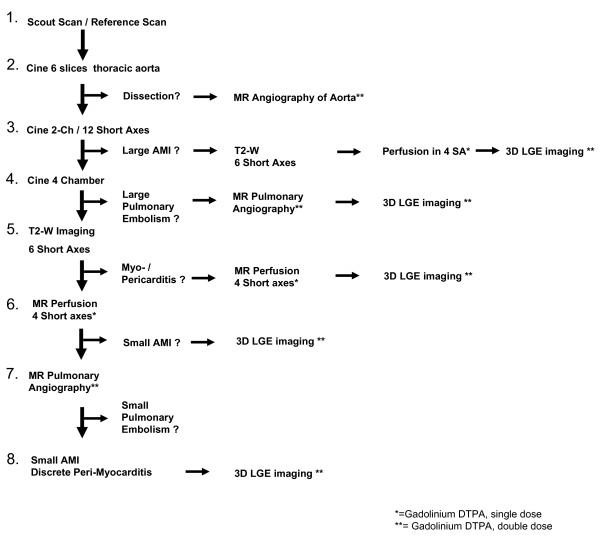
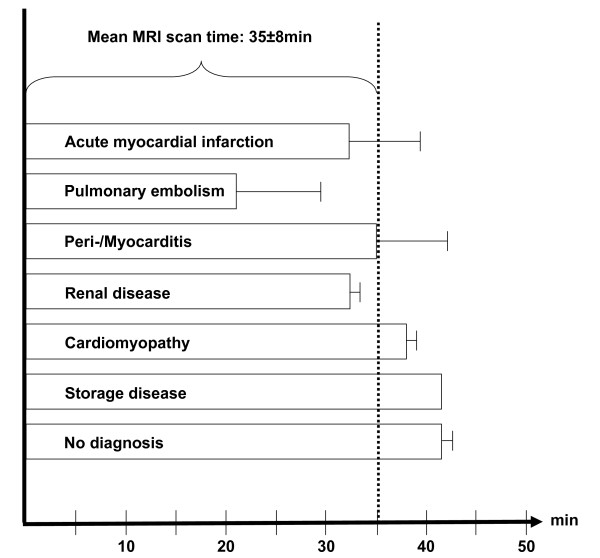
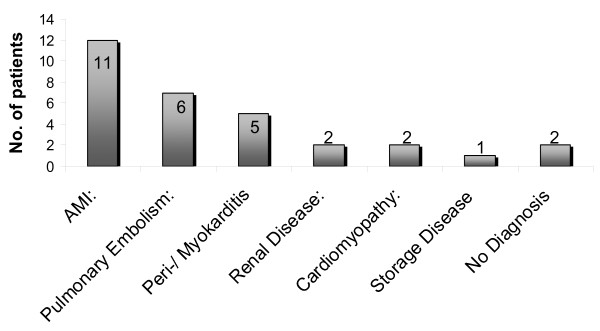
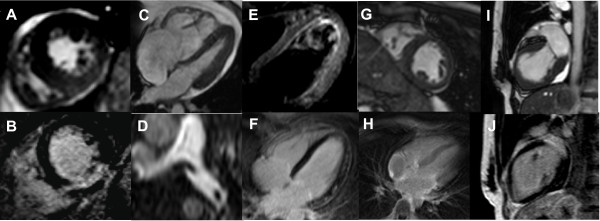
CPU patients (n = 29) who had positive cTnT were scanned at 1.5T with a new step-by-step CMR algorithm including cine-, perfusion-, T2-, angiography-and late gadolinium enhancement (LGE) imaging. For comparison patients also underwent echocardiography and coronary angiography if necessary. CMR was conducted successfully in all patients and detected 93% of cTnT releases of unknown cause, without adverse hemodynamic or arrhythmic events. Acute myocardial infarction was detected in 11, pulmonary embolism in 6, myocarditis in 5, renal disease and cardiomyopathy in 2, storage disorder in 1 patient. In 2 patients CMR was unable to reveal the cause of cTnT elevations. Mean CMR scan-time was 35 ± 8 min. In 4 patients, CMR led to immediate coronary angiography with correct prediction of the infarct related artery.
We implemented a novel CMR algorithm to show the clinical value and practical feasibility of acute CMR in a non-conclusive patient cohort with unclear cTnT elevation. Since this pilot study has shown the feasibility of CMR in CPU patients, further prospective studies are warranted to compare CMR with other imaging modalities.
心肌肌钙蛋白 T(cTnT)是由于缺血或非缺血事件导致心肌坏死的心脏特异性标志物。考虑到心肌损伤的多种原因和治疗后果,明确 cTnT 释放的根本原因具有重要的临床意义。我们试图将急性心脏磁共振成像(CMR)作为一种非侵入性成像方法,用于鉴别诊断胸痛单元(CPU)中症状和心电图改变不明确且冠状动脉疾病(CAD)的低到中度可能性但 cTnT 升高的患者。
在 1.5T 上使用新的逐步 CMR 算法对具有阳性 cTnT 的 CPU 患者(n = 29)进行扫描,该算法包括电影、灌注、T2、血管造影和晚期钆增强(LGE)成像。必要时,为了比较,患者还接受了超声心动图和冠状动脉造影。所有患者均成功进行了 CMR 检查,并且在没有不良血液动力学或心律失常事件的情况下检测到了 93%的未知原因的 cTnT 释放。在 11 例患者中检测到急性心肌梗死,6 例患者中检测到肺栓塞,5 例患者中检测到心肌炎,2 例患者中检测到肾脏疾病和心肌病,1 例患者中检测到储存障碍。在 2 例患者中,CMR 无法揭示 cTnT 升高的原因。CMR 扫描的平均时间为 35 ± 8 分钟。在 4 例患者中,CMR 立即进行了冠状动脉造影,正确预测了梗死相关动脉。
我们实施了一种新的 CMR 算法,以展示急性 CMR 在 cTnT 升高不明确的非明确患者队列中的临床价值和实际可行性。由于这项初步研究已经表明了 CMR 在 CPU 患者中的可行性,因此需要进一步的前瞻性研究来比较 CMR 与其他成像方式。