Flinders Centre for Cancer Prevention and Control, School of Medicine, Flinders University, Sturt Road, Bedford Park, SA 5042, Australia.
BMC Med Inform Decis Mak. 2010 Sep 16;10:50. doi: 10.1186/1472-6947-10-50.
Australia has a comparatively high incidence of colorectal (bowel) cancer; however, population screening uptake using faecal occult blood test (FOBT) remains low. This study will determine the impact on screening participation of a novel, Internet-based Personalised Decision Support (PDS) package. The PDS is designed to measure attitudes and cognitive concerns and provide people with individually tailored information, in real time, that will assist them with making a decision to screen. The hypothesis is that exposure to (tailored) PDS will result in greater participation in screening than participation following exposure to non-tailored PDS or resulting from the current non-tailored, paper-based approach.
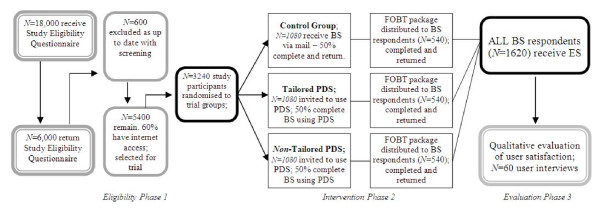
METHODS/DESIGN: A randomised parallel trial comprising three arms will be conducted. Men and women aged 50-74 years (N = 3240) will be recruited. They must have access to the Internet; have not had an FOBT within the previous 12 months, or sigmoidoscopy or colonoscopy within the previous 5 years; have had no clinical diagnosis of bowel cancer. Groups 1 and 2 (PDS arms) will access a website and complete a baseline survey measuring decision-to-screen stage, attitudes and cognitive concerns and will receive immediate feedback; Group 1 will receive information 'tailored' to their responses in the baseline survey and group 2 will received 'non-tailored' bowel cancer information. Respondents in both groups will subsequently receive an FOBT kit. Group 3 (usual practice arm) will complete a paper-based version of the baseline survey and respondents will subsequently receive 'non-tailored' paper-based bowel cancer information with accompanying FOBT kit. Following despatch of FOBTs, all respondents will be requested to complete an endpoint survey. Main outcome measures are (1) completion of FOBT and (2) change in decision-to-screen stage. Secondary outcomes include satisfaction with decision and change in attitudinal scores from baseline to endpoint. Analyses will be performed using Chi-square tests, analysis of variance and log binomial generalized linear models as appropriate.
It is necessary to restrict participants to Internet users to provide an appropriately controlled evaluation of PDS. Once efficacy of the approach has been established, it will be important to evaluate effectiveness in the wider at-risk population, and to identify barriers to its implementation in those settings.
Australian New Zealand Clinical Trials Registry ACTRN12610000095066.
澳大利亚结直肠癌(肠道)的发病率相对较高;然而,粪便潜血试验(FOBT)的人群筛查参与率仍然很低。本研究将确定一种新的基于互联网的个性化决策支持(PDS)方案对筛查参与的影响。该 PDS 旨在测量态度和认知问题,并实时为人们提供个性化信息,以帮助他们做出筛查决策。假设接触(定制)PDS 将导致比接触非定制 PDS 或当前非定制的纸质方法更多的人参与筛查。
方法/设计:将进行一项包含三个组的随机平行试验。将招募年龄在 50-74 岁的男性和女性(N=3240)。他们必须能够访问互联网;在过去 12 个月内未进行 FOBT,或在过去 5 年内未进行乙状结肠镜或结肠镜检查;没有肠道癌的临床诊断。第 1 组和第 2 组(PDS 组)将访问一个网站并完成一项测量决策筛查阶段、态度和认知问题的基线调查,并将立即收到反馈;第 1 组将收到与基线调查中他们的回答“定制”的信息,第 2 组将收到“非定制”的结直肠癌信息。两组的受访者随后将收到 FOBT 试剂盒。第 3 组(常规实践组)将填写纸质版的基线调查,受访者随后将收到“非定制”的纸质结直肠癌信息和配套的 FOBT 试剂盒。FOBT 寄出后,所有受访者都将被要求完成终点调查。主要结果测量指标是(1)完成 FOBT 和(2)决策筛查阶段的变化。次要结果包括对决策的满意度和从基线到终点的态度得分变化。分析将使用卡方检验、方差分析和对数二项式广义线性模型进行,具体取决于情况。
有必要将参与者限制为互联网用户,以对 PDS 进行适当的对照评估。一旦该方法的疗效得到确定,就需要在更广泛的高危人群中评估其有效性,并确定在这些环境中实施该方法的障碍。
澳大利亚新西兰临床试验注册 ACTRN12610000095066。