Natoli Riccardo, Zhu Yuan, Valter Krisztina, Bisti Silvia, Eells Janis, Stone Jonathan
Division of Biomedical Sciences & Biochemistry, Research School of Biology, Australian National University, Sydney, Australia.
Mol Vis. 2010 Sep 3;16:1801-22.
To identify the genes and noncoding RNAs (ncRNAs) involved in the neuroprotective actions of a dietary antioxidant (saffron) and of photobiomodulation (PBM).
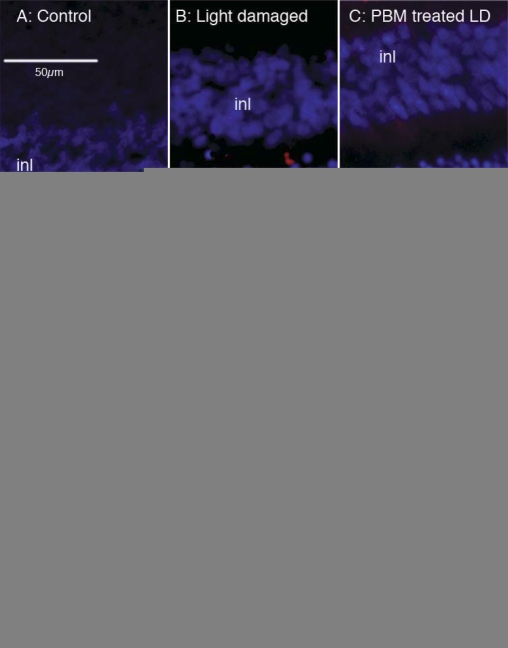
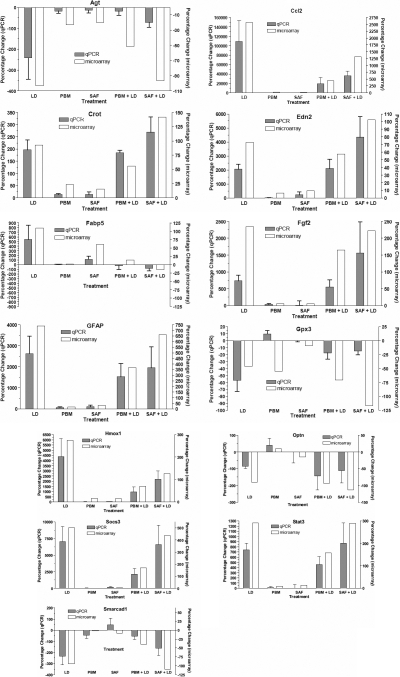
We used a previously published assay of photoreceptor damage, in which albino Sprague Dawley rats raised in dim cyclic illumination (12 h 5 lux, 12 h darkness) were challenged by 24 h exposure to bright (1,000 lux) light. Experimental groups were protected against light damage by pretreatment with dietary saffron (1 mg/kg/day for 21 days) or PBM (9 J/cm(2) at the eye, daily for 5 days). RNA from one eye of four animals in each of the six experimental groups (control, light damage [LD], saffron, PBM, saffronLD, and PBMLD) was hybridized to Affymetrix rat genome ST arrays. Quantitative real-time PCR analysis of 14 selected genes was used to validate the microarray results.
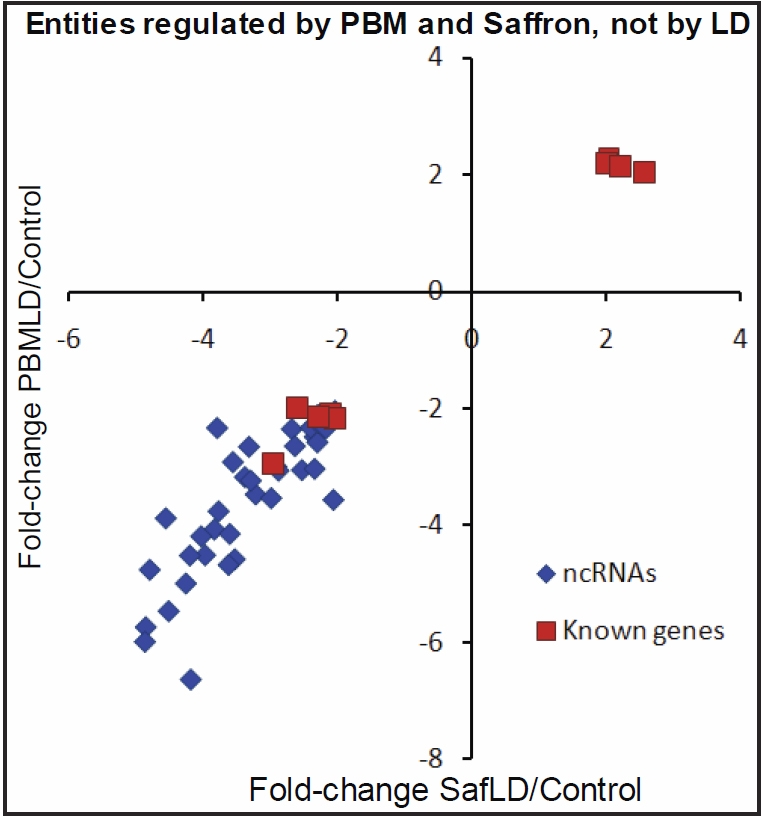
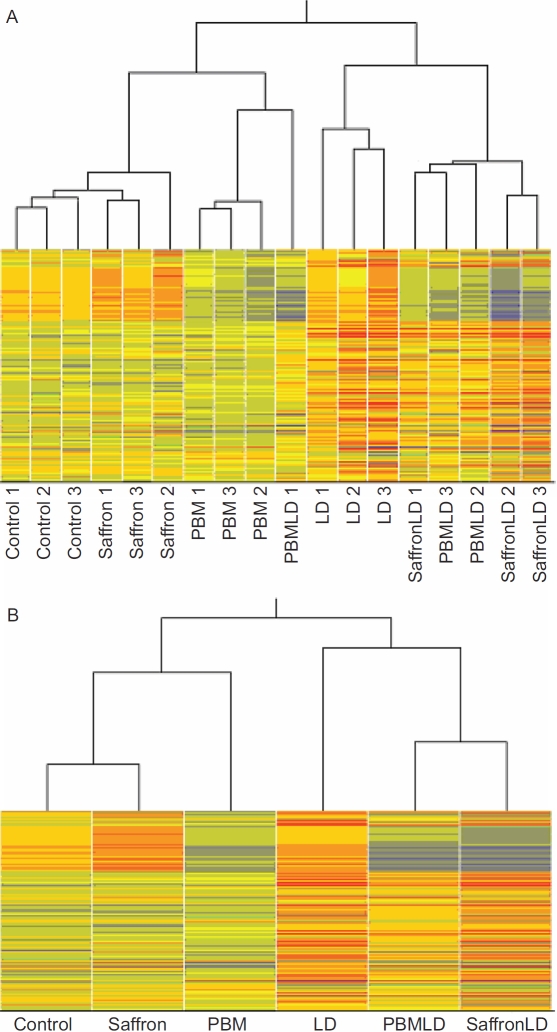
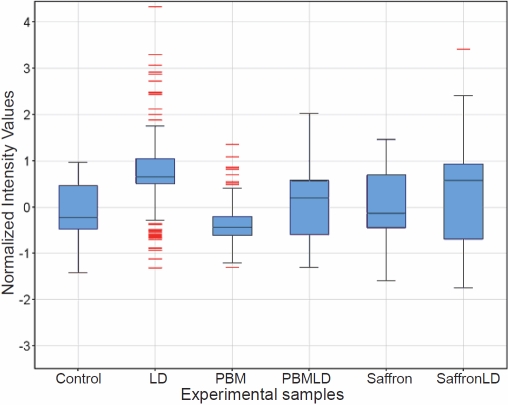
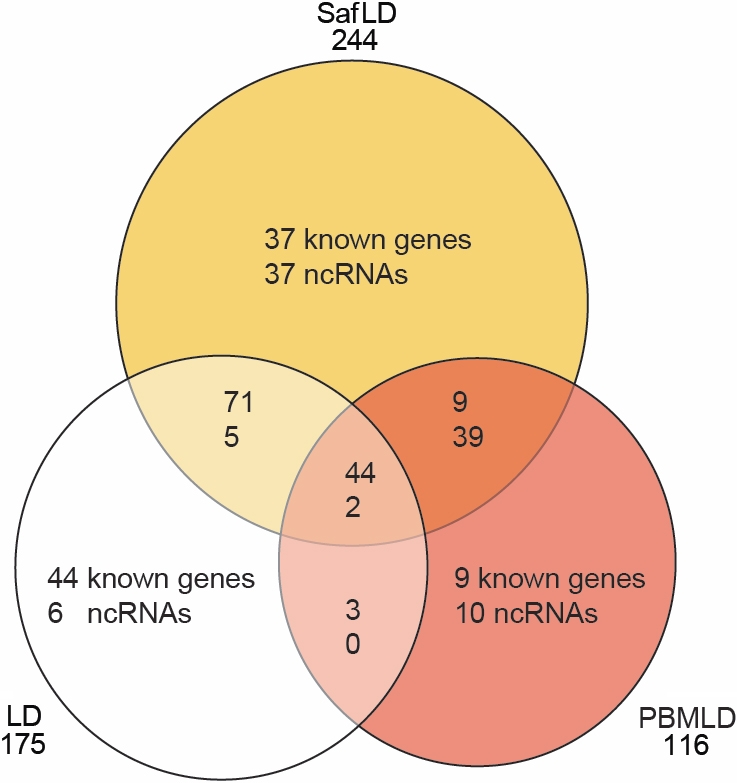
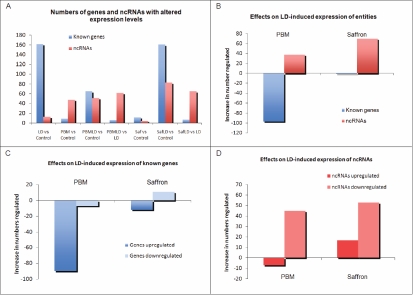
LD caused the regulation of 175 entities (genes and ncRNAs) beyond criterion levels (p<0.05 in comparison with controls, fold-change >2). PBM pretreatment reduced the expression of 126 of these 175 LD-regulated entities below criterion; saffron pretreatment reduced the expression of 53 entities (50 in common with PBM). In addition, PBM pretreatment regulated the expression of 67 entities not regulated by LD, while saffron pretreatment regulated 122 entities not regulated by LD (48 in common with PBM). PBM and saffron, given without LD, regulated genes and ncRNAs beyond criterion levels, but in lesser numbers than during their protective action. A high proportion of the entities regulated by LD (>90%) were known genes. By contrast, ncRNAs were prominent among the entities regulated by PBM and saffron in their neuroprotective roles (73% and 62%, respectively).
Given alone, saffron and (more prominently) PBM both regulated significant numbers of genes and ncRNAs. Given before retinal exposure to damaging light, thus while exerting their neuroprotective action, they regulated much larger numbers of entities, among which ncRNAs were prominent. Further, the downregulation of known genes and of ncRNAs was prominent in the protective actions of both neuroprotectants. These comparisons provide an overview of gene expression induced by two neuroprotectants and provide a basis for the more focused study of their mechanisms.
鉴定参与膳食抗氧化剂(藏红花)和光生物调节(PBM)神经保护作用的基因和非编码RNA(ncRNA)。
我们使用了先前发表的光感受器损伤检测方法,将在昏暗循环光照(12小时5勒克斯,12小时黑暗)下饲养的白化斯普拉格-道利大鼠暴露于明亮(1000勒克斯)光线下24小时进行挑战。实验组通过用膳食藏红花(1毫克/千克/天,持续21天)或PBM(眼部9焦/平方厘米,每天1次,持续5天)预处理来预防光损伤。六个实验组(对照组、光损伤组[LD]、藏红花组、PBM组、藏红花-LD组和PBM-LD组)中每组四只动物的一只眼睛的RNA与Affymetrix大鼠基因组ST阵列杂交。对14个选定基因进行定量实时PCR分析以验证微阵列结果。
LD导致175个实体(基因和ncRNA)超过标准水平的调控(与对照组相比,p<0.05,倍数变化>2)。PBM预处理将这175个受LD调控的实体中的126个的表达降低至标准水平以下;藏红花预处理将53个实体(与PBM有50个相同)的表达降低。此外,PBM预处理调控了67个不受LD调控的实体的表达,而藏红花预处理调控了122个不受LD调控的实体(与PBM有48个相同)。在没有LD的情况下给予PBM和藏红花,它们调控了超过标准水平的基因和ncRNA,但数量少于其发挥保护作用时。受LD调控的实体中很大一部分(>90%)是已知基因。相比之下,ncRNA在PBM和藏红花发挥神经保护作用时调控的实体中占突出比例(分别为73%和62%)。
单独给予时,藏红花和(更显著的)PBM都调控了大量的基因和ncRNA。在视网膜暴露于损伤性光之前给予时,即在发挥其神经保护作用时,它们调控了更多数量的实体,其中ncRNA占突出比例。此外,已知基因和ncRNA的下调在两种神经保护剂的保护作用中都很突出。这些比较提供了两种神经保护剂诱导的基因表达概况,并为更深入研究其机制提供了基础。