Cleveland Clinic Lerner College of Medicine of Case Western Reserve University, Department of Cell Biology, Cleveland Clinic Foundation, Cleveland, Ohio, United States of America.
PLoS One. 2010 Sep 10;5(9):e12691. doi: 10.1371/journal.pone.0012691.
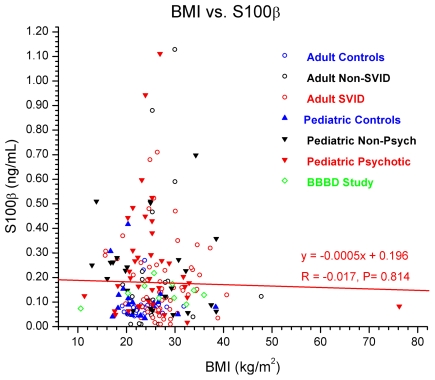
S100B, established as prevalent protein of the central nervous system, is a peripheral biomarker for blood-brain barrier disruption and often also a marker of brain injury. However, reports of extracranial sources of S100B, especially from adipose tissue, may confound its interpretation in the clinical setting. The objective of this study was to characterize the tissue specificity of S100B and assess how extracranial sources of S100B affect serum levels. The extracranial sources of S100B were determined by analyzing nine different types of human tissues by ELISA and Western blot. In addition, brain and adipose tissue were further analyzed by mass spectrometry. A study of 200 subjects was undertaken to determine the relationship between body mass index (BMI) and S100B serum levels. We also measured the levels of S100B homo- and heterodimers in serum quantitatively after blood-brain barrier disruption. Analysis of human tissues by ELISA and Western blot revealed variable levels of S100B expression. By ELISA, brain tissue expressed the highest S100B levels. Similarly, Western blot measurements revealed that brain tissue expressed high levels of S100B but comparable levels were found in skeletal muscle. Mass spectrometry of brain and adipose tissue confirmed the presence of S100B but also revealed the presence of S100A1. The analysis of 200 subjects revealed no statistically significant relationship between BMI and S100B levels. The main species of S100B released from the brain was the B-B homodimer. Our results show that extracranial sources of S100B do not affect serum levels. Thus, the diagnostic value of S100B and its negative predictive value in neurological diseases in intact subjects (without traumatic brain or bodily injury from accident or surgery) are not compromised in the clinical setting.
S100B 是中枢神经系统中常见的蛋白,它是血脑屏障破坏的外周生物标志物,通常也是脑损伤的标志物。然而,S100B 有颅外来源的报道,特别是来自脂肪组织的来源,可能会混淆其在临床环境中的解释。本研究的目的是描述 S100B 的组织特异性,并评估颅外 S100B 来源如何影响血清水平。通过 ELISA 和 Western blot 分析 9 种不同类型的人体组织来确定 S100B 的颅外来源。此外,还通过质谱法进一步分析脑和脂肪组织。对 200 名受试者进行了研究,以确定体重指数 (BMI) 与 S100B 血清水平之间的关系。我们还在血脑屏障破坏后定量测量了 S100B 同型和异型二聚体在血清中的水平。ELISA 和 Western blot 分析人体组织显示 S100B 表达水平不同。通过 ELISA,脑组织表达的 S100B 水平最高。同样,Western blot 测量结果表明,脑组织表达高水平的 S100B,但在骨骼肌中也发现了相当水平的 S100B。对脑组织和脂肪组织的质谱分析证实了 S100B 的存在,但也揭示了 S100A1 的存在。对 200 名受试者的分析显示,BMI 与 S100B 水平之间没有统计学上的显著关系。从大脑释放的 S100B 的主要物种是 B-B 同源二聚体。我们的结果表明,颅外 S100B 来源不会影响血清水平。因此,在完整受试者(无创伤性脑或因意外或手术造成的身体损伤)的神经疾病中,S100B 的诊断价值及其阴性预测值在临床环境中不会受到影响。