Department of Chemistry & Biochemistry, NSF Center for Theoretical Biological Physics, National Biomedical Computation Resource, Howard Hughes Medical Institute, University of California San Diego, La Jolla, California 92093, USA.
J Chem Inf Model. 2010 Oct 25;50(10):1865-71. doi: 10.1021/ci100244v.
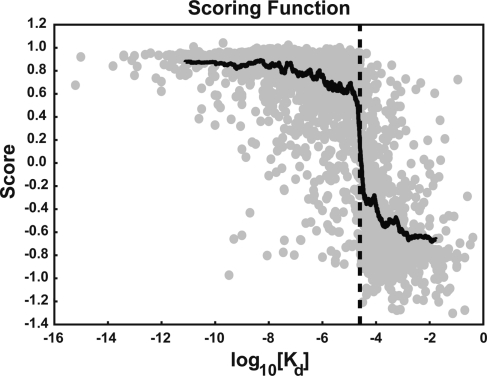
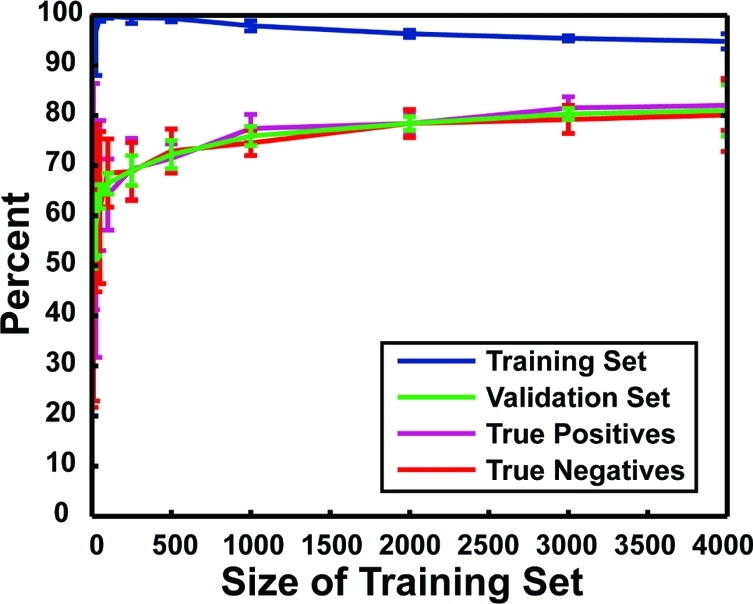
As high-throughput biochemical screens are both expensive and labor intensive, researchers in academia and industry are turning increasingly to virtual-screening methodologies. Virtual screening relies on scoring functions to quickly assess ligand potency. Although useful for in silico ligand identification, these scoring functions generally give many false positives and negatives; indeed, a properly trained human being can often assess ligand potency by visual inspection with greater accuracy. Given the success of the human mind at protein-ligand complex characterization, we present here a scoring function based on a neural network, a computational model that attempts to simulate, albeit inadequately, the microscopic organization of the brain. Computer-aided drug design depends on fast and accurate scoring functions to aid in the identification of small-molecule ligands. The scoring function presented here, used either on its own or in conjunction with other more traditional functions, could prove useful in future drug-discovery efforts.
由于高通量生化筛选既昂贵又耗费大量人力,学术界和工业界的研究人员越来越多地转向虚拟筛选方法。虚拟筛选依赖于评分函数来快速评估配体的效力。虽然这些评分函数对于计算机识别配体很有用,但它们通常会产生许多错误的阳性和阴性结果;事实上,经过适当训练的人通常可以通过目视检查更准确地评估配体的效力。鉴于人类在蛋白质-配体复合物特征描述方面的成功,我们在这里提出了一种基于神经网络的评分函数,这是一种试图模拟大脑微观结构的计算模型,尽管不充分。计算机辅助药物设计依赖于快速准确的评分函数来帮助识别小分子配体。这里提出的评分函数,无论是单独使用还是与其他更传统的函数结合使用,都可能对未来的药物发现工作有用。