Department of Chemistry and Biochemistry and §Department of Pharmacology, University of California San Diego, La Jolla, California 92093, USA.
J Chem Inf Model. 2011 Nov 28;51(11):2897-903. doi: 10.1021/ci2003889. Epub 2011 Nov 3.
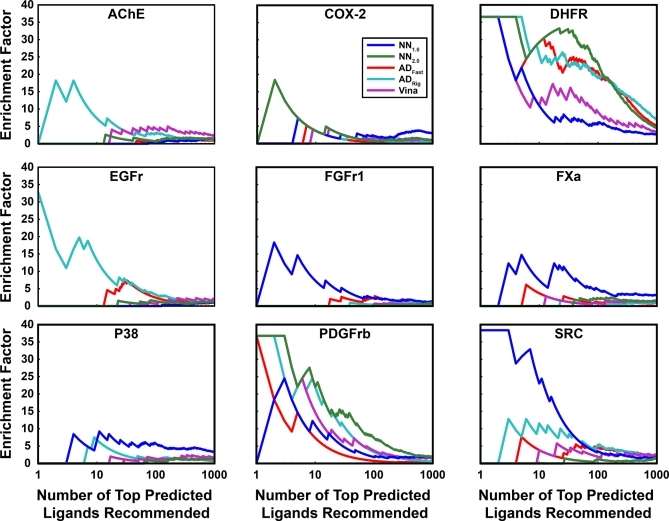
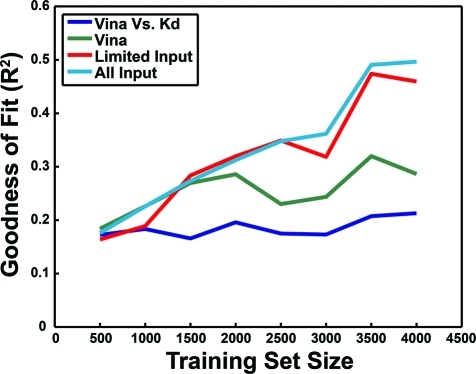
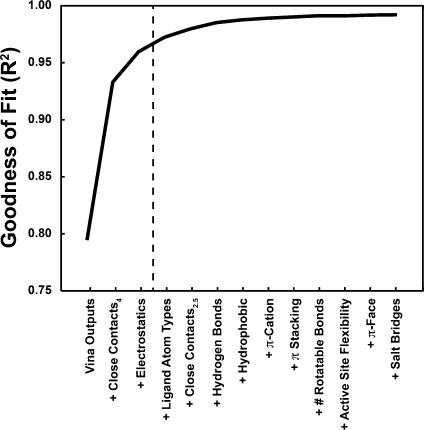
NNScore is a neural-network-based scoring function designed to aid the computational identification of small-molecule ligands. While the test cases included in the original NNScore article demonstrated the utility of the program, the application examples were limited. The purpose of the current work is to further confirm that neural-network scoring functions are effective, even when compared to the scoring functions of state-of-the-art docking programs, such as AutoDock, the most commonly cited program, and AutoDock Vina, thought to be two orders of magnitude faster. Aside from providing additional validation of the original NNScore function, we here present a second neural-network scoring function, NNScore 2.0. NNScore 2.0 considers many more binding characteristics when predicting affinity than does the original NNScore. The network output of NNScore 2.0 also differs from that of NNScore 1.0; rather than a binary classification of ligand potency, NNScore 2.0 provides a single estimate of the pK(d). To facilitate use, NNScore 2.0 has been implemented as an open-source python script. A copy can be obtained from http://www.nbcr.net/software/nnscore/ .
NNScore 是一种基于神经网络的评分函数,旨在帮助计算识别小分子配体。虽然原始 NNScore 文章中包含的测试案例证明了该程序的实用性,但应用示例有限。目前这项工作的目的是进一步证实神经网络评分函数是有效的,即使与最先进的对接程序(如 AutoDock,这是引用最多的程序,以及被认为快两个数量级的 AutoDock Vina)的评分函数相比也是如此。除了为原始 NNScore 功能提供额外的验证外,我们在此还提出了第二个神经网络评分函数,即 NNScore 2.0。NNScore 2.0 在预测亲和力时考虑了更多的结合特征,而不仅仅是原始 NNScore 中的配体效力的二进制分类。NNScore 2.0 的网络输出也与 NNScore 1.0 不同;NNScore 2.0 提供了一个 pK(d)的单一估计值,而不是配体效力的二进制分类。为了方便使用,NNScore 2.0 已作为开源 Python 脚本实现。可以从 http://www.nbcr.net/software/nnscore/ 获得副本。