Department of Nutrition and Exercise Physiology, The University of Missouri, Columbia, Missouri, USA.
Obesity (Silver Spring). 2011 Apr;19(4):818-24. doi: 10.1038/oby.2010.203. Epub 2010 Sep 16.
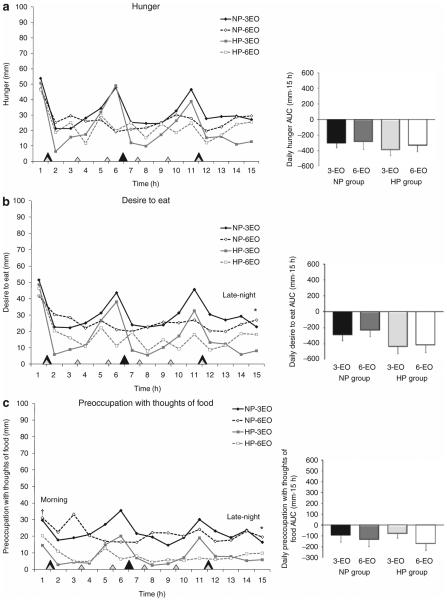
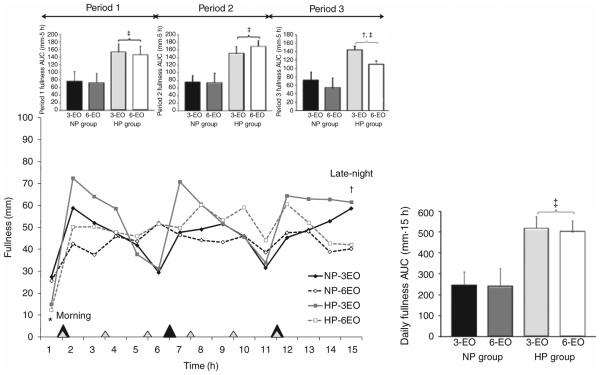
The purpose of this study was to determine the effects of dietary protein and eating frequency on perceived appetite and satiety during weight loss. A total of 27 overweight/obese men (age 47 ± 3 years; BMI 31.5 ± 0.7 kg/m(2)) were randomized to groups that consumed an energy-restriction diet (i.e., 750 kcal/day below daily energy need) as either higher protein (HP, 25% of energy as protein, n = 14) or normal protein (NP, 14% of energy as protein, n = 13) for 12 weeks. Beginning on week 7, the participants consumed their respective diets as either 3 eating occasions/day (3-EO; every 5 h) or 6 eating occasions/day (6-EO; every 2 h), in randomized order, for 3 consecutive days. Indexes of appetite and satiety were assessed every waking hour on the third day of each pattern. Daily hunger, desire to eat, and preoccupation with thoughts of food were not different between groups. The HP group experienced greater fullness throughout the day vs. NP (511 ± 56 vs. 243 ± 54 mm · 15 h; P < 0.005). When compared to NP, the HP group experienced lower late-night desire to eat (13 ± 4 vs. 27 ± 4 mm, P < 0.01) and preoccupation with thoughts of food (8 ± 4 vs. 21 ± 4 mm; P < 0.01). Within groups, the 3 vs. 6-EO patterns did not influence daily hunger, fullness, desire to eat, or preoccupation with thoughts of food. The 3-EO pattern led to greater evening and late-night fullness vs. 6-EO but only within the HP group (P < 0.005). Collectively, these data support the consumption of HP intake, but not greater eating frequency, for improved appetite control and satiety in overweight/obese men during energy restriction-induced weight loss.
这项研究的目的是确定饮食蛋白质和进食频率对减肥过程中感知食欲和饱腹感的影响。共有 27 名超重/肥胖男性(年龄 47 ± 3 岁;BMI 31.5 ± 0.7 kg/m²)被随机分为两组,分别摄入能量限制饮食(即每天比日常能量需求低 750 卡路里),其中高蛋白组(HP,能量的 25%来自蛋白质,n = 14)或正常蛋白组(NP,能量的 14%来自蛋白质,n = 13),持续 12 周。从第 7 周开始,参与者以随机顺序连续 3 天,每天分别进食 3 次(3-EO,每 5 小时一次)或 6 次(6-EO,每 2 小时一次),进食各自的饮食。在每种模式的第三天,每小时评估一次食欲和饱腹感指数。在两组之间,每日饥饿感、进食欲望和对食物的关注程度没有差异。与 NP 相比,HP 组全天饱腹感更强(511 ± 56 与 243 ± 54mm·15h;P < 0.005)。与 NP 相比,HP 组夜间食欲较低(13 ± 4 与 27 ± 4mm,P < 0.01)和对食物的关注程度较低(8 ± 4 与 21 ± 4mm;P < 0.01)。在组内,3 次与 6 次进食频率对每日饥饿感、饱腹感、进食欲望或对食物的关注程度没有影响。与 6 次进食相比,3 次进食频率导致晚上和深夜饱腹感更强,但仅在 HP 组中(P < 0.005)。总的来说,这些数据支持在超重/肥胖男性进行能量限制减肥时,摄入高蛋白,而不是增加进食频率,可更好地控制食欲和饱腹感。