Department of Immunology, St Jude Children's Research Hospital, Memphis, Tennessee 38105, USA.
Nat Rev Immunol. 2010 Oct;10(10):688-98. doi: 10.1038/nri2851. Epub 2010 Sep 17.
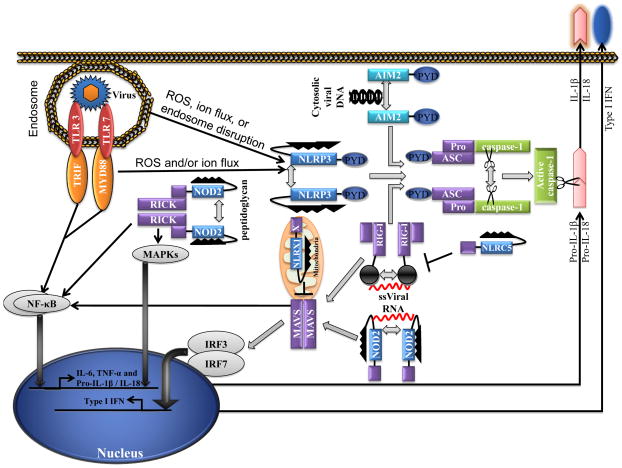
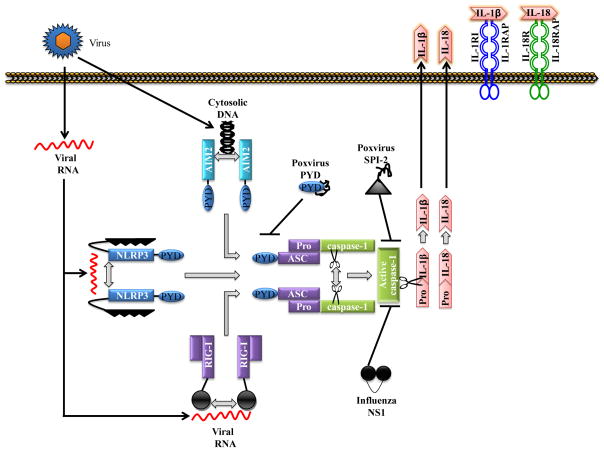
The immune response to viral infections is determined by a complex interplay between the pathogen and the host. Innate immune cells express a set of cytosolic sensors to detect viral infection. Recognition by these sensors induces the production of type I interferons and the assembly of inflammasome complexes that activate caspase-1, leading to production of interleukin-1β (IL-1β) and IL-18. Here, I discuss recent progress in our understanding of the central roles of NOD-like receptors (NLRs) and inflammasomes in the immune response during viral infections. This information will improve our understanding of host defence mechanisms against viruses and provide new avenues for interfering in the pathogenesis of infectious diseases.
病毒感染的免疫反应是由病原体和宿主之间的复杂相互作用决定的。先天免疫细胞表达一组胞质传感器来检测病毒感染。这些传感器的识别诱导 I 型干扰素的产生和炎性小体复合物的组装,激活半胱天冬酶-1,导致白细胞介素-1β(IL-1β)和 IL-18 的产生。在这里,我讨论了我们对 NOD 样受体(NLRs)和炎性小体在病毒感染期间免疫反应中的核心作用的理解的最新进展。这些信息将提高我们对宿主防御病毒的机制的理解,并为干预传染病的发病机制提供新的途径。