Department of Viticulture and Enology, University of California, Robert Mondavi Institute North, 595 Hilgard Lane, Davis, CA 95616-8749, USA.
J Exp Bot. 2011 Jan;62(1):99-109. doi: 10.1093/jxb/erq247. Epub 2010 Sep 17.
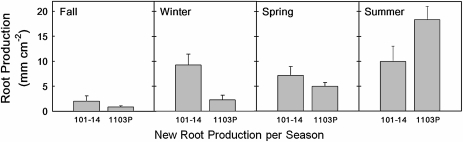
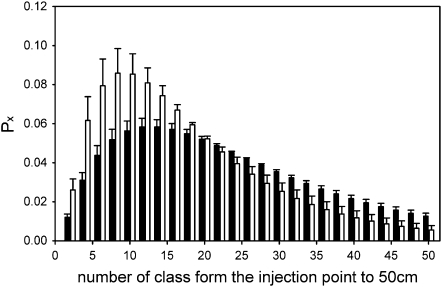
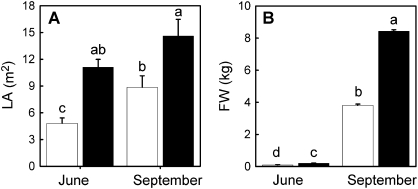
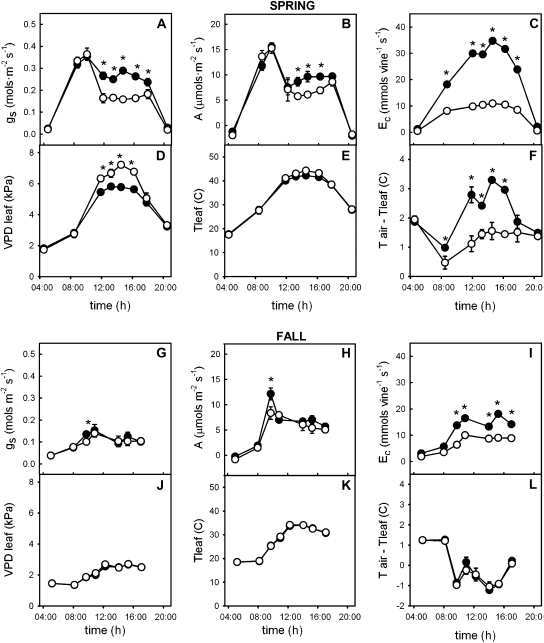
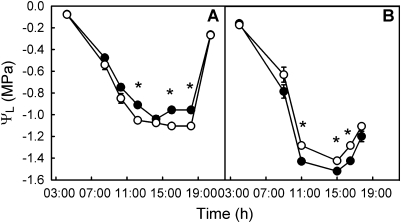
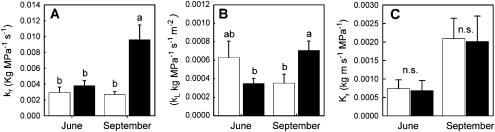
The role of root systems in drought tolerance is a subject of very limited information compared with above-ground responses. Adjustments to the ability of roots to supply water relative to shoot transpiration demand is proposed as a major means for woody perennial plants to tolerate drought, and is often expressed as changes in the ratios of leaf to root area (A(L):A(R)). Seasonal root proliferation in a directed manner could increase the water supply function of roots independent of total root area (A(R)) and represents a mechanism whereby water supply to demand could be increased. To address this issue, seasonal root proliferation, stomatal conductance (g(s)) and whole root system hydraulic conductance (k(r)) were investigated for a drought-tolerant grape root system (Vitis berlandieri×V. rupestris cv. 1103P) and a non-drought-tolerant root system (Vitis riparia×V. rupestris cv. 101-14Mgt), upon which had been grafted the same drought-sensitive clone of Vitis vinifera cv. Merlot. Leaf water potentials (ψ(L)) for Merlot grafted onto the 1103P root system (-0.91±0.02 MPa) were +0.15 MPa higher than Merlot on 101-14Mgt (-1.06±0.03 MPa) during spring, but dropped by approximately -0.4 MPa from spring to autumn, and were significantly lower by -0.15 MPa (-1.43±0.02 MPa) than for Merlot on 101-14Mgt (at -1.28±0.02 MPa). Surprisingly, g(s) of Merlot on the drought-tolerant root system (1103P) was less down-regulated and canopies maintained evaporative fluxes ranging from 35-20 mmol vine(-1) s(-1) during the diurnal peak from spring to autumn, respectively, three times greater than those measured for Merlot on the drought-sensitive rootstock 101-14Mgt. The drought-tolerant root system grew more roots at depth during the warm summer dry period, and the whole root system conductance (k(r)) increased from 0.004 to 0.009 kg MPa(-1) s(-1) during that same time period. The changes in k(r) could not be explained by xylem anatomy or conductivity changes of individual root segments. Thus, the manner in which drought tolerance was conveyed to the drought-sensitive clone appeared to arise from deep root proliferation during the hottest and driest part of the season, rather than through changes in xylem structure, xylem density or stomatal regulation. This information can be useful to growers on a site-specific basis in selecting rootstocks for grape clonal material (scions) grafted to them.
与地上部分的响应相比,根系在耐旱性中的作用是一个信息非常有限的课题。有人提出,相对于地上部分的蒸腾需求,根系供应水分的能力的调整是木本多年生植物耐受干旱的主要手段,通常表现为叶面积与根面积(A(L):A(R))的比值的变化。在定向季节根系增殖可以增加根系的供水功能,而不依赖于总根面积(A(R)),代表了一种可以增加供水与需水之间的匹配的机制。为了解决这个问题,研究了耐旱葡萄根系(Vitis berlandieri×V. rupestris cv. 1103P)和非耐旱根系(Vitis riparia×V. rupestris cv. 101-14Mgt)的季节性根系增殖、气孔导度(g(s))和整个根系系统水力导度(k(r)),这些根系上嫁接了相同的耐旱葡萄品种 Vitis vinifera cv. Merlot 的敏感克隆。嫁接在 1103P 根系上的梅洛(Merlot)的叶片水势(ψ(L))(-0.91±0.02 MPa)比嫁接在 101-14Mgt 上的梅洛(-1.06±0.03 MPa)高出 0.15 MPa,而在春季到秋季期间,叶片水势下降了约 0.4 MPa,与嫁接在 101-14Mgt 上的梅洛相比,叶片水势显著降低了 0.15 MPa(-1.43±0.02 MPa)(-1.28±0.02 MPa)。令人惊讶的是,耐旱根系(1103P)上的梅洛的气孔导度(g(s))的下调程度较小,树冠在春季到秋季的白天高峰期维持的蒸发通量分别为 35-20 mmol 叶-1 s-1,是嫁接在耐旱砧木 101-14Mgt 上的梅洛的三倍。耐旱根系在温暖的夏季干旱期在更深的地方生长出更多的根,整个根系导度(k(r))在同一时期从 0.004 增加到 0.009 kg MPa-1 s-1。k(r)的变化不能用木质部解剖结构或个别根段的导度变化来解释。因此,耐旱性传递给耐旱克隆的方式似乎是由于在季节最热和最干旱的部分进行深层根系增殖,而不是通过木质部结构、木质部密度或气孔调节的变化。这些信息可以根据具体情况为种植者提供有用的信息,以便为嫁接在他们身上的葡萄无性系材料(接穗)选择砧木。